• Find My Drone

Can Drones See Inside Your House? What Cameras Actually Capture

Updated

By Paul Posea

Can Drones See Inside Your House? What Cameras Actually Capture - drone reviews and comparison

What Drone Cameras Can and Cannot See

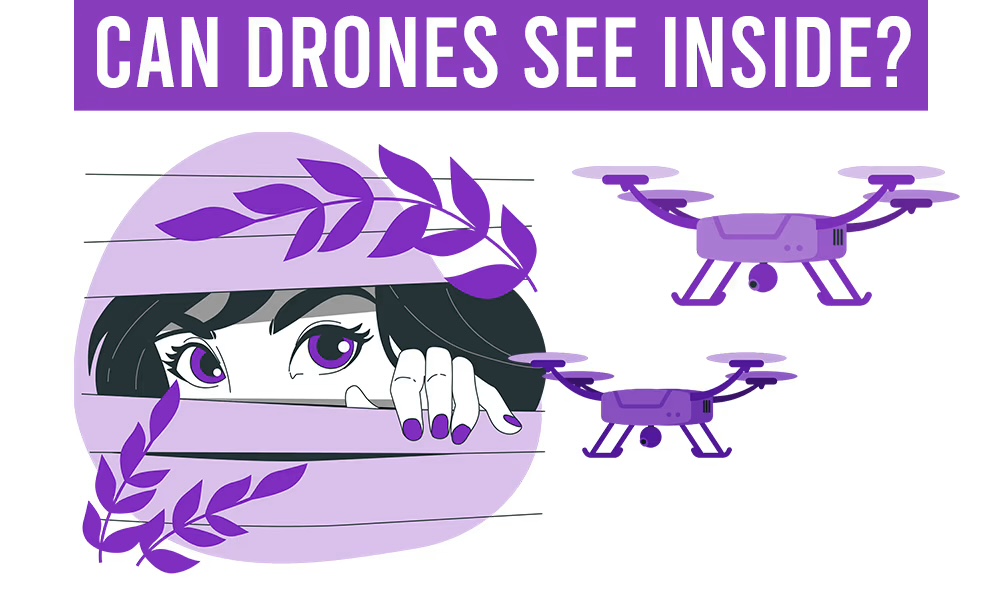
Illustration of what a drone camera can and cannot capture from outside a house
Consumer drone cameras work on visible light. Walls, roofs, and solid blinds block their view entirely. Only open windows or uncovered skylights create a potential line of sight.

Understanding what a consumer drone camera actually sees requires understanding the sensor technology used.

What standard cameras can see

Consumer drone cameras capture visible light reflected from surfaces. They can photograph and video anything exposed to open air with a clear line of sight from the camera. From drone altitude, this includes:

  • Open outdoor areas: yards, pools, decks, driveways
  • Rooftops and anything visible from above
  • Through open, uncovered windows at close range and the right angle
  • Activity in unenclosed outdoor spaces

What standard cameras cannot see

  • Through walls, floors, ceilings, or roofs
  • Through closed blinds, shutters, or solid window coverings
  • Through frosted or textured glass
  • In the dark without supplemental lighting
  • Anything below the surface level of the ground

Zoom cameras and close-up capture

Some drones like the DJI Air 3S include a 3x optical zoom. With zoom, a drone further away can capture detail that would require closer range on a wide-angle camera. A drone hovering 100 meters away with a 3x telephoto can capture roughly the same framing as a drone at 33 meters with a standard lens. This extends practical surveillance range but does not change what surfaces can or cannot be seen through.

Note: No consumer drone sold today includes thermal imaging as standard. Thermal cameras, which can detect heat signatures through some materials, are sold as aftermarket payloads for professional platforms like the DJI Mavic 3 Thermal. They are not part of any consumer drone under $2,000.

Can a Drone See Through Your Windows?

Window blinds and their effect on what a drone camera can see inside a house
Closed blinds, curtains, or shutters block drone cameras completely. An open window with interior lighting creates a potential line of sight, but angle and distance limit what is visible.

Windows are the realistic privacy concern for drone cameras, not walls or roofs. Whether a drone can see through a window depends on several factors.

The angle problem

A drone flying at 30-60 meters altitude above your property is looking mostly downward. To see through a vertical window on the side of your house, the drone would need to position itself at roughly the same height as the window and at an angle that provides a line of sight into the interior. Most drone altitude and position combinations don't achieve this naturally.

The lighting problem

Interior rooms visible through windows are often darker than the outdoor scene the drone camera is exposed for. A camera correctly exposed for bright sky and outdoor areas will render the window interior as dark and difficult to see. At night with interior lights on, this reverses: the interior becomes brighter than the exterior and a camera can capture more detail through a window.

The glass and distance problem

Glass reduces image clarity even when a window is closed. Dual-pane insulated windows cause visible distortion. Screens add further degradation. At normal consumer drone flying altitudes of 30+ meters, the resolution needed to capture meaningful detail through a window is at the edge of what consumer cameras provide. Very close range (under 10 meters) changes this equation significantly.

The short answer: a drone hovering 5-10 meters outside an open, illuminated window can see inside it. A drone at legal flying altitude conducting normal operations is unlikely to capture meaningful indoor detail through a window.

Drone Privacy Laws

Privacy protections for drone surveillance over private property come from both federal law and a growing body of state law. The legal landscape is still developing, but several clear rules apply.

FAA airspace jurisdiction

The FAA regulates airspace, not privacy. Flying a drone legally (at proper altitude, with registration, following Part 107 or recreational rules) is permissible under FAA rules regardless of what is below. The FAA does not evaluate privacy implications of individual flights.

State drone privacy laws

More than 30 states have enacted drone-specific privacy laws. Common provisions include:

  • Prohibiting drone surveillance of private property without consent
  • Creating civil liability for capturing images of people in areas where they have a reasonable expectation of privacy
  • Prohibiting persistent hovering over private property with intent to surveil
  • Restrictions on law enforcement drone use without warrants in some states

State laws vary significantly. Some states have strong protections; others have minimal drone-specific legislation. The National Conference of State Legislatures maintains a current summary of state drone laws at ncsl.org.

Voyeurism and peeping tom laws

In all 50 states, using any device (including a drone) to capture images of people in places where they have a reasonable expectation of privacy without consent is a criminal offense under voyeurism or peeping tom statutes. A person in their bedroom or bathroom has a clear expectation of privacy regardless of whether a window is technically visible from outside. These laws apply to drone operators.

Fourth Amendment and law enforcement

The Supreme Court's 2018 Carpenter decision raised questions about warrantless aerial surveillance. Law enforcement drone use is regulated differently than civilian use, and several states have enacted specific warrant requirements for police drone surveillance. For civilian drones, the relevant laws are voyeurism, trespassing (for landing on private property), and applicable state privacy statutes.

Warning: Using a drone to intentionally observe or photograph people in their homes, yards, or other private areas without consent can result in criminal charges under voyeurism or harassment statutes, civil lawsuits for privacy violations, and FAA enforcement if the flight itself violated regulations. The fact that you can see something from a drone does not make capturing or sharing it legal.

What Legitimate Drone Operators Are Actually Doing

The vast majority of consumer drone flights are photography, videography, inspection work, and recreational flying. Very few drone flights involve intentional surveillance of private individuals.

Real estate photography

The most common professional drone use over residential neighborhoods is real estate photography. Operators photograph the property for sale: exterior, yard, roof, and surrounding area. They are not filming neighbors or interior spaces. Part 107 commercial pilots working in real estate have professional reputations and liability exposure that make intentional privacy violations both illegal and commercially destructive.

Inspection work

Roof inspections, insurance claims, and utility surveys are common commercial uses. These drones fly directly over a specific property for a defined purpose and typically capture roof and exterior conditions only.

Hobbyists and recreational pilots

Most recreational drone flights are about getting aerial perspectives of landscapes, events, or property for personal photography. A neighborhood drone flying over a park or along a river is almost certainly not focused on private yards or windows.

Tip: If you see a drone hovering persistently near your property at low altitude, note the time, location, and any identifying details about the operator or vehicle. A single pass overhead at altitude is almost certainly a real estate or recreational flight. Repeated, close-range hovering near windows is unusual and may be worth reporting to local law enforcement.

How to Protect Your Privacy from Drones

If you are concerned about drone surveillance, practical measures exist that are effective at blocking what any camera can see.

Effective privacy measures

  • Window coverings: Closed blinds, shutters, or curtains block drone cameras completely. No consumer camera technology can see through solid window coverings.
  • Privacy screens and landscaping: Dense hedges, privacy fencing, or pergola structures limit aerial views of outdoor areas like pools and patios.
  • Smart glass: Electrochromic glass that switches from transparent to opaque is an option for new construction or significant renovation, though it is expensive ($50-$150 per square foot).

Anti-drone technology

Products marketed as drone jammers or anti-drone devices that interfere with RF signals are illegal for civilian use in the US under FCC regulations. The FCC prohibits jamming devices regardless of the purpose. Using one is a federal offense. These products should not be purchased or used.

Reporting concerns

If a drone is being flown in a way that appears to violate privacy laws in your state, contact local law enforcement rather than attempting to interfere with the aircraft. Shooting down or physically disabling a drone is a federal crime under aircraft destruction statutes, regardless of where the drone is flying. Several people have faced federal charges for shooting down drones they believed were over their property.

Note: The FAA considers all navigable airspace to be under federal jurisdiction. Courts have generally upheld that airspace above private property is not the exclusive domain of the property owner, though lower courts have disagreed on exactly where property rights end and public airspace begins. This area of law is actively developing.

FAQ

No. Consumer drone cameras capture visible light and cannot see through solid surfaces like walls, roofs, or floors. No consumer drone sold today includes technology that can see through solid materials. Thermal cameras, which detect heat signatures, exist as professional aftermarket payloads but are not part of any consumer drone package.

No. Closed blinds, curtains, or shutters block a drone camera completely. The camera captures only visible light with a direct line of sight. Solid window coverings eliminate that line of sight. Open windows with interior lighting are the only realistic scenario where a drone camera might capture interior views.

Flying over a house at proper altitude is generally not illegal under FAA rules, but intentionally surveilling private individuals may violate state drone privacy laws, voyeurism statutes, or harassment laws. More than 30 states have drone-specific privacy legislation. Check your state's laws and the NCSL's state drone law summary for specifics.

Document the incident: time, location, operator details if visible, and footage if possible. Report to local law enforcement. Do not attempt to interfere with or shoot down the drone. Shooting down a drone is a federal crime under aircraft destruction statutes regardless of what the drone was doing. Civil remedies under state privacy laws may also be available.

No. Shooting down any aircraft, including a drone, is a federal crime under 18 U.S.C. § 32 regardless of where the drone is flying. Multiple people have faced federal charges for shooting down drones. If a drone is violating your privacy, contact law enforcement rather than attempting to physically disable it.

Standard consumer drones do not have true night vision. Their cameras perform poorly in low light because they use the same sensor technology as phone cameras, which require adequate light to produce a clear image. Some drones have enhanced low-light modes that improve performance in dim conditions, but these are not night vision. True night vision or thermal imaging requires separate hardware not found in consumer camera drones.

A zoom lens extends the range at which a camera can capture detail, but it does not change what surfaces the camera can see through. If an open window provides a line of sight into your home, a zoom lens lets a drone capture that view from further away. Closed blinds or curtains still block the camera regardless of focal length.

Thermal cameras detect heat signatures and can reveal heat patterns through some materials, but they do not produce the kind of clear interior images that standard cameras do. Professional thermal drone payloads are used for building inspections, solar panel surveys, and search and rescue. They are not standard equipment in any consumer drone and cost thousands of dollars as aftermarket additions.

Paul Posea

Paul Posea

Author · Dronesgator

Paul Posea is the founder of Dronesgator and has been reviewing and comparing drones since 2015. With a Part 107 certification, 195 YouTube drone reviews, and published work on Digital Photography School, he combines hands-on flight testing with data-driven analysis to help pilots find the right drone.