Flying a drone for money in the United States requires an FAA Part 107 Remote Pilot Certificate. That covers more ground than most people expect: real estate photography, paid video work, insurance inspections, construction monitoring, social media content tied to sponsorships, and footage sold to news outlets all count as commercial. If any payment is connected to a flight, recreational rules no longer apply.
Getting certified is a four-step process: create an IACRA account, study for and pass the 60-question knowledge test at a testing center ($175), apply through IACRA, and wait for the FAA background check to clear. Most people receive their certificate number within a week. The knowledge test is the only real obstacle. The rest is paperwork.
If you haven't registered your drone yet, start with our FAA drone registration guide (registration is a separate requirement that applies regardless of which license path you're on).
Do You Need a Part 107 License to Fly Your Drone?
The FAA draws one line: recreational or commercial. If you fly purely for personal enjoyment with no money attached to the flight in any form, you fall under the recreational exception and don't need Part 107. If compensation enters the picture (directly or indirectly) you need the certificate before you fly.
Flights that require Part 107
Photography or video for a paying client
Real estate listing photos and walkthroughs
Construction site progress documentation
Infrastructure or property inspections
News, journalism, and media work
Content for a monetized YouTube channel or paid brand deal
Academic or corporate research tied to a grant or salary
Any flight where the pilot is compensated in any way
Flights that don't require Part 107
Personal hobby flying with no income involved
Filming for your own non-monetized accounts
Flying at an AMA club field under community-based safety guidelines
Warning: The FAA's definition of commercial is stricter than most people assume. Flying footage to a monetized YouTube channel has resulted in enforcement actions against pilots who claimed recreational status. If there's any possible connection to income, treat the flight as commercial and fly under Part 107.
One common misconception: flying a drone under 250 grams does not exempt you from Part 107. Weight limits only matter for registration requirements. Once you're flying commercially, Part 107 applies regardless of how light the drone is.
Part 107 Eligibility Requirements
The FAA sets four baseline requirements to apply for a Remote Pilot Certificate. All four must be met before you can hold a certificate.
Age: You must be at least 16 years old.
English proficiency: You must be able to read, speak, write, and understand English. No exceptions. English is the standard language of aviation communication in the US.
Physical and mental condition: You must be in a physical and mental condition that doesn't interfere with safe drone operation. The FAA does not require a medical exam, but you are responsible for self-certifying that you're fit to fly.
Background check: The TSA runs a security threat assessment on all Part 107 applicants. Certain criminal convictions are disqualifying. The check happens automatically after you submit your IACRA application and typically clears within a few business days.
Note: Non-US citizens can hold a Part 107 certificate. The process is the same (no citizenship requirement), though the TSA background check may take longer for applicants without a US Social Security Number.
What the Part 107 Knowledge Test Covers
The test has 60 multiple-choice questions and a 2-hour time limit. You need to answer at least 42 correctly to pass. That's 70%.. Most test-takers finish in 60 to 90 minutes. You can skip questions and return to them, which helps when you hit airspace chart questions that take more time to work through.
Topic areas on the test
Topic
What to expect
Airspace classification
Class A through G airspace rules, controlled vs. uncontrolled, special use airspace (MOAs, TFRs, prohibited areas)
VFR sectional charts
Reading aeronautical charts, airport symbols, airspace boundaries, latitude/longitude. This is where most people lose points.
Weather and meteorology
Wind, turbulence, fog, how weather affects drone performance, reading METARs and TAFs
Part 107 regulations
Operating rules, waiver requirements, Remote ID, registration, what you can and can't do
Radio communications
Basic phraseology, when to contact ATC, how to request airspace authorization
Runway markings, taxiway signs, right-of-way rules near airports
The hardest part: VFR sectional charts
Most people who fail do so because of sectional chart questions. These ask you to read an aeronautical map and determine what airspace a location falls in, what altitude limits apply, and whether you need authorization. Spending 3 to 4 hours specifically on sectional chart reading (more than on any other topic) pays off. The FAA's interactive sectional chart tool is free and lets you practice on actual charts used in the test.
Free study resources from the FAA
The FAA publishes official study materials at no cost. These are the source documents the test questions come from, so studying them directly is more reliable than third-party summaries:
FAA sample questions, official practice questions in the same format as the real test
Tip: Most people need 15 to 20 hours of study to pass comfortably. If sectional charts are new to you, budget the higher end of that range. If you've studied aviation before, 10 hours may be enough.
How to Get Your Part 107 Certificate: Step by Step
The process runs in a specific order. You need your IACRA account and FTN number before you schedule the test. The testing center requires it at check-in..
Step 1: Create your IACRA account and get your FTN
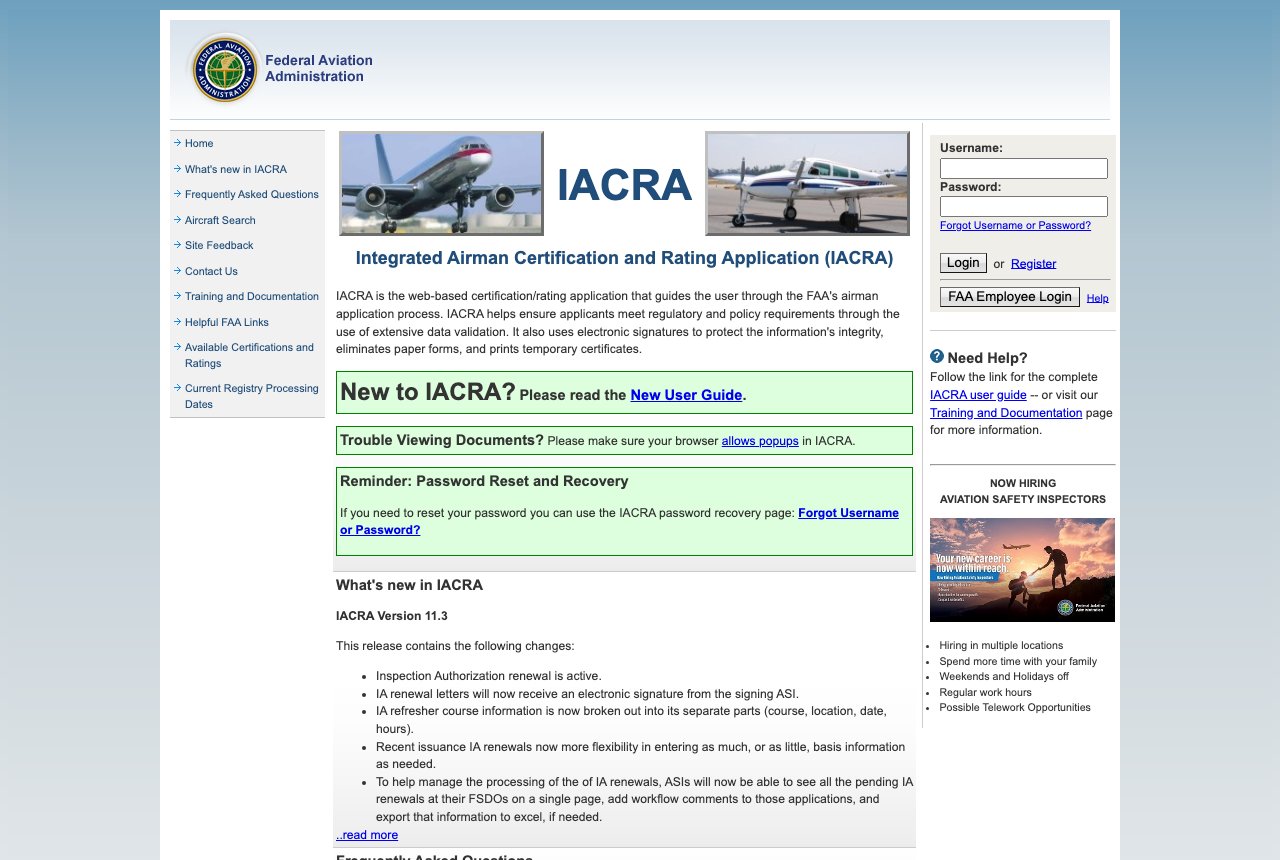
Go to iacra.faa.gov and register as an applicant. After completing registration, the system displays your FAA Tracking Number (FTN). Write this down. You need it to register for the knowledge test. Without it, you cannot check in at the testing center.
The IACRA portal at iacra.faa.gov. Create an account here first to get your FTN before scheduling the test.
Step 2: Study for the knowledge test
Use the FAA's official study materials (listed in the previous section) or a paid prep course. Give yourself at least two weeks if you're starting from scratch. Sectional chart reading takes the most practice time. Don't leave it until the day before.
Step 3: Schedule and take the knowledge test
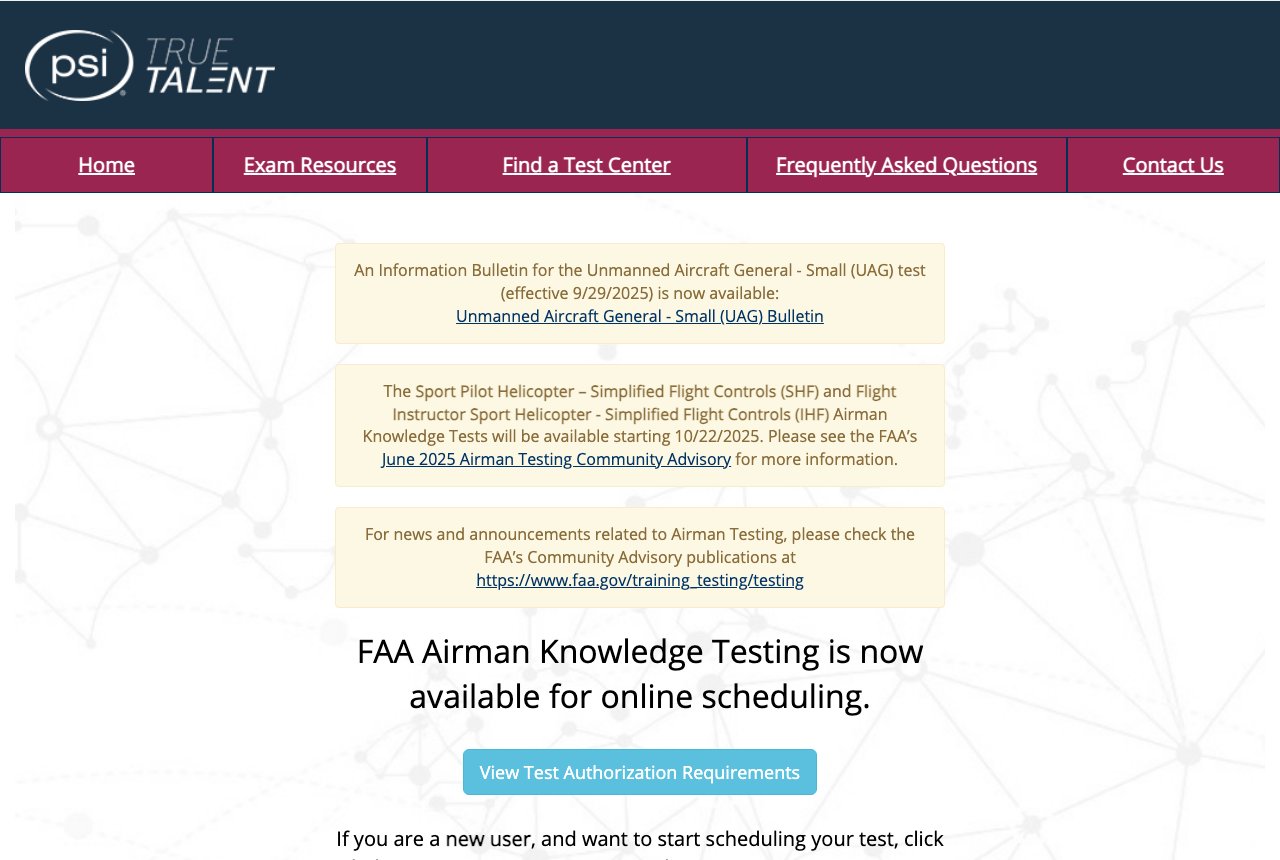
The Part 107 knowledge test is administered in person at PSI testing centers nationwide. The fee is $175, paid when you schedule.
The PSI portal at faa.psiexams.com. Search for a testing center near you and schedule your exam here.
Bring a valid government-issued photo ID and your FTN number. The test is 60 questions with a 2-hour limit. You need 70% (42/60) to pass. Results are shown immediately. If you pass, you receive a test result sheet. Keep it for the IACRA application.
Note: If you don't pass on the first attempt, you can retake the test after 14 days. There's no limit on how many times you can take it, but each attempt costs $175. Most first-time test-takers pass when they've put in 15 to 20 hours of focused study.
Step 4: Apply for your certificate in IACRA
Log back into IACRA with your test result sheet in hand. Start a new application for a Remote Pilot Certificate (sUAS rating). Enter your test confirmation number when prompted. The application takes about 10 minutes and triggers the TSA background check automatically.
Step 5: Wait for the background check and certificate
The TSA security review typically clears within a few business days. Once it does, you'll receive a Temporary Remote Pilot Certificate by email. It's a valid, printable certificate that lets you fly commercially right away. Your official plastic certificate arrives by mail within 60 to 90 days. You can fly under the temporary certificate until it arrives.
Tip: After passing the test, check your IACRA account daily. Some applicants see approval within 24 hours. Once the temporary certificate is available in IACRA, download it immediately and save a copy to your phone.
What Part 107 Lets You Do (and the Rules You Must Follow)
The certificate opens up commercial drone work, but it comes with a set of operating rules that apply to every flight. Knowing what's standard versus what requires extra steps saves you from violations.
Standard Part 107 operating rules
Fly within visual line of sight (VLOS): you or a visual observer must be able to see the drone at all times without binoculars
Stay at or below 400 feet AGL (or within 400 feet of a structure you're inspecting)
Don't fly over moving vehicles or people who aren't part of your crew unless your drone qualifies under the Category rules
Don't fly near airports without LAANC authorization (request through FAA LAANC or the B4UFLY app)
Yield right-of-way to all manned aircraft
Don't fly under the influence of drugs or alcohol
Register each drone you fly commercially for $5 per aircraft (one FA number covers all recreational drones; Part 107 requires individual N-numbers)
Operations now permitted without a waiver
FAA rules updated in 2021 removed the waiver requirement for two previously restricted operation types:
Night flying: Permitted if you've completed the updated Part 107 knowledge test (or FAA online recurrent training) and your drone carries anti-collision lighting visible from at least 3 statute miles.
Over people and moving vehicles: Permitted depending on your drone's risk category. Category 1 drones weigh under 0.55 lbs with no exposed rotating parts that could cause lacerations. Most consumer DJI drones fall into Category 1 or Category 3. Check your specific model on the FAA's drone categories page.
Operations that still require a waiver
Beyond Visual Line of Sight (BVLOS): flying beyond what you can see unaided
Operations in Class B, C, or D airspace without LAANC authorization
Flying from a moving vehicle (unless in a rural area with no non-participating people below)
Warning: Remote ID is mandatory under Part 107 regardless of drone weight. Recreational pilots flying drones under 250g are exempt from Remote ID; Part 107 pilots are not. Your drone must either have built-in Remote ID (standard on DJI drones made after 2023) or broadcast through an add-on module.
Renewing Your Part 107 Certificate
Part 107 certificates expire every 24 months. The renewal process is simpler than the initial certification. You don't have to visit a testing center unless you want to.
Two renewal options
Option 1: Free online recurrent training (recommended): The FAA offers free online recurrent training at FAASafety.gov. Complete the course, download your completion certificate, and update your IACRA record. No test center visit required. This takes 1 to 2 hours and covers regulatory updates since your last certification).
Option 2: Retake the knowledge test: You can renew by passing the full initial knowledge test again at a PSI testing center. This costs $175 and takes the same preparation effort as the original certification. There's no advantage to this path for most pilots. The online training covers the same regulatory updates at no cost.
Tip: Set a calendar reminder 60 days before your certificate expires. The FAA does not send reminders. Your certificate expiration date is printed on your physical card and visible in IACRA. Flying commercially with an expired certificate carries the same penalties as flying without one.
One more thing to track separately: drone registrations expire on their own 3-year cycle, independent of your certificate renewal schedule. A pilot with a valid certificate and an expired aircraft registration is still in violation. Check both dates in IACRA and mark them in the same calendar.
FAQ
The knowledge test fee is $175, paid when you schedule at a PSI testing center. The IACRA application and TSA background check are free. If you use a paid study course, prices range from free (FAA official materials) to $299 for structured courses like Drone Pilot Ground School. There are no annual fees once you hold the certificate. Renewal is free through the FAA's online recurrent training.
Most people spend 2 to 4 weeks from start to certificate in hand. Study time runs 15 to 20 hours for someone new to aviation concepts. After passing the test, the IACRA application takes about 10 minutes. The TSA background check typically clears within a few business days, at which point you can download a Temporary Remote Pilot Certificate that's valid for commercial flight immediately.
You need 70% to pass: 42 correct answers out of 60 questions. The test has a 2-hour time limit, though most test-takers finish in under 90 minutes. Results are shown immediately when you complete the exam. If you don't pass, you must wait 14 days before retaking it.
Yes. Part 107 pilots can fly recreationally. When doing so, recreational rules apply to that specific flight: the TRUST requirement, community-based organization safety guidelines, and the recreational registration number (not your commercial N-numbers). The purpose of each individual flight determines which rule set applies, not your certificate type.
For commercial flights, yes. The 250-gram threshold only affects registration requirements for recreational pilots. It doesn't create any exemption from Part 107. If you're flying commercially with any drone, including a DJI Mini 4 Pro or similar sub-250g aircraft, you need the certificate and must follow all Part 107 operating rules including Remote ID.
The easiest way is the free online recurrent training at FAASafety.gov. Complete the course, download your completion certificate, and update your IACRA record. No test center visit required. Alternatively, you can retake the full 60-question knowledge test at a PSI center for $175. Certificates expire every 24 months. The FAA does not send reminders, so track the date yourself.
Yes, without a waiver, as long as you've completed the updated FAA knowledge test or online recurrent training, and your drone is equipped with anti-collision lighting visible from at least 3 statute miles. The waiver requirement for night operations was removed in 2021 when the FAA updated Part 107 rules. The anti-collision light requirement is the main practical consideration for most night flights.
At PSI testing centers, which are located throughout the United States. You schedule and pay online at faa.psiexams.com. You'll need your FAA Tracking Number (FTN) from your IACRA account at check-in, plus a valid government-issued photo ID. Testing is in person only. There is no remote or at-home option for the initial certification.
Paul Posea founded Dronesgator in 2015 and has been reviewing consumer drones for over a decade. With 195 YouTube drone reviews drawing 3.55 million views and published work on Digital Photography School, he combines hands-on flight testing with data-driven analysis to help pilots find the right drone.
Marcus Taylor is a UK CAA certified drone pilot and owner of Deployed Consultancy Ltd. With 6 years of commercial experience spanning UN site surveys in West Africa, aerial photography across Europe, Africa, and Japan, and defence consulting, he verifies the technical accuracy of Dronesgator's drone reviews and guides.