Yes, drone flight at night is legal in the United States. For years it required a waiver. That changed on April 21, 2021, when the FAA updated 14 CFR Part 107 to allow night operations without a waiver, provided two conditions are met: the pilot completed (or updated) their knowledge test or training after April 6, 2021, and the drone carries anti-collision lighting visible for at least 3 statute miles.
Recreational pilots follow a parallel rule: night flight is allowed with the same anti-collision light requirement. No separate authorization needed for either type of pilot, as long as the lighting requirement is met.
That is the legal answer. The practical picture is more complicated. Night removes most of the safety systems that make modern consumer drones so forgiving to fly. Obstacle avoidance stops working in darkness. Visual positioning shuts down. You lose depth perception and orientation cues. Night flight is legal, but it demands more skill and preparation than flying in daylight.
FAA Night Flying Rules (What Actually Changed in 2021)
Before April 21, 2021, commercial drone pilots who wanted to fly at night had to apply for a Part 107 waiver, submit operational documentation, and wait for FAA approval. Most waivers took weeks. The 2021 rule change under the FAA's Remote ID and Operations Over People Final Rule eliminated the waiver requirement entirely for standard night operations.
Part 107 pilots: what's required
Under the updated 14 CFR 107.29, commercial drone pilots can operate at night without a waiver if:
The pilot completed an initial Part 107 knowledge test after April 6, 2021. Pilots who passed the test before that date must complete a free online night operations training course at the FAA Safety website (FAASTeam) to satisfy the updated requirement.
The drone is equipped with anti-collision lighting visible for at least 3 statute miles, with a flash rate sufficient to avoid a collision.
All other Part 107 rules remain in effect at night: 400ft altitude ceiling, VLOS requirement (you must be able to see your drone), airspace restrictions, and operating in Class G uncontrolled airspace or with LAANC authorization in controlled airspace.
Recreational pilots: same light requirement
Recreational pilots flying under the community-based safety guidelines (TRUST framework) can also fly at night. The anti-collision light requirement is the same: visible for at least 3 statute miles. There is no knowledge test requirement for recreational night flight beyond what the TRUST framework already requires.
The VLOS rule still applies at night
This is the most commonly misunderstood aspect of night flight. Both rules require visual line of sight at all times. At night, this means you must be able to see the drone with your unaided eyes throughout the flight. Anti-collision lights serve two purposes: keeping the drone legally identifiable and maintaining your visual contact with it. If conditions make VLOS impossible even with the lights, the flight is not legal.
Note: The FAA's remote pilot in command may reduce the intensity of the anti-collision light if doing so is in the interest of safety (for example, in military coordination situations). The pilot may not extinguish it entirely.
How Night Affects Your Drone's Safety Systems
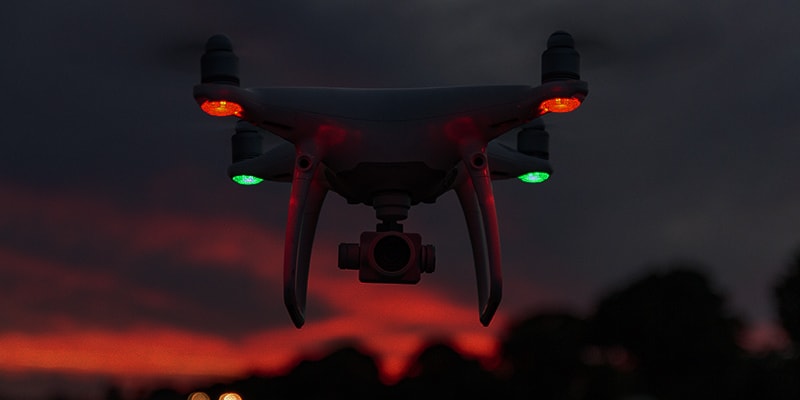
Consumer drone navigation lights are not bright enough for the FAA's 3-mile anti-collision requirement.
Modern consumer drones are engineered around daytime operation. Light is the input that powers most of the safety systems pilots take for granted. Remove the light, and the safety net shrinks considerably.
Obstacle avoidance: mostly offline
Consumer drone obstacle avoidance cameras use visible light spectrum imaging to detect and classify objects. In darkness, these cameras see little to nothing. Most DJI, Autel, and similar consumer drones will display a warning in the app when lighting is insufficient for obstacle detection. Some drones will disable obstacle avoidance automatically. Others continue displaying the feature as active while providing degraded or no protection.
The practical result: night flying with obstacle avoidance turned on gives pilots a false sense of security. Assume obstacle avoidance is not working and fly accordingly. Give more lateral clearance to structures, trees, and power lines than you would during the day.
Visual positioning: offline
The downward-facing VPS cameras that help the drone hold position near the ground also require visible light to see the surface below. At night, VPS is effectively disabled. The drone switches to GPS-only positioning for altitude and position hold. This normally works well at altitude, but near the ground (under approximately 3 to 5 meters), position hold becomes less precise without VPS contribution.
What does still work
GPS positioning, barometric altitude hold, compass heading, and Return to Home all function normally in darkness. The drone's flight controller is not impaired by the absence of light. The losses are specific to the camera-based safety systems, not the flight fundamentals. A properly configured, GPS-locked drone in calm air is perfectly stable at night. The risk comes from the pilot's reduced ability to assess the environment, not from the drone's ability to fly.
Warning: Some consumer drones enter a reduced-performance mode when obstacle avoidance is unavailable. Check your specific drone's behavior by testing in a safe, open environment before attempting a technical night flight over obstacles.
Anti-Collision Lights: What You Need and What Works
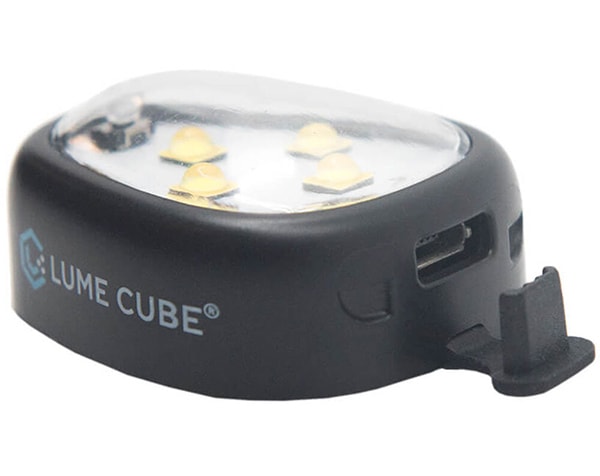
Aftermarket strobes like the Lume Cube are designed to meet the FAA's 3-statute-mile visibility requirement.
The FAA requirement is specific but leaves room for different solutions: the light must be visible for at least 3 statute miles (4.8 km) and must have a flash rate sufficient to avoid a collision. No specific lux, lumens, or color is mandated in the regulation.
Built-in vs. aftermarket lights
Many modern drones include built-in navigation and status lights, but these are typically not strong enough to meet the 3-mile visibility standard. DJI's Mini 4 Pro, Air 3S, and Mavic 4 Pro all have built-in LEDs, but DJI explicitly states these are not designed to meet the anti-collision lighting requirement for night operations. An aftermarket strobe is required for legal night flights.
The most commonly used compliant options in the drone community are the Lume Cube Strobe (visible to 3+ miles, FAA-compliant marketing), the Firehouse Technology ARC series, and the Ulanzi DR-02. All three attach to the accessory mounting points on most consumer drones and draw power from the drone's USB port or separately from an internal battery.
What 3 statute miles actually means
Three statute miles is 4.8 kilometers or approximately 15,840 feet. To put that in perspective: if you're flying at the standard 400ft ceiling and something goes wrong, a manned aircraft pilot 3 miles away can see your drone's anti-collision light in time to take evasive action. That is the safety purpose of the requirement. The light isn't for you to see your drone. It's for manned aircraft to see your drone.
Tip: Mount the strobe on top of the drone (the highest point) rather than below the camera gimbal. From a manned aircraft approaching from above, a bottom-mounted light may be blocked by the drone body itself. Top mounting maximizes visibility from all approach angles.
How to Prepare for a Night Flight
Night flight preparation starts during daylight. The scout you skip during the day becomes the obstacle you hit at night.
Scout the location in daylight. Walk the area, identify every obstacle (trees, power lines, poles, fences), note where streetlights and other ambient light sources are, and plan your flight path around what you know. Aerial scouting in daylight works better: fly a preview route at slow speed and note anything you'll need to clear at night.
Set your RTH altitude high. Return to Home runs on GPS navigation, not camera systems, so it functions normally at night. But it can only clear obstacles it knows about (the home point altitude + your set RTH height). Set RTH altitude high enough to clear the tallest obstacle between you and the home point. 50 meters is a reasonable minimum in areas with trees or structures.
Pre-program a simple flight path. If your drone supports waypoints or flight plan features, pre-program a simple path in daylight, then execute it at night. Reduces the risk of misjudging distances in the dark.
Bring a spotter. FAA rules allow and recommend visual observers for night operations. A spotter with a headlamp can watch the drone while you focus on the controller. Two sets of eyes mean one can track the drone while the other scans for approaching aircraft.
Tell someone your location and expected return. Night flying in remote areas creates a safety scenario if something goes wrong. Send your GPS pin to a friend before launch.
Charge everything fully. Batteries, controller, phone, remote. Night operations typically run shorter than planned because the pilot loses confidence faster without daylight reference points. A full charge means more margin.
Test the strobe before the flight. Confirm the anti-collision light is powered on and flashing before takeoff. It is a required piece of equipment, and forgetting to activate it makes the entire flight non-compliant.
Tip: Fly slower at night than you would during the day. Speed amplifies the consequences of any misjudgment. Night flights are better suited to slow orbits, steady tracking shots, and careful position adjustments rather than fast cinematic moves.
Night Photography and Video Settings
Night flying opens up genuinely spectacular footage opportunities: city lights from above, star fields, light trails, illuminated landmarks. Getting usable footage requires different camera settings than daytime work.
Exposure settings for night stills
Night photography from a drone works on the same principles as ground-based night photography, with one complication: the drone is moving slightly at all times, even in a hover, which limits how long a shutter you can use before motion blur degrades sharpness.
ISO: Start at 800 and adjust up as needed. Most modern drone cameras handle ISO 1600 reasonably well. ISO 3200 and above introduces visible noise, but for artistic shots can work. The DJI Mavic 4 Pro and Air 3S have larger sensors that handle high ISO better than the Mini series.
Shutter speed: In a stable hover, 1/30s to 1/8s can work for static scenes. For any movement (orbiting a subject), keep shutter at 1/60s or faster to avoid motion blur. Slower shutter speeds create light trail effects on moving vehicles below, which can be intentional and striking.
Aperture: For drones with a fixed aperture (most consumer drones), this isn't adjustable. The Mavic 4 Pro and Mavic 3 Pro have variable aperture, where opening to f/2.8 significantly improves low-light performance.
White balance: Avoid auto white balance in mixed artificial lighting. Set manually to 3200K for warm tungsten/sodium street lighting, or 4500K for LED-heavy urban environments. Auto WB shifts between shots and makes sequences look inconsistent.
EV compensation for video
In video mode, set EV (exposure value) compensation to +1 to +2 in dark environments to expose brighter. Night city footage at 0 EV often looks underexposed compared to what your eyes see. Apply ND filters only if you need to control shutter speed for a cinematic 180-degree rule effect. In most low-light conditions, you want to let in as much light as possible.
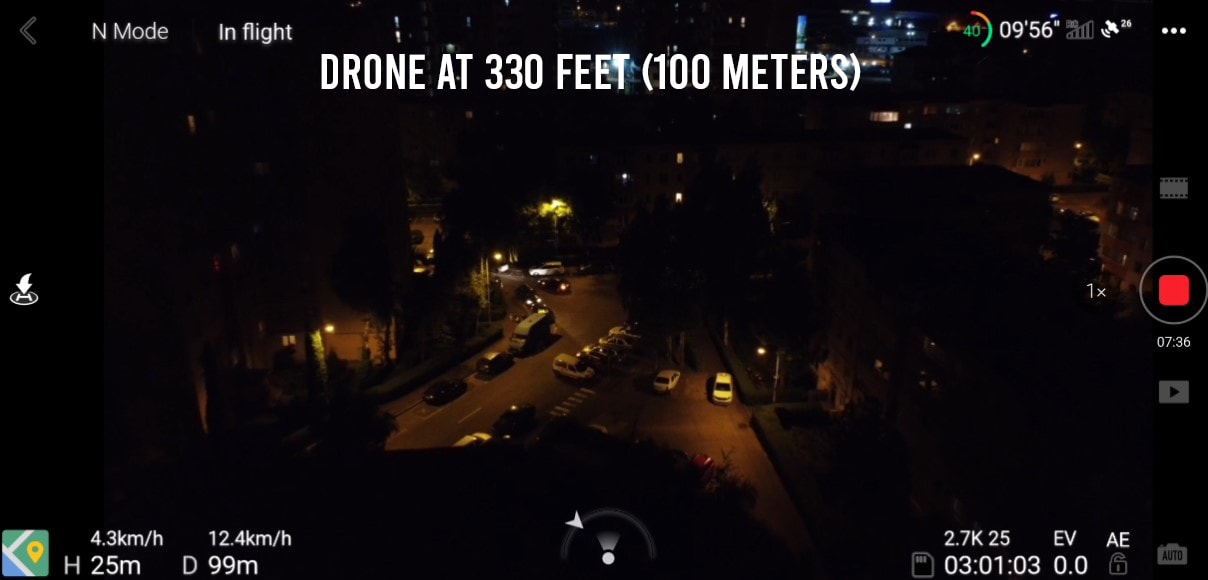
Night drone photography captures city lights and light trails that are impossible to shoot in daylight.
FAQ
Yes. Since April 21, 2021, the FAA allows both Part 107 commercial pilots and recreational pilots to fly at night without a waiver. The requirements are: anti-collision lighting visible for at least 3 statute miles with a sufficient flash rate, and for Part 107 pilots, completion of a knowledge test or training after April 6, 2021 (or completion of the free FAA Safety Team night operations course if your test was before that date).
The FAA requires anti-collision lighting visible for at least 3 statute miles (4.8 km) with a flash rate sufficient to avoid a collision. No specific lumen or color standard is mandated. Common compliant options include the Lume Cube Strobe, Firehouse Technology ARC series, and Ulanzi DR-02. Most built-in drone navigation lights do not meet the 3-mile visibility standard and are not sufficient on their own.
No, not reliably. Consumer drone obstacle avoidance cameras use visible light spectrum imaging. In darkness, these cameras cannot detect obstacles effectively. Most drones will display a warning or disable obstacle avoidance automatically in low light. Treat obstacle avoidance as non-functional during night flights and maintain wider clearance from all structures than you would during the day.
Yes. Recreational pilots flying under the TRUST framework can fly at night with the same anti-collision light requirement as Part 107 pilots: visible for at least 3 statute miles with a sufficient flash rate. All other recreational rules apply at night: fly below 400ft AGL, maintain visual line of sight, check airspace authorization, and follow local ordinances.
Yes. Airspace authorization requirements don't change at night. If you're flying in Class B, C, or D controlled airspace (near airports), you still need LAANC authorization or a Part 107 airspace waiver. The 2021 rule change only removed the waiver requirement for night operations specifically, not for controlled airspace. Check the Aloft or Airspace Link apps before any night flight.
Yes, legally, with an aftermarket anti-collision strobe. The Mini 4 Pro's built-in lights are not sufficient to meet the 3-mile visibility FAA requirement on their own. Attach a compliant strobe (Lume Cube, Firehouse ARC, or similar), confirm your knowledge test or TRUST completion, and fly in appropriate airspace. Note that the Mini 4 Pro's obstacle avoidance will be degraded or disabled in low light.
Start with ISO 800-1600, shutter speed 1/30s to 1/60s (faster if moving), and manual white balance around 3200-4500K depending on lighting. Set EV compensation to +1 or +2 in video mode for brighter exposure. Avoid auto white balance, which shifts between shots and creates inconsistency. Drones with larger sensors and variable apertures (Mavic 4 Pro, Air 3S) perform significantly better in low light than the Mini series.
Yes. The visual line of sight requirement applies equally at night. You must maintain unaided visual contact with your drone throughout the flight. Anti-collision lights serve this dual purpose: making the drone visible to manned aircraft and allowing you to track it yourself. First-person view screens and FPV goggles do not satisfy the VLOS requirement, even at night.
Paul Posea founded Dronesgator in 2015 and has been reviewing consumer drones for over a decade. With 195 YouTube drone reviews drawing 3.55 million views and published work on Digital Photography School, he combines hands-on flight testing with data-driven analysis to help pilots find the right drone.
Marcus Taylor is a UK CAA certified drone pilot and owner of Deployed Consultancy Ltd. With 6 years of commercial experience spanning UN site surveys in West Africa, aerial photography across Europe, Africa, and Japan, and defence consulting, he verifies the technical accuracy of Dronesgator's drone reviews and guides.