• Find My Drone

Can You Fly Drones Over Private Property? What the Law Actually Says

Updated

By Paul Posea

Can You Fly Drones Over Private Property? What the Law Actually Says - drone reviews and comparison

Federal Law: What the FAA Says About Flying Drones Over Private Property

Drone flying low over a residential neighborhood, illustrating the legal gray zone of private property overflights
FAA rules govern navigable airspace but do not explicitly address low-altitude residential overflights. The legal gray zone sits roughly between 50 and 200 feet above ground level.

Under 49 U.S.C. § 40103, the FAA has exclusive sovereignty over navigable airspace. This authority preempts most local and state attempts to ban drones outright. No federal statute, however, specifically prohibits a drone from flying over private property. The FAA's UAS regulations focus on registration, airspace authorization, and operational rules (below 400 feet AGL, visual line of sight, no flying over people without a waiver), not on property rights.

What FAA rules actually require

FAA regulations require drones over 250g to be registered (recreational fliers pay $5 for a 3-year registration covering all their drones; Part 107 commercial operators register each aircraft separately). Recreational fliers must pass the TRUST knowledge test and fly under community-based safety guidelines. Commercial operators need a Part 107 remote pilot certificate. None of these rules restrict flying over specific types of property.

The altitude gray zone

Manned aircraft must maintain at least 500 feet AGL over suburban areas and 1,000 feet over congested areas under 14 CFR § 91.119. Drones have no analogous minimum altitude rule. A drone hovering at 50 feet over someone's backyard is technically legal under FAA rules (assuming registration and VLOS compliance), but courts and state laws are increasingly treating very low-altitude residential overflights as potential trespass or invasion of privacy.

The Causby doctrine: where your airspace rights end

U.S. v. Causby (1946) established that landowners have property rights extending above their surface, not just to it. The Supreme Court said rights extend to the "immediate reaches" above the land. What constitutes "immediate reaches" for a drone at 100 feet has not been definitively ruled on by any federal court as of 2026. State courts are filling this gap unevenly, which is why the rules differ so dramatically by state.

State Laws on Drones Over Private Property

At least 13 states have enacted drone-specific privacy statutes that add restrictions on top of FAA rules. These laws generally target the camera, not the flight path: flying over someone's property is often tolerated, but capturing images of people in private settings without consent is not.

States with significant drone privacy laws

StateKey Restriction
California (AB 856)Prohibits using drones to capture images that invade someone's reasonable expectation of privacy
Florida (SB 766)Bans recording people with a reasonable expectation of privacy without consent
Indiana (HB 1009)Drone surveillance without permission of owner is a criminal offense
North CarolinaLimits drone overflights and prohibits unauthorized surveillance
Texas (HB 912)Bans capturing or sharing drone images of private property or people without permission
VirginiaFlying within 50 feet of a private residence without permission is a misdemeanor
Tennessee (SB 1892)Prohibits intentional surveillance without warrant or consent
WisconsinIllegal surveillance in locations where people have reasonable privacy expectations

What "reasonable expectation of privacy" means in practice

Courts apply this standard contextually. A backyard with a fence and high hedges carries a high expectation of privacy. A front driveway visible from the street does not. Flying at 300 feet and briefly overflying a property is treated differently than hovering at 50 feet and pointing a camera through a bedroom window. The legal distinction is not altitude alone but intent and context together.

HOA rules and local ordinances

Homeowners associations can restrict drone use within their jurisdiction independently of state law or FAA rules. Some HOAs ban drone launches from community property, ban flights below specific altitudes, or require member approval before any filming. Local ordinances at the city or county level can add further restrictions, particularly in dense residential areas. Check your local municipality's drone ordinance before flying in residential neighborhoods.

Note: The FAA's federal preemption doctrine prevents states from banning drone flight outright, but does not prevent states from regulating drone-enabled activities like surveillance or photography. State privacy laws that target the camera, not the aircraft, survive federal preemption challenges.

What to Do If a Drone Is Flying Over Your Property

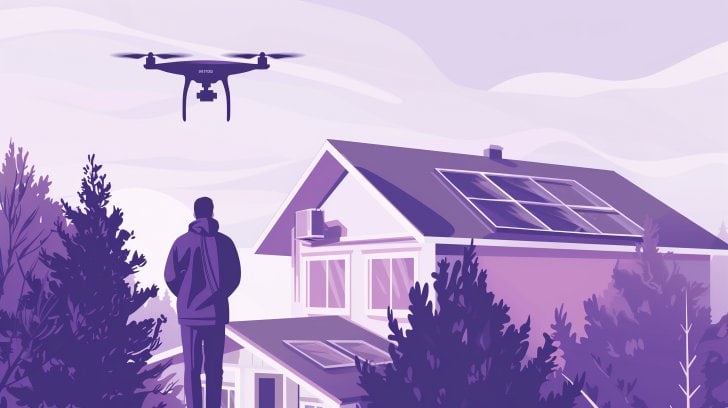
Property owner looking up at drone hovering above residential property
Shooting down a drone is a federal crime. Property owners have legal recourse through local authorities, the FAA, and civil courts, but destroying a drone is never a legal option.

If a drone appears over your property, the first question is whether the operator is flying legally. Most drone pilots who fly over residential areas are not surveilling you specifically. They may be testing a new drone, photographing their own house, or simply transiting to another location. Most situations resolve with a conversation.

Steps for property owners

Start by documenting the incident. Note the date, time, drone description, flight path, and any details about the operator if visible. Photograph or video the drone if possible. This documentation matters if you proceed with a complaint or legal action.

If the operator is nearby, a direct conversation is usually the fastest resolution. Most pilots will move on when politely asked. If the operator is unresponsive or the overflights are repeated, escalate to local law enforcement. Law enforcement can cite the operator under applicable state privacy laws or local ordinances, even if FAA rules don't cover the situation.

Filing a complaint with the FAA

You can file a UAS safety report through the FAA's UAS sightings portal. This is most useful when you have reason to believe the drone is operating illegally (flying over people, near an airport, or outside registration requirements). The FAA investigates persistent reports and can fine or revoke the licenses of Part 107 operators. For recreational fliers, enforcement is less direct but still possible.

Civil recourse: nuisance, trespass, and privacy claims

Property owners can pursue civil claims on three theories: airspace trespass (low-altitude overflights that invade the "immediate reaches" of your property), nuisance (repeated interference with the use and enjoyment of property), and invasion of privacy (capturing images in locations where you have a reasonable expectation of privacy). Consulting an attorney before filing is worthwhile, as local court precedents vary significantly. Some states' drone privacy statutes include private rights of action with statutory damages.

Can You Shoot Down a Drone Over Your Property?

No. Shooting down a drone is a federal crime under 18 U.S.C. § 32, which makes it illegal to destroy aircraft. The FAA has classified all drones as aircraft. This applies regardless of where the drone is flying or what it is filming. Shooting a drone with a firearm, disabling it with a signal jammer, or using any other method to intentionally bring it down exposes you to federal charges, regardless of the state's drone privacy laws.

Why the law is this way

The federal aircraft destruction statute was written for planes, not drones, but courts and the FAA have consistently applied it to UAS. The FAA's position, formalized in several advisory circulars, is that all UAS are aircraft, and all aircraft are protected from intentional destruction. Even where a drone is clearly violating your privacy rights or your state's drone laws, the remedy is legal action, not physical destruction.

What you can legally do

You can photograph and document the drone. You can call law enforcement. You can file an FAA complaint. You can record the drone's flight path as evidence for a civil claim. You can physically block the drone's view by moving indoors or drawing curtains. You can hire an attorney to send a cease-and-desist letter to the operator if you can identify them. Signal jammers are also federally illegal (FCC jurisdiction), so that is not a legal option either.

Law enforcement and government drones

Law enforcement drones present a different legal question. Courts have generally required warrants for surveillance that intrudes on a reasonable expectation of privacy near homes, though this area of law is still developing. The Alaska Supreme Court ruled in 2024 (State v. McKelvey) that photographing a private backyard from an aircraft without a warrant violated the state constitution. State rules on government drone use vary and are being actively litigated in multiple jurisdictions.

Best Practices for Drone Pilots Flying Near Private Property

The legal answer to "can you fly over private property" is yes, with significant caveats depending on your state and what you do with the camera. The practical answer is that respectful, minimal-impact flying is both the ethical standard and the safest way to avoid legal exposure.

Altitude and camera discipline

Fly high enough to eliminate any reasonable claim of surveillance. At 200 feet over a neighborhood, you are clearly transiting, not surveilling. At 50 feet hovering over a backyard, the situation is inverted regardless of whether you are actually recording. Keep the camera pointed away from residential windows and yards unless you have explicit permission or a clear editorial purpose.

Notifying neighbors

For planned shoots near residential areas, a brief conversation with neighbors before you fly eliminates most conflicts before they start. Explain what you're filming and roughly how long the flight will take. Most people are fine with a quick flight once they know there's a real person and a real purpose behind it, not a surveillance operation.

How long is too long to hover

Duration matters legally. A single transit pass over a property at 200 feet raises little concern. Hovering over the same backyard for 5-10 minutes is a different situation: courts and law enforcement treat sustained low-altitude hovering as evidence of surveillance intent, even if no footage was captured. Keep flights purposeful and move on once you have what you need.

Flying your own neighborhood

Flying over your own house or neighborhood is not automatically legal, even if you own the property directly below. If you take off and land from your own property, you still fly through airspace above other properties during the flight. HOA rules may prohibit launches from shared community land. Local ordinances may restrict residential flights. Check local rules before assuming that owning a house gives you the right to fly commercially over your neighbor's property.

Tip: Commercial operators using drone footage of private property for real estate, construction, or marketing should obtain written permission from the property owner before the flight. Even if the flight is technically legal, the footage may not be usable commercially without consent, particularly in states with drone privacy statutes.

FAQ

Federally, yes. No FAA rule explicitly prohibits flying over private property. However, at least 13 states have drone-specific privacy laws that restrict certain overflights, particularly those involving cameras near homes or backyards. HOA rules and local ordinances can add further restrictions. The legal answer varies by state.

No. Shooting down a drone is a federal crime under 18 U.S.C. § 32, which makes it illegal to destroy aircraft. The FAA classifies all drones as aircraft. This applies regardless of whether the drone is violating your privacy. Legal remedies include contacting law enforcement, filing an FAA complaint, and pursuing civil action.

Document the incident with photos or video of the drone and operator if visible. Note the date, time, and flight path. Contact local law enforcement, who can cite the operator under applicable state privacy laws. File a complaint through the FAA's UAS sightings portal. If overflights are repeated, consult an attorney about civil remedies including nuisance or invasion of privacy claims.

There is no federal minimum altitude for drones over private property. FAA rules require staying below 400 feet AGL and maintaining visual line of sight. State courts and privacy laws increasingly treat very low-altitude overflights (under 50-100 feet) near homes as potential trespass or invasion of privacy, particularly when cameras are involved. Virginia specifically prohibits flying within 50 feet of a home without permission.

HOAs can restrict drone use within their jurisdiction, including banning launches from community property, setting altitude limits, or requiring member approval before filming. These restrictions apply independently of FAA rules and state law. Violating HOA rules is not a federal crime but can result in fines or other enforcement actions under your HOA agreement.

Courts are increasingly requiring warrants for law enforcement drone surveillance near homes. The Alaska Supreme Court ruled in 2024 that photographing a private backyard from aircraft without a warrant violated the state constitution. Federal courts have not uniformly settled this question. State rules on government drone use vary and are actively being litigated in multiple jurisdictions.

At least 13 states have enacted drone-specific privacy laws, including California, Florida, Indiana, North Carolina, Texas, Virginia, Tennessee, Wisconsin, Michigan, Oklahoma, Pennsylvania, South Carolina, and Washington. These laws generally target camera use near homes rather than flight paths. Virginia also has a specific distance restriction: flying within 50 feet of a residential structure without permission is a misdemeanor.

Federally, yes, as long as they follow FAA rules (registration, below 400 feet, visual line of sight). But if they hover at low altitude and use the camera in a way that invades your privacy, state privacy laws may apply. The distinction courts use is "reasonable expectation of privacy" in context. A fenced backyard where people are present carries more legal weight than an open driveway visible from the street.

Paul Posea

Paul Posea

Author · Dronesgator

Paul Posea is the founder of Dronesgator and has been reviewing and comparing drones since 2015. With a Part 107 certification, 195 YouTube drone reviews, and published work on Digital Photography School, he combines hands-on flight testing with data-driven analysis to help pilots find the right drone.