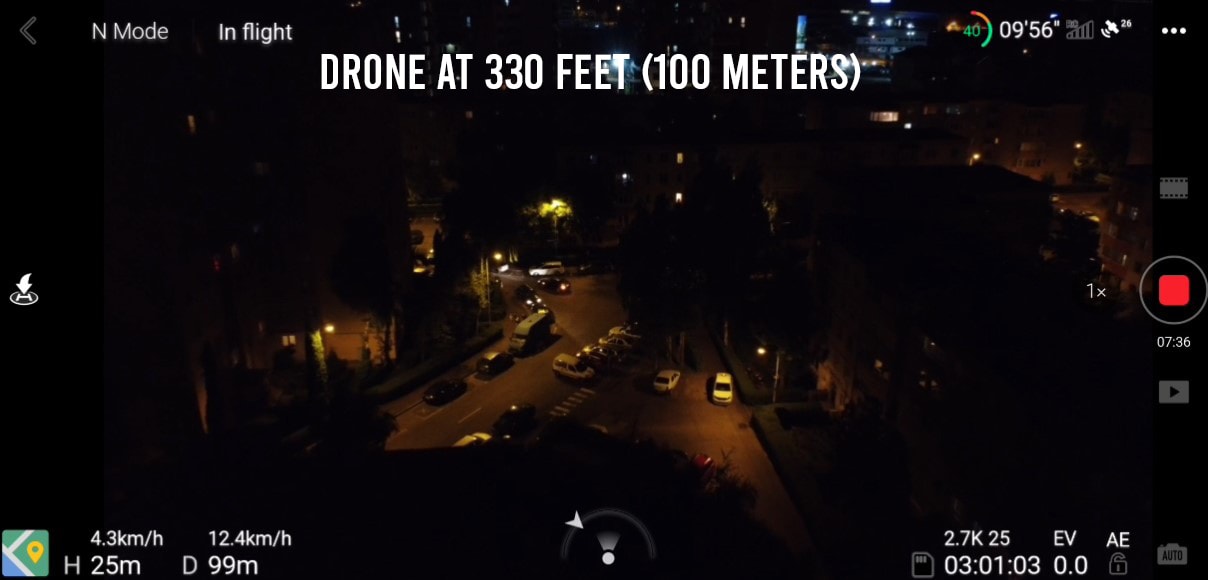
No consumer drone sold at retail has true night vision. The DJI Mini 4 Pro, Air 3S, and Mavic 4 Pro all use low-light optical cameras that amplify available light. That is not the same thing as night vision, which relies on image intensification tubes or thermal sensors that work in complete darkness. At 100 meters altitude on a moonless night, a consumer drone can capture a usable image of a lit street. A field with no ambient light will look black.
The confusion comes partly from DJI's marketing language. Terms like "night shooting mode" and "low-light performance" sound like night vision capability, but they describe the camera's ability to gather more photons in a short exposure, not to see without light. The distinction matters if you are trying to figure out what someone else's drone can see, or planning a night flight yourself.
This guide covers how consumer drone cameras handle low light, what they can realistically capture at various altitudes and lighting conditions, when thermal cameras enter the picture, and what the FAA requires for night operations.
What 'Night Vision' Actually Means and What Consumer Drones Use Instead
f/1.7DJI Mavic 4 Pro aperture
f/1.8DJI Air 3S aperture
$4,799Autel EVO II 640T (entry thermal)
The Three Types of Night Vision Technology
Night vision is a generic term covering three distinct technologies:
Image intensification (I2): Amplifies existing light (including near-infrared not visible to humans) using a vacuum tube. Produces the green-tinted monochrome image from military equipment. Works in very low light but needs some ambient photons. Used in military goggles and law enforcement monoculars, not drone cameras.
Thermal infrared (FLIR): Detects heat emitted by objects rather than reflected light. Works in complete darkness. Shows heat signatures as color gradients. Requires specialized sensors that cost thousands of dollars. Used in search-and-rescue, public safety, and precision agriculture drones.
Low-light optical: A standard camera sensor with a large aperture, large pixel size, and software processing. Captures more photons in a given exposure time. Requires ambient light (city glow, moonlight, streetlights). This is what consumer drones use.
Why Consumer Drones Cannot See in True Darkness
A DJI Mini 4 Pro or Air 3S camera is a visible-light sensor. It captures the same spectrum of light the human eye does. In a dark environment with no ambient light, it captures essentially nothing. The sensor amplifies signal, but amplifying noise and darkness produces a dark, grainy image, not a useful one.
Consumer drone cameras require ambient light to produce a usable image. No amount of software processing, "night mode," or sensor size change allows an optical camera to see in complete darkness. That requires thermal technology, which starts at $4,799 for entry-level drone platforms.
How Consumer Drone Night Vision Cameras Actually Work
Aperture and Sensor Size Are the Real Variables
Three hardware specifications determine how well a drone camera handles low light. Aperture controls how much light hits the sensor per unit time. Sensor size controls how many photons each pixel captures. Pixel size determines noise performance at high ISO settings.
Drone
Aperture
Sensor Size
Low-Light Capability
DJI Mini 4 Pro
f/1.7
1/1.3-inch
Strong for the class
DJI Air 3S
f/1.8
1-inch
Best in consumer class
DJI Mavic 4 Pro
f/1.7 (variable)
4/3-inch
Best consumer low-light available
DJI Mini 5 Pro
f/1.7
1/1.3-inch
Similar to Mini 4 Pro
DJI Neo 2
f/2.8
1/2-inch
Limited, usable only in well-lit conditions
What DJI Night Mode Actually Does
DJI Fly's night shooting mode shoots multiple frames in rapid succession and stacks them computationally. Each frame captures slightly different noise patterns. The stacking process averages out the random noise while preserving the consistent signal (the actual image content). The result is a cleaner image at the same exposure settings.
This is effective in conditions with some ambient light (city glow, streetlights, a bright moon). It does not produce better results in genuine darkness because there is no consistent signal to preserve, only noise to average. The limitation is fundamental physics, not a software gap DJI can fix in a firmware update.
Auto-ISO and Shutter Speed Tradeoffs at Night
In auto mode at night, DJI cameras raise ISO and slow shutter speed to expose correctly. High ISO introduces grain. Slow shutter speed on a moving drone causes motion blur. The Air 3S and Mavic 4 Pro handle this better than smaller sensor models because their larger pixels capture more light at a given ISO setting, requiring less amplification to reach a correct exposure.
What Drones with Night Vision Can Actually See at Different Altitudes
A consumer drone at 100 meters at night over a lit street. The camera requires ambient light from streetlights or city glow to produce a usable image.
Altitude and Lighting Scenarios
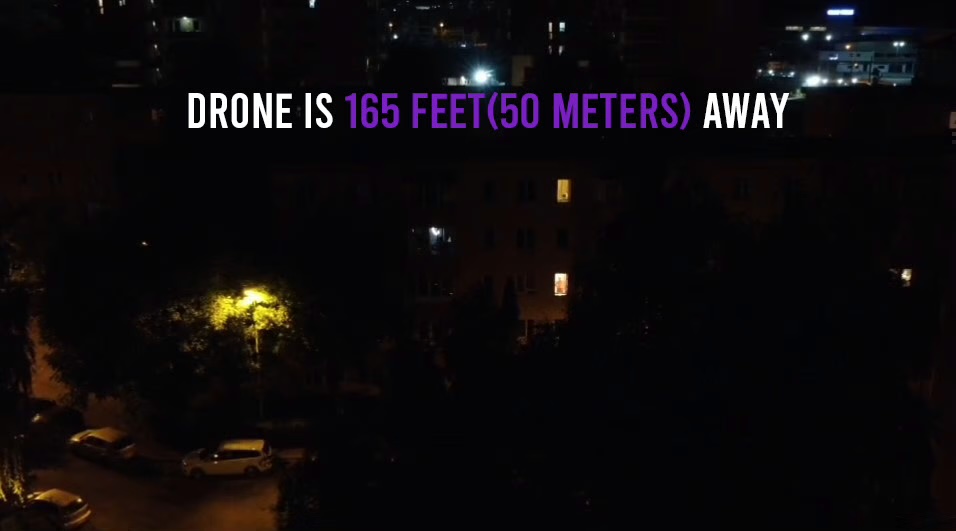
What a consumer drone camera can actually see at night depends heavily on altitude and available light. At 30 meters over a lit street, a DJI Air 3S captures detail clearly. At 120 meters (the FAA altitude ceiling) over that same street, individual faces are not identifiable but vehicles, structures, and groups of people are visible. Over a dark field with no ambient light, the image is near-black regardless of altitude.
The following describes realistic capability, not advertised spec:
Under 50 meters, well-lit urban area: Clear footage of streets, vehicles, building features. Similar to a smartphone in night mode but from above.
50-120 meters, urban with streetlights: Shapes identifiable, vehicles readable, ground features distinguishable. Color accuracy degrades.
Any altitude, rural with no lights: Minimal usable image even on the Air 3S or Mavic 4 Pro. Star glow and terrain silhouettes only.
Any altitude, strong moonlight: Better than no light, but still limited. Full moon over open water or snow gives usable images.
The Privacy Reality: What Someone's Drone Can See from Your Property
At 50 meters with ambient streetlight, a consumer drone camera captures shapes and movement but not fine detail or facial features.
If you are concerned about a drone observing your property at night: a consumer drone in darkness over a rural property cannot see fine detail. Over a well-lit property (exterior lights, bright windows), it can see movement and general activity. Infrared floodlights (used in home security cameras) are in the near-IR spectrum that visible-light sensors cannot capture, so those do not help a drone see better in the dark. A porch light, however, does help a drone camera because it provides visible light.
Tip: If you want to fly your own drone at night for cinematic footage, use locations with interesting ambient light sources. City skylines, lit bridges, coastal towns with harbor lights, and sports stadiums all provide enough ambient light for consumer drone cameras to produce compelling footage.
Thermal Drones: The Real Night Vision Capability
How Thermal Cameras Work on Drones
Thermal cameras detect infrared radiation emitted by warm objects rather than reflected visible light. Every object above absolute zero emits infrared radiation proportional to its temperature. A thermal camera converts this into a visible image where warmer areas are brighter (or a different color, depending on palette setting). The result works in complete darkness because it does not depend on reflected light at all.
This is genuinely different from a low-light optical camera. A person hiding behind a bush is invisible to a low-light optical camera in the dark. To a thermal camera, they are a bright blob of body heat that reads clearly regardless of light conditions.
Which Consumer or Prosumer Drones Have Thermal Cameras
No drone sold at mainstream consumer retail has a thermal camera. Thermal sensors are expensive to manufacture and require export licenses in some configurations. The entry point for thermal drone capability is the prosumer/enterprise tier:
Drone
Thermal Resolution
Price
Market
Autel EVO II 640T
640x512
~$4,799
Prosumer / inspection
DJI Mavic 3 Thermal
640x512
~$6,698
Enterprise / public safety
DJI Matrice 4T
640x512
~$10,000+
Law enforcement / SAR
DJI Matrice 30T
640x512
~$14,999
Enterprise / public safety
Who Uses Thermal Drones
Search and rescue teams use the DJI Matrice 4T and 30T for missing person searches at night. Police agencies use the same platforms for suspect tracking. Industrial inspection companies use the Mavic 3 Thermal for electrical infrastructure, HVAC systems, and solar panel fault detection. Firefighters use thermal drones to see through smoke and identify hotspots in structure fires.
Note: Police departments flying drones over your neighborhood at night are almost certainly using thermal-equipped platforms (Matrice 4T or 30T), not consumer DJI drones. The visual of a small buzzing quadcopter is the same, but the capability is fundamentally different from a DJI Mini or consumer Air model.
FAA Night Flying Rules and Your Drone's Night Camera Setup
The Anti-Collision Light Requirement for Night Drone Flying
Under FAA Part 107 and recreational rules, flying a drone at night requires an anti-collision light that is visible for 3 statute miles. This applies to recreational and commercial pilots equally. The DJI Mini 4 Pro and Air 3S have built-in front LED lights, but DJI does not officially certify these as meeting the 3-mile requirement. Most pilots flying for commercial work add an aftermarket strobe such as the Firehouse Arc V (visible at 3+ miles, 14.5g weight) to avoid any compliance question.
The anti-collision light requirement is about the drone being visible to manned aircraft, not about helping the drone camera see. It is a safety rule for airspace sharing, not a camera enhancement.
Civil Twilight and the Night Flying Window
For Part 107 operations, "night" begins at the end of evening civil twilight (30 minutes after official sunset) and ends at the beginning of morning civil twilight (30 minutes before official sunrise). Between sunset and the end of civil twilight is not technically "night" under the regulations, and anti-collision lights are not required during that window, though using them is best practice. Civil twilight times vary by date and location: use the USNO Solar and Lunar Data calculator for your specific date and location.
Camera Settings for Night Drone Flights
Manual camera settings produce better night footage than auto mode on consumer drones. A starting point for an Air 3S or Mavic 4 Pro over a lit area:
ISO: 800-3200 (start at 800 and raise only as needed)
Shutter speed: 1/30s or 1/50s (twice the frame rate is the standard rule)
Aperture: widest available (f/1.7 or f/1.8)
ND filter: remove all ND filters at night (they are for bright conditions)
For the DJI Neo 2 with its f/2.8 fixed aperture and smaller sensor, night footage will be noticeably grainier than the Air 3S or Mavic 4 Pro at equivalent settings. The Neo 2 is a daytime drone with limited low-light capability.
FAQ
No consumer drones have true night vision. They use low-light optical cameras that amplify available ambient light (city glow, moonlight, streetlights). True night vision requires either image intensification tubes or thermal infrared sensors, both of which start at enterprise price points well above consumer retail. The DJI Air 3S and Mavic 4 Pro have the best low-light optical performance in the consumer tier but still require ambient light to produce a usable image.
It depends on the lighting conditions and drone type. A consumer drone (DJI Mini, Air, Mavic series) over a well-lit area can capture clear video of movement and general activity. Over a dark rural property with no exterior lighting, a consumer drone camera produces a near-black image. A thermal drone (used by police and search-and-rescue) can detect body heat in complete darkness regardless of visible light conditions.
Police drones with thermal cameras (such as the DJI Matrice 4T or 30T) can see body heat in complete darkness. Most law enforcement agencies that operate drones have moved to thermal-equipped platforms specifically for nighttime operations. Consumer-grade DJI drones used by smaller agencies without thermal capability cannot see effectively in darkness without ambient light.
The DJI Mini 4 Pro does not have night vision. It has a 1/1.3-inch CMOS sensor with an f/1.7 aperture and a night shooting mode that stacks multiple frames to reduce noise. This produces better low-light footage than smaller-sensor drones, but it is still an optical camera that requires ambient light. In genuine darkness, it cannot produce a usable image.
For consumer optical cameras, the DJI Mavic 4 Pro (4/3-inch sensor, f/1.7) and DJI Air 3S (1-inch sensor, f/1.8) have the best low-light capability available at retail. For true night vision (thermal), the entry point is the Autel EVO II 640T at around $4,799 or the DJI Mavic 3 Thermal at $6,698. Law enforcement uses the DJI Matrice 4T and 30T series.
Horizontal range is limited by light, not focal length. Vertically, from 120 meters altitude over a lit area, a DJI Air 3S can capture clear video of streets, vehicles, and structure outlines. Individual faces are not identifiable at that altitude in low light. The practical limit is the amount of ambient light present in the scene, not the camera's optical specification.
Yes. Under FAA Part 107 and recreational rules, all drones flying at night are required to have an anti-collision light visible at 3 statute miles. This light is for airspace safety (making the drone visible to manned aircraft), not for helping the camera see. DJI Mini 4 Pro and Air 3S have built-in LEDs, though many commercial pilots add a dedicated strobe like the Firehouse Arc V to clearly meet the FAA standard.
No. Optical cameras cannot see through walls regardless of lighting conditions or time of day. Thermal cameras can detect heat signatures through thin materials in some conditions (for example, a person pressed against a wall heats the surface slightly), but this is not the same as seeing through a solid wall. No commercially available drone has the sensor technology to see through standard construction materials.
Paul Posea founded Dronesgator in 2015 and has been reviewing consumer drones for over a decade. With 195 YouTube drone reviews drawing 3.55 million views and published work on Digital Photography School, he combines hands-on flight testing with data-driven analysis to help pilots find the right drone.
Marcus Taylor is a UK CAA certified drone pilot and owner of Deployed Consultancy Ltd. With 6 years of commercial experience spanning UN site surveys in West Africa, aerial photography across Europe, Africa, and Japan, and defence consulting, he verifies the technical accuracy of Dronesgator's drone reviews and guides.