Starting a drone business in 2026 requires exactly three things before you can legally accept your first dollar: a Part 107 Remote Pilot Certificate ($175), FAA drone registration ($5 per aircraft), and a client willing to pay. Everything else, the LLC, the website, the second battery, can come after your first job.
The barrier to entry is low compared to most service businesses. Total startup costs range from $2,000 for a basic real estate photography setup to $8,000 for a mapping or inspection rig with thermal capabilities. Most successful operators start as a side hustle alongside a day job, building a portfolio and client base before going full-time.
This guide walks through the five steps from getting licensed to scaling beyond solo operation. Each step includes the actual costs, the common mistakes that stall new operators, and the pricing benchmarks that separate profitable businesses from expensive hobbies.
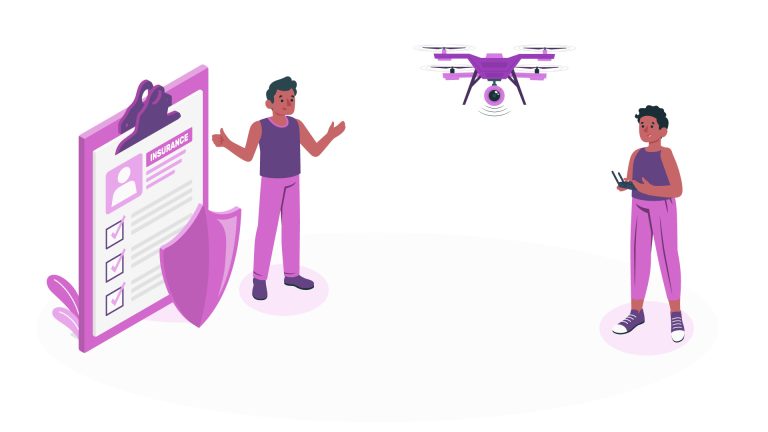
Step 1: Get Licensed and Insured for Your Drone Business
Insurance and licensing are the two non-negotiable prerequisites before accepting any commercial drone work
$175Part 107 test
$5Per-drone registration
$500-1,500/yrInsurance
Part 107 Certification
Every commercial drone flight in the United States requires a Part 107 Remote Pilot Certificate. The knowledge test costs $175 at a PSI testing center. Most people pass on the first attempt after 2-4 weeks of study using a $99-150 online course from Pilot Institute or Drone Launch Academy. The certificate is valid for 24 months and renewal is free through the FAA's online recurrent training.
Drone Insurance
Hull and liability insurance is not legally required for Part 107 operations, but no serious client will hire an uninsured operator. Liability coverage protects you if your drone damages property or injures someone. Hull coverage protects your equipment. The main providers for drone businesses:
Thimble: on-demand policies starting at $17/flight, good for part-time operators
SkyWatch: monthly plans from $45/month with $1M liability
Avion Insurance: annual policies from $500-1,500/year with broader coverage
State Farm and other traditional insurers: increasingly offering drone riders on business policies
Warning: Many clients, especially real estate brokerages and construction companies, require you to name them as an additional insured on your policy before they will sign a contract. Ask your insurer about the process for adding additional insureds, as some charge per certificate.
Business Entity and Registration
An LLC is the most common structure for solo drone operators. It separates your personal assets from business liability. Filing fees range from $50 (states like Kentucky) to $800/year franchise tax (California). You will also need a business bank account, a simple accounting system (Wave or QuickBooks Self-Employed), and a local business license if your municipality requires one.
Tip: Register your FAA drone under your business name rather than your personal name once your LLC is formed. This keeps your personal address off the public FAA registry and looks more professional on the registration label affixed to your aircraft.
Step 2: Choose Your Drone Business Niche and Equipment
Choosing the right niche determines your equipment investment and revenue potential
Pick One or Two Services to Start
The biggest mistake new drone operators make is listing every possible service on their website: real estate, weddings, inspections, mapping, agriculture, and film production. Each niche has different equipment requirements, pricing structures, and client acquisition channels. Trying to serve all of them means mastering none. Start with one primary service and add a second after you have consistent revenue.
Equipment by Niche
Niche
Recommended Drone
Startup Equipment Cost
Average Job Revenue
Real estate photography
DJI Air 3S or Flip
$1,500-2,500
$150-400/property
Construction inspection
DJI Mavic 4 Pro + thermal
$3,000-5,000
$500-1,500/inspection
Mapping and surveying
DJI Mavic 3 Enterprise
$5,000-8,000
$1,000-3,000/project
Event and film
DJI Mavic 4 Pro
$2,500-4,000
$500-2,000/event
Roof inspection
DJI Air 3S + ND filters
$1,500-2,500
$150-350/roof
Essential Accessories Beyond the Drone
Budget for more than the drone itself. A complete field kit includes:
3-4 batteries (one is never enough for a commercial shoot)
ND filter set for controlling exposure in bright conditions
Landing pad for dusty or wet environments
Hardshell case for transport and client-facing professionalism
iPad or tablet for client preview on location
MicroSD cards (at least 256GB, preferably two for redundancy)
Note: For real estate, the DJI Air 3S hits the sweet spot of image quality, portability, and price. You do not need a $2,000+ drone to shoot properties unless you are targeting luxury listings that demand 4K/120fps or RAW photography capabilities.
Step 3: Price Your Drone Business Services Correctly
$150-400Per-property real estate
$150+/hrMinimum viable hourly rate
40-60%Profit margin target
Why Most New Operators Undercharge
New drone pilots often price at $50-75/hour because that sounds like good money. It is not. Once you factor in equipment depreciation ($1,500-5,000 spread over 2-3 years), insurance ($500-1,500/year), vehicle costs to reach the site, editing time (usually 1-2x flight time), and self-employment tax (15.3%), a $75/hour rate can net below minimum wage. The actual minimum viable hourly rate for a sustainable drone business is $150/hour when you account for all costs.
Pricing Models by Service
Different services use different pricing structures. Do not force a per-hour model onto a service that clients expect to pay per-deliverable:
Real estate: per-property flat rate ($150-400), includes 10-20 edited photos + 60-second video
Construction progress: monthly retainer ($500-2,000/month), recurring flyovers on a schedule
Mapping: per-acre pricing ($15-50/acre), scales with project size
Event/film: half-day ($500-800) or full-day ($1,000-2,000) rate
The Cost-Plus Pricing Formula
Calculate your minimum price for any job using this formula: (equipment depreciation per job) + (insurance allocation) + (travel cost) + (editing hours x hourly value) + (flight hours x hourly value) + (30-50% profit margin). For a typical real estate shoot, this works out to roughly $45 in hard costs + $100 in labor value + $55 profit = $200 minimum. Any job priced below your cost-plus number is charity.
Tip: Offer tiered packages instead of hourly billing. A three-tier structure (Basic: photos only, Standard: photos + video, Premium: photos + video + twilight reshoot) lets clients self-select and gives you natural upsell opportunities without awkward negotiations.
Warning: Avoid race-to-the-bottom pricing on platforms like Fiverr or Thumbtack. Winning jobs at $50 trains clients to expect $50 forever and makes it nearly impossible to raise rates later. Price for the market you want, not the market that clicks the cheapest option.
Step 4: Find Your First Drone Business Clients
Your first paid client usually comes from your network, not cold outreach
Real Estate Agents: The Fastest Path to Revenue
Real estate agents are the most common first clients for drone businesses because they have a recurring need, they understand the value of aerial photography, and there are thousands of them in every metro area. The approach that works: identify agents who list properties above $300K (they have marketing budget), look at their current MLS listings to see if they already use aerial photos, and email the ones who do not. Offer a free or discounted first shoot in exchange for permission to use the footage in your portfolio.
Local Business Outreach
Beyond real estate, local businesses with physical locations often need aerial content:
Roofing companies (inspection services, not just photos)
Construction firms (progress documentation for investors or compliance)
Golf courses, resorts, and event venues (marketing content)
Solar installers (roof assessment before installation)
Marketplace platforms can supplement your direct client work, though they typically pay less and take a percentage:
DroneBase: connects pilots with commercial jobs, pays $75-200 per mission
Thumbtack: lead generation for local services, you pay per lead ($10-30)
Google Business Profile: free, essential for local search visibility
Angi (formerly Angie's List): leads for home inspection-adjacent services
Building a Portfolio Before You Have Clients
You need footage to show before anyone will hire you. Fly local landmarks, downtown skylines, parks, and neighborhoods. Create a simple website with 8-12 of your best shots and a 90-second demo reel. WordPress, Squarespace, or a simple portfolio on Pixieset works. The portfolio does not need to be from paid work; it needs to demonstrate that you can capture clean, well-composed aerial imagery.
Tip: When emailing real estate agents, attach 2-3 sample images directly in the email rather than linking to a portfolio site. Agents are busy and will not click through to a website, but they will glance at an attached image that shows their market area from the air.
Step 5: Scale Your Drone Business Beyond Side Hustle
Specialized services like FPV cinematography open higher-margin scaling paths beyond standard aerial photography
6+ monthsConsistent revenue before quitting day job
$3,000-5,000/moMinimum recurring before full-time
When to Go Full-Time
Do not quit your day job after three good months. The drone business is seasonal in most markets (real estate slows in winter, construction pauses in bad weather). The benchmark for going full-time: 6 months of consistent revenue averaging $3,000-5,000/month, with at least 3 recurring clients who book monthly or quarterly. Recurring revenue from retainer clients (construction progress, property management portfolios) is worth more than one-off project revenue of the same dollar amount.
Hiring and Subcontracting
When demand exceeds your capacity, you have two options. Subcontracting to other Part 107 pilots lets you take more jobs without the overhead of an employee. You book the client, set the price, and pay the subcontractor 50-60% of the job rate. The subcontractor must have their own Part 107 certificate and insurance. Hiring an employee makes sense when you have enough volume to justify the payroll tax, workers' comp, and equipment costs.
Expanding Your Service Menu
Once your primary niche is profitable, expand into adjacent services that leverage the same client relationships:
Real estate photography leads to virtual tours, floor plans, and Matterport scanning
Construction inspection leads to mapping, orthomosaic, and 3D modeling
Event coverage leads to live streaming and social media content packages
Roof inspection leads to insurance claims documentation and solar assessment
Operational Tools for Growth
As you scale past 10-15 jobs per month, manual scheduling and invoicing become bottlenecks. Tools that drone business operators commonly use:
HoneyBook or Studio Ninja: booking, contracts, invoicing in one platform
Calendly: client self-scheduling for routine shoots
Google Drive or Dropbox: client delivery of final files
QuickBooks: accounting and tax preparation
Notion or Trello: project tracking across multiple active jobs
Note: Every subcontractor who flies under your business name must carry their own Part 107 and insurance. If an uninsured subcontractor causes damage on a job you booked, your business is liable. Verify credentials before every engagement, not just the first one.
FAQ
You need a FAA Part 107 Remote Pilot Certificate for any commercial drone operation. Beyond that, most cities and counties require a general business license to operate any business, including drone services. Check with your local municipality for specific requirements. The Part 107 is federal; business licenses are local.
The minimum startup cost is roughly $2,000: $800-1,500 for a capable drone like the DJI Air 3S, $175 for the Part 107 test, $5 for FAA registration, and $500-1,500 for annual insurance. A more complete setup with extra batteries, ND filters, a case, and an LLC filing runs $3,000-5,000. Mapping and inspection businesses that need enterprise-grade equipment may spend $5,000-8,000.
Real estate agents are the fastest path. Identify agents in your area who list properties above $300K but do not currently use aerial photography in their MLS listings. Email them directly with 2-3 sample aerial images from your portfolio. Offer a discounted or free first shoot to build the relationship. Beyond real estate, reach out to roofing companies, construction firms, and event venues.
Yes, when priced correctly. A solo operator working 15-20 jobs per month at $200-400 per job can generate $3,000-8,000/month in revenue. After expenses (equipment depreciation, insurance, fuel, software), net profit margins of 40-60% are achievable. The key is avoiding the race-to-the-bottom pricing that many new operators fall into. Profitability depends on choosing the right niche and maintaining rates above your cost-plus minimum.
An LLC is recommended for any drone business accepting paid work. It separates personal and business liability, which matters when you are flying equipment over people's property. Filing fees range from $50 to $800 depending on your state. An LLC also makes it easier to open a business bank account, get insurance, and appear professional to clients who require a W-9.
It is not legally required by the FAA, but it is effectively required by the market. Most commercial clients, especially real estate brokerages, construction companies, and property managers, require proof of liability insurance before signing a contract. Many also require you to add them as an additional insured. Expect to pay $500-1,500/year for a policy with $1M liability coverage.
Real estate aerial photography typically runs $150-400 per property. Construction progress documentation ranges from $500-2,000 per visit or $1,000-3,000/month on retainer. Event coverage runs $500-2,000 per event. Mapping and surveying is priced per acre at $15-50. The minimum viable hourly rate, after factoring equipment depreciation and overhead, is approximately $150/hour.
You can start with a DJI Mini series drone for basic real estate photography and social media content. The DJI Mini 4 Pro and Mini 5 Pro both shoot 4K video and capture 48MP photos, which is sufficient for most real estate and event work. The main limitation is wind resistance (the sub-250g frame struggles in winds above 20 mph) and the lack of a mechanical shutter, which can cause rolling shutter artifacts in fast movement.
Paul Posea founded Dronesgator in 2015 and has been reviewing consumer drones for over a decade. With 195 YouTube drone reviews drawing 3.55 million views and published work on Digital Photography School, he combines hands-on flight testing with data-driven analysis to help pilots find the right drone.
Marcus Taylor is a UK CAA certified drone pilot and owner of Deployed Consultancy Ltd. With 6 years of commercial experience spanning UN site surveys in West Africa, aerial photography across Europe, Africa, and Japan, and defence consulting, he verifies the technical accuracy of Dronesgator's drone reviews and guides.