• Find My Drone

Drone Business Plan: Template and Financial Projections for 2026

Updated

By Paul Posea

Drone Business Plan: Template and Financial Projections for 2026 - drone reviews and comparison

Why a Drone Business Plan Matters (Even for Solo Operators)

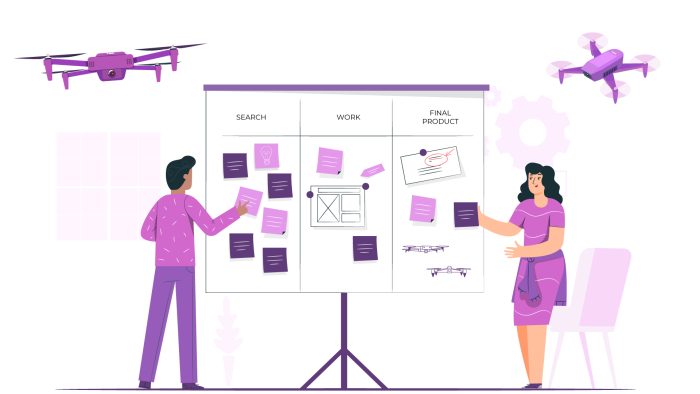
Drone business launch guide showing step-by-step planning process
A structured business plan gives solo drone operators a roadmap before the first client call

It Is Not Just for Investors

Most drone businesses start as one-person operations with no outside funding. The plan is not for a venture capitalist. It is for you. Writing down your target market, pricing, and costs forces you to confront assumptions that feel reasonable in your head but fall apart in a spreadsheet. "I will charge $200 per real estate shoot" sounds viable until you calculate that you need 20 shoots per month to cover expenses, and there are only 15 agents in your area who list above $300K.

One-Page Lean Plan vs. Full Business Plan

There are two formats, and the right one depends on your situation:

  • Lean plan (1 page): Services offered, target customer, revenue model, startup costs, 90-day goals. Sufficient for solo operators self-funding with savings.
  • Full business plan (5-15 pages): Executive summary, market analysis, financial projections, marketing strategy, operations plan. Required for SBA loans, bank lines of credit, or bringing on a business partner.
If you are funding your drone business from savings and do not need a loan, a one-page lean plan is enough. The full version becomes necessary when someone else's money is involved.

When You Need the Full Version

Three scenarios require a formal business plan with financial projections:

  1. Applying for an SBA microloan or small business loan (lenders want 3-year projections)
  2. Bringing on a business partner who will invest capital or equipment
  3. Pitching a corporate client for a long-term retainer (enterprise clients sometimes request a company overview as part of vendor onboarding)
Note: Even if you start with the lean version, save it. You can expand it into a full plan later when the opportunity requires one. The financial projections section is the hardest part to create from scratch, so building it early saves time.

Executive Summary and Drone Business Overview

What the Executive Summary Covers

The executive summary is a single page that answers six questions. Write it last (after completing the other sections), but place it first in the document. A lender or partner should be able to read this one page and understand your entire business.

  1. What services do you offer? (e.g., aerial real estate photography, construction progress documentation)
  2. Who is your target customer? (e.g., real estate agents listing properties above $300K in the Austin metro area)
  3. What is your geographic service area? (radius from your base, or specific counties/cities)
  4. What is your revenue model? (per-project, retainer, per-acre, day rate)
  5. What makes you different from competitors? (faster turnaround, thermal capability, specific niche expertise)
  6. What are your Year 1 revenue and expense projections? (summary numbers from your financial section)

Writing Your Value Proposition

Your value proposition is not "I have a drone and a Part 107." Every competitor has that. The value proposition answers: why should this specific client hire you instead of the other operator who emailed them last week? Strong value propositions for drone businesses are usually built on one of these:

  • Niche specialization (you only do construction, so you understand progress documentation requirements)
  • Turnaround speed (24-hour delivery when competitors take 3-5 days)
  • Technical capability (thermal imaging, 3D modeling, RTK mapping accuracy)
  • Local market knowledge (you know the neighborhoods, the agents, the seasonal patterns)
Tip: Test your value proposition by reading it aloud and asking: would a real estate agent or construction manager care about this? "Professional aerial photography" is generic. "Edited aerial photos delivered within 24 hours of the shoot, formatted for MLS upload" is specific and solves an actual workflow problem.

Market Analysis: Drone Business Customers and Competitors

Drone business insurance and market research documentation
Insurance requirements and competitor pricing are core inputs for your market analysis

Sizing Your Local Market

Market analysis for a drone business is local, not national. National statistics about the drone industry being worth $XX billion are irrelevant to your business. What matters is the number of potential clients within your service radius. Here is how to estimate demand for the most common niches:

Data PointWhere to Find ItWhy It Matters
Active real estate agents in your areaLocal MLS, Realtor.com agent searchEach active agent is a potential recurring client
New construction permits (last 12 months)County building department websiteEach permit represents a potential progress documentation contract
Roofing companies within 30 milesGoogle Maps searchRoofing + drone inspection is a growing partnership model
Annual events, festivals, venuesLocal tourism board, event calendarsEvent coverage is seasonal but high-value per job

Competitor Research

Search Google for "drone photography [your city]" and document the first 10 results. For each competitor, record their services, pricing (if listed), portfolio quality, Google review count, and whether they specialize or generalize. Most drone markets have 5-15 active operators per metro area. The gap you are looking for is either an underserved niche (nobody local does thermal inspection) or underserved quality (existing operators have poor portfolios or slow turnaround).

SWOT Analysis for a Drone Business

A simple SWOT framework applied to a new drone business typically looks like this:

  • Strengths: Low overhead, portable business, high-margin services, growing demand
  • Weaknesses: Weather dependent, seasonal in many markets, limited to daylight hours (without Part 107 night waiver), single point of failure if equipment breaks
  • Opportunities: Real estate market adoption still growing, insurance and inspection demand increasing, corporate events replacing fireworks with drone shows
  • Threats: Price competition from hobbyists, DJI import restrictions affecting equipment availability, regulatory changes requiring additional certifications
Note: If your competitor research reveals more than 10 active operators in your area all doing real estate photography, that niche may be saturated. Consider adjacent niches like construction progress, solar assessment, or roof inspection where competition is typically lighter.

Drone Business Services, Pricing, and Financial Projections

$30KYear 1 conservative
$60KYear 1 realistic
$90KYear 1 optimistic

Services Menu with Price Ranges

Define your services as specific deliverables with clear pricing. Avoid vague descriptions like "aerial photography services." Clients need to know exactly what they get and what it costs:

ServiceDeliverablesPrice Range
Real estate aerial package15-25 edited photos, 60-sec video, next-day delivery$150-400
Construction progress reportOrthomosaic, annotated photos, comparison to previous visit$500-1,500
Roof inspectionThermal + RGB imagery, condition report, damage annotations$150-350
Event aerial coverageHalf-day coverage, 20-40 edited photos, 2-min highlight video$500-1,200
Mapping/surveyingOrthomosaic, DSM/DTM, point cloud (per acre)$15-50/acre

Startup Costs Table

CategoryLow EstimateHigh Estimate
Drone + batteries + accessories$1,500$5,000
Part 107 test + study course$175$325
FAA registration$5$15
Drone insurance (annual)$500$1,500
LLC formation + business license$100$800
Website + portfolio hosting$0$200
Editing software (annual)$120$600
Marketing (first 3 months)$0$500
Total$2,400$8,940

Break-Even and Year 1 Revenue Scenarios

Your break-even point is the number of jobs needed to cover monthly fixed costs. For a typical solo operator with $300-500 in monthly overhead (insurance allocation, software, vehicle expenses), break-even at $250/job averages is 1-2 jobs per month. The three Year 1 scenarios assume a full-time operator who started with an established niche:

  • Conservative ($30K): 10 jobs/month at $250 average, slower winter months, 12-month ramp
  • Realistic ($60K): 15-18 jobs/month at $300 average, 2-3 recurring clients, some seasonal dips
  • Optimistic ($90K): 20+ jobs/month at $350+ average, multiple retainer clients, minimal seasonal impact
Warning: These projections assume you are working the business full-time and actively acquiring clients. A side-hustle operator working weekends only should expect 30-50% of these numbers. Be honest about your available hours when projecting revenue.

Marketing Plan and Operational Details for Your Drone Business

Client Acquisition Channels

Your marketing plan should specify which channels you will use to find clients, how much time or money each channel requires, and what results you expect. For a new drone business with limited budget, rank these by cost-effectiveness:

  1. Direct outreach to real estate agents and construction firms (free, highest conversion rate)
  2. Google Business Profile with portfolio photos (free, generates inbound leads over time)
  3. Local networking events and chamber of commerce (low cost, builds referral network)
  4. Social media portfolio on Instagram or YouTube (free, long-term brand building)
  5. Paid Google Ads for local searches like "drone photography [city]" ($200-500/month, fast results)

Operational Workflow

Document your workflow from booking to delivery. This becomes your standard operating procedure and is critical if you ever hire or subcontract. A typical workflow for a real estate aerial shoot:

  1. Client books through your scheduling tool or email
  2. You check weather forecast and confirm the shoot date
  3. Pre-flight: charge batteries, format SD cards, review the property on Google Maps
  4. On site: safety check, fly mission (15-30 minutes typical), capture photos and video
  5. Post-production: select best shots, color correct, edit video (1-2 hours)
  6. Deliver finals via Google Drive or Dropbox link within 24 hours
  7. Invoice and follow up

Contracts, Legal, and File Retention

Every commercial drone job should have a written agreement, even if it is a one-page contract. The contract should cover:

  • Scope of work (what you will deliver and when)
  • Payment terms (50% deposit, balance on delivery is standard for new clients)
  • Weather cancellation and reschedule policy
  • Liability limitations and insurance coverage
  • Usage rights (who owns the footage, where it can be published)
  • File retention policy (how long you keep raw files, typically 90 days)
Tip: Use a contract template from a platform like HoneyBook or Studio Ninja. These services provide drone-specific contract templates that cover FAA compliance, liability waivers, and usage rights. Having a professional contract impresses clients and protects you from scope creep.
Note: Keep certificates of insurance readily available as PDFs. Many clients need these before the shoot date, and delays in providing proof of insurance can cost you the job. Ask your insurer for a digital certificate you can email within minutes of a client request.

FAQ

A formal plan is not legally required, but some form of planning is essential. At minimum, write a one-page lean plan covering your target market, services, pricing, and startup costs. A full business plan with financial projections is necessary if you are applying for a loan, bringing on a partner, or pitching corporate clients for retainers.

A full-time solo operator can realistically generate $30,000-60,000 in the first year, depending on niche, local market size, and how aggressively they acquire clients. Part-time operators working weekends typically earn $10,000-25,000. The key variables are jobs per month (10-20 for full-time) and average job value ($200-400 for most services).

A complete plan includes: executive summary, services menu with pricing, target market description, competitor analysis, startup cost breakdown, monthly operating cost estimate, Year 1 revenue projections (conservative, realistic, optimistic), marketing strategy with specific channels, operational workflow, and legal requirements (Part 107, insurance, contracts).

Start with your monthly fixed costs (insurance, software, vehicle, phone). Add variable costs per job (battery wear, travel, editing time). Multiply your average job price by a conservative number of monthly jobs to get revenue. Subtract total costs from revenue for net profit. Build three scenarios: conservative (50% of capacity), realistic (75%), and optimistic (100%). Project monthly for Year 1 and quarterly for Years 2-3.

Yes. Writing the plan while studying for Part 107 is an efficient use of time. The plan helps you decide which drone to buy (based on your chosen niche), how much to budget for startup costs, and which clients to target first. Waiting until after certification means you may buy equipment before knowing which niche is viable in your local market.

Total startup costs range from $2,400 to $8,940 depending on equipment tier and niche. The minimum includes a capable drone ($1,500-5,000), Part 107 test ($175), study course ($0-150), FAA registration ($5-15), insurance ($500-1,500/year), LLC formation ($100-800), and editing software ($120-600/year). Real estate photography sits at the low end; mapping and thermal inspection sit at the high end.

Most drone businesses do not need outside investors. The startup cost ($2,400-8,940) is low enough to self-fund from savings or a small personal loan. Outside investment makes sense only for large-scale operations like drone light show companies (requiring $30,000+ in fleet equipment) or enterprise mapping services that need RTK-capable aircraft and specialized software licenses.

Paul Posea

Paul Posea

Author · Dronesgator

Paul Posea is the founder of Dronesgator and has been reviewing and comparing drones since 2015. With a Part 107 certification, 195 YouTube drone reviews, and published work on Digital Photography School, he combines hands-on flight testing with data-driven analysis to help pilots find the right drone.