• Find My Drone

How Do Drones Fly? The Physics Behind Quadcopters

Updated

By Paul Posea

How Do Drones Fly? The Physics Behind Quadcopters - drone reviews and comparison

How Drones Fly: The Physics of Lift

4Motors
Newton 3Lift principle
500+Loop updates/sec

Newton's Third Law and Rotor Lift

Every drone flies on the same principle: rotating blades push air downward, and the air pushes the drone upward. This is Newton's third law applied to rotary-wing flight. The faster the blades spin, the more air they move per second, and the more upward thrust they generate.

Consumer drone propellers are designed with a pitch (the angle of the blade relative to horizontal) and a diameter that together determine how much air each rotation displaces. A DJI Mini 4 Pro uses 145mm propellers with a relatively low pitch, optimized for efficiency at low airspeeds. Larger drones use bigger props that move more air per rotation, which is why they can lift heavier payloads without spinning faster than smaller drones do.

Why Four Motors Instead of One

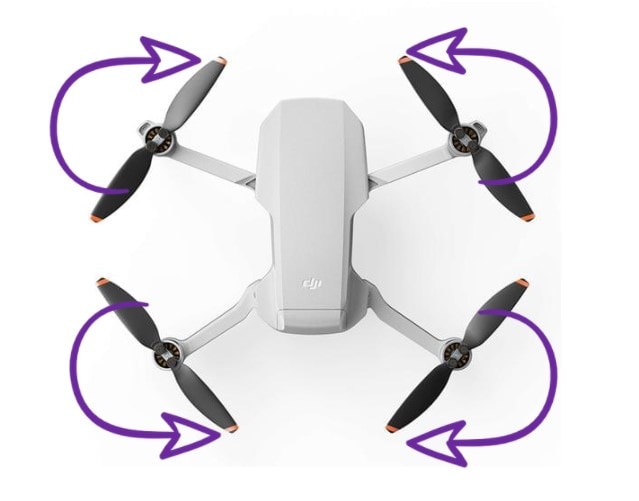
A single large rotor, like a helicopter's main rotor, generates a torque reaction: the fuselage wants to spin in the opposite direction. Helicopters solve this with a tail rotor. Quadcopters solve it differently: two motors spin clockwise and two spin counter-clockwise, arranged diagonally in pairs. The torque from each pair cancels the other out, so the drone body stays stable with no tail rotor needed.

The four-motor arrangement also gives the flight controller four independent variables to work with. By adjusting each motor's speed individually, the controller can produce any combination of up, down, forward, backward, left, right, or rotation.

Diagram showing which drone propellers spin clockwise and which spin counter-clockwise
Two motors spin clockwise, two counter-clockwise. Diagonal pairs match rotation direction to cancel torque.

How Drones Fly and Change Direction

Throttle: Going Up and Down

When all four motors increase speed simultaneously, total lift exceeds the drone's weight and it climbs. When all four motors slow down, lift drops below weight and it descends. Hover is the point where total thrust exactly equals weight, which the flight controller maintains automatically by making continuous small adjustments to all four motors.

This sounds simple but the controller must account for changing battery voltage (which affects motor speed), air density changes, and wind gusts. The 500+ Hz update loops in modern flight controllers handle this faster than any human could react.

Pitch and Roll: Moving Forward, Backward, Left, Right

To fly forward, the front two motors slow down slightly while the rear two speed up. This tilts the drone nose-down. Because the rotor disc is now angled, some of the thrust vector points forward instead of straight up. The drone accelerates in that direction.

The same logic applies sideways. Slow the left motors, speed up the right motors, and the drone tilts left. Tilt it far enough and it moves quickly; a gentle tilt produces slow, controlled lateral movement. Pitch (forward/backward tilt) and roll (left/right tilt) are both controlled through this differential motor speed approach.

Yaw: Rotating Without Moving

To rotate in place, the controller speeds up one diagonal pair while slowing the other. Since the clockwise motors and counter-clockwise motors each produce torque in opposite directions, making them unequal disrupts the torque balance. The excess torque from the faster pair rotates the entire drone in that direction.

Yaw doesn't require the drone to tilt. It's a pure rotation produced entirely by imbalancing the torque between the two diagonal motor pairs.

The Flight Controller: How Drones Know What to Do

What the Flight Controller Actually Is

The flight controller is a small circuit board that reads sensor inputs dozens of times per second and adjusts motor speeds in response. In a DJI Mini 4 Pro, this chip runs a proprietary algorithm called FlightAutonomy. In open-source platforms, it might run Betaflight, ArduPilot, or PX4. The underlying job is the same regardless of platform: keep the drone stable and translate pilot commands into motor outputs.

The Sensor Stack

Modern consumer drones combine several sensors to understand their position and orientation:

  • IMU (Inertial Measurement Unit): accelerometers and gyroscopes that detect tilt, rotation, and acceleration in real time
  • GPS/GLONASS: satellite positioning for holding a fixed location outdoors
  • Barometer: measures air pressure to hold altitude when GPS signals are weak
  • Vision sensors: downward-facing cameras that detect ground texture for position hold without GPS (useful indoors or near the ground)
  • Ultrasonic sensors: short-range altitude measurement for precision landing

ESCs: The Bridge Between Controller and Motor

Between the flight controller and each motor sits an Electronic Speed Controller (ESC). The flight controller outputs a signal specifying desired motor speed; the ESC converts that signal into the specific voltage and current needed to spin a brushless motor at exactly that speed. Brushless motors used in modern drones don't have physical contacts that wear out, which is why they can spin at 15,000 RPM continuously without maintenance.

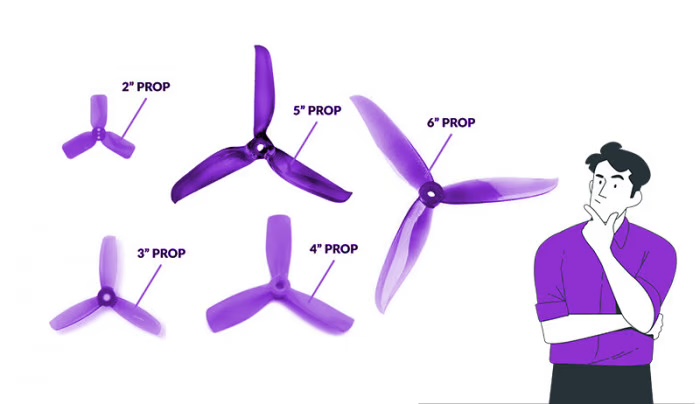
Different types of drone propellers showing fixed-pitch and quick-release designs
Propeller design affects efficiency, noise level, and flight characteristics. Most consumer drones use fixed-pitch quick-release props.

How Drones Fly Stably in Windy Conditions

Attitude vs. GPS Hold Modes

Consumer drones operate in two main stability modes. In GPS mode, the drone actively tracks its GPS coordinates and fights to stay at the same lat/lon/altitude. A gust pushes it sideways and the controller detects the movement, tilts to apply counter-thrust, and returns to the original position. This is what makes modern drones feel "locked in place."

In attitude mode (Atti mode on DJI, sometimes called ATTI), the GPS hold is disabled. The drone still self-levels using its IMU, so it won't flip, but it will drift with the wind. Atti mode was common on older DJI models and is sometimes deliberately used by professional videographers for smoother, more cinematic drift shots.

Why Smaller Drones Struggle More in Wind

A 249g DJI Mini 4 Pro has less inertia than an 895g DJI Air 3S. When a crosswind hits, the lighter drone experiences a larger percentage change in its trajectory and must correct more aggressively. The flight controller can compensate up to a point, but in strong gusts the motors may not have enough thrust headroom to hold position while also maintaining altitude.

Tip: DJI rates wind resistance in Beaufort scale levels. Mini 4 Pro is rated Beaufort 5 (fresh breeze, up to 38 km/h). Air 3S and Mavic 4 Pro are rated Beaufort 7 (near gale, up to 61 km/h). If you're flying in gusty conditions, the spec sheet number matters.

How Air Density and Temperature Affect Drone Flight

Drone propellers generate thrust by pushing air downward. In thin air, there are fewer air molecules per cubic meter to push, so each rotation produces less thrust. At 3,000 meters elevation, air density is roughly 25% lower than at sea level. A drone that hovers comfortably at the coast may struggle at altitude, running motors harder to generate the same lift, which drains the battery faster and reduces flight time.

Temperature affects motor efficiency and battery output. Cold batteries deliver less current, which limits maximum motor speed. Hot air (high temperature reduces density slightly) compounds the elevation effect. Professional operators flying in mountains or deserts account for this with more conservative altitude and payload limits. For most hobbyists at sea level in moderate temperatures, the effect is negligible.

Return to Home and Obstacle Sensing

Most GPS drones include an automated Return to Home (RTH) function that activates when the signal is lost or battery reaches a critical level. The drone climbs to a preset safe altitude, navigates back to its recorded home point using GPS, and descends. Higher-end models add obstacle avoidance sensors that can detect and avoid obstacles during RTH automatically.

How Drone Propellers Work and Why They Matter

Propeller Size, Pitch, and Efficiency

A propeller is described by two numbers: diameter and pitch. A 5-inch, 4.5-pitch prop has a 5-inch blade span and is designed to move 4.5 inches of air per rotation theoretically. Higher pitch moves more air but requires more torque, drawing more current. Lower pitch is more efficient at lower speeds, which is why sub-250g drones optimized for flight time use low-pitch propellers.

Propeller blade count matters too. Two-blade props are most efficient at low speeds. Three-blade props generate more thrust per rotation at the cost of slightly more current draw. FPV racing drones often use three-blade props for their faster response. Consumer camera drones almost universally use two-blade designs to maximize flight time.

How Drones Fly with Quick-Release Props

Modern DJI drones use a self-tightening quick-release system: clockwise-mounted props have a counter-clockwise thread, and vice versa. As each motor spins up, it actually tightens the prop onto the shaft rather than loosening it. This is why props can't fly off in flight (barring physical damage to the mount) even without any fasteners.

What Happens When a Drone Loses a Motor

If one motor fails in flight, the flight controller loses its torque balance and can no longer maintain yaw stability. Depending on the altitude and how quickly the failure occurs, some drones can briefly maintain partial control by spinning the remaining three motors asymmetrically, but this is unstable and the drone will typically descend rapidly. Some enterprise drones have six or eight motors specifically to provide redundancy against single-motor failure.

Note: A propeller strike on a hard object is the most common cause of mid-flight motor failure. If you hear a blade hit anything during flight, land immediately and inspect before flying again.

FAQ

Drones generate lift by spinning rotors that push air downward. When the combined upward thrust from all four motors exceeds the drone's weight, it rises. A flight controller adjusts motor speeds hundreds of times per second to maintain stable hover and respond to wind. Without this constant automatic correction, the drone would tilt and fall.

To move forward, the front motors slow slightly while the rear motors speed up. This tilts the drone nose-down, directing part of the rotor thrust forward. The same differential motor speed approach controls all lateral movement. To move left, the left motors slow and the right motors speed up, tilting the drone left.

Quadcopters use two counter-rotating motor pairs instead of a tail rotor. Two diagonal motors spin clockwise, two spin counter-clockwise. The torque from each pair cancels the other out, keeping the drone body stable. To rotate (yaw), the controller makes one diagonal pair faster than the other, briefly unbalancing the torque.

The flight controller reads data from gyroscopes, accelerometers, GPS, and barometric sensors up to 500+ times per second. It adjusts individual motor speeds to correct any detected tilt, drift, or altitude change. On consumer drones, GPS hold keeps the drone at a fixed coordinate even when the pilot is not touching the controls.

In GPS mode, the drone detects any wind-induced movement through its GPS and IMU sensors and commands motors to apply counter-thrust, returning to the original position. Smaller, lighter drones have less inertia and are pushed off course more easily. DJI rates wind resistance using the Beaufort scale: the Mini 4 Pro handles Beaufort 5 and the Air 3S handles Beaufort 7.

Consumer camera drones use four motors arranged in an X pattern, making them quadcopters. Some specialized drones use six motors (hexacopters) or eight motors (octocopters) for added payload capacity or motor redundancy. FPV drones also typically use four motors. The quadcopter configuration is the best balance of efficiency, weight, and simplicity.

A quadcopter cannot fly stably with only three propellers. Losing one motor eliminates the torque balance and makes stable yaw control impossible. The drone will spin and crash. Some research platforms have demonstrated limited emergency descent modes with three working motors, but no consumer drone is designed to handle this scenario.

Consumer drones use GPS and GLONASS satellite systems to determine their outdoor position with roughly 1-2 meter accuracy. Indoors or near the ground, downward-facing optical flow cameras track ground texture to hold position. Barometric pressure sensors track altitude. All of these sensor readings feed into the flight controller, which synthesizes them into a combined position estimate.

Paul Posea

Paul Posea

Author · Dronesgator

Paul Posea is the founder of Dronesgator and has been reviewing and comparing drones since 2015. With a Part 107 certification, 195 YouTube drone reviews, and published work on Digital Photography School, he combines hands-on flight testing with data-driven analysis to help pilots find the right drone.