Modern mid-range drones can transmit video from 10-20 km away in open, unobstructed conditions. The DJI Mini 4 Pro is rated at 20 km, the Mavic 4 Pro at 30 km. These are marketing-condition numbers: line-of-sight, no interference, FCC regulation territory. Real-world range in urban or suburban environments with Wi-Fi interference and obstacles is significantly shorter, typically 1-5 km before signal starts dropping.
The legal ceiling is almost never the technical ceiling. FAA rules require visual line of sight (VLOS) at all times during recreational and most Part 107 flights. A standard human eye loses reliable tracking of a consumer drone somewhere around 400-800 meters. At 1 km, the drone is invisible without binoculars. You hit the visual limit long before the signal limit.
This guide covers what the range spec actually measures, what limits it in practice, how transmission systems differ across price points, and what VLOS means for how far you can realistically fly.
What the Range Spec Actually Measures
Signal range is measured under ideal conditions: open area, no interference, FCC regulation. Urban environments with Wi-Fi congestion can cut that number by 80% or more.
The range number on a spec sheet represents the maximum control and video transmission distance measured in optimal conditions. Those conditions are:
Open, flat terrain with no obstacles between controller and drone
FCC regulation mode (US), which uses higher transmit power than CE/European mode
No Wi-Fi or 2.4/5.8 GHz interference nearby
Clear weather
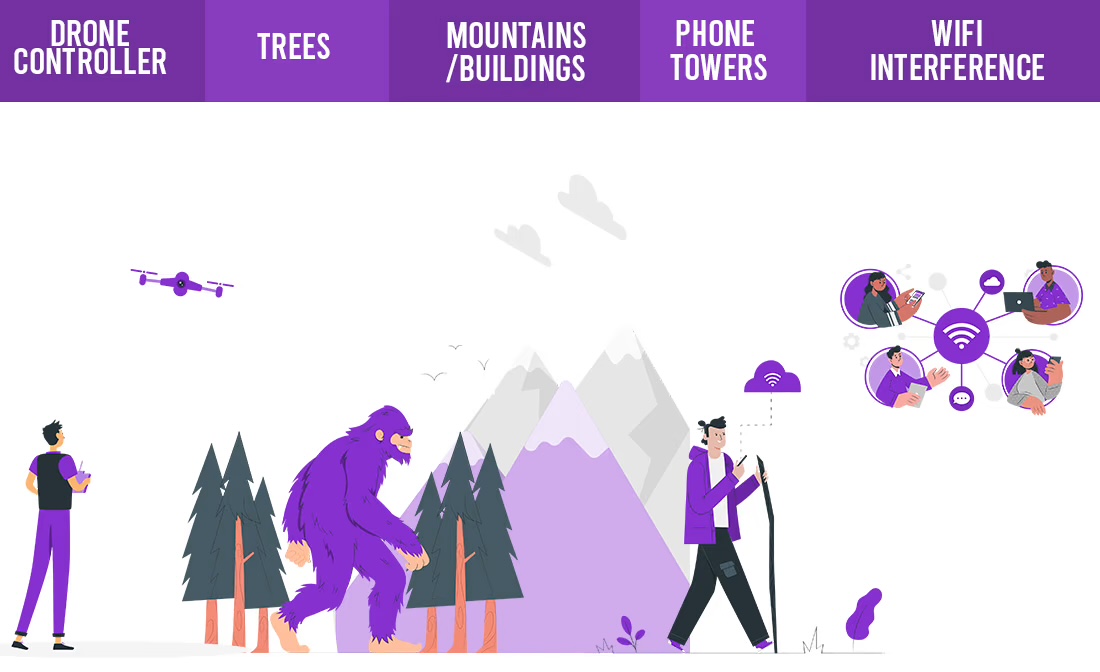
In a suburban backyard with neighbors' Wi-Fi routers and a house between you and the drone, real range can be a fraction of the spec. Urban pilots routinely see video dropout at 300-500 meters on drones rated for 10+ km.
FCC vs CE regulation
DJI drones purchased in the US use FCC mode, which allows higher radio transmit power. The same drone sold in Europe operates in CE mode with lower power limits mandated by EU regulation. FCC-mode drones have meaningfully longer real-world range than CE-mode versions of the same hardware. A DJI Mini 4 Pro bought in the UK will not achieve the same range as one bought in the US.
Why the number matters anyway
Even if 20 km is unreachable in practice, there is a meaningful difference between a drone rated for 20 km and one rated for 1 km. The higher-rated system has more margin before signal degradation begins. In a typical suburban environment, a 20 km drone might give you 1.5-3 km before issues appear, while a 1 km budget drone might cut out at 200-400 meters.
Note: DJI changed from OcuSync 3.0 to O4 transmission and then to O4+ in their recent models. Each generation improved video bitrate, latency, and reliability at range. A drone using O4+ (Mavic 4 Pro, Mini 4 Pro) has meaningfully better real-world range than earlier OcuSync 2 models at the same regulatory rating.
How Transmission Systems Compare
Transmission technology varies significantly across price tiers. DJI's O4+ system outperforms budget Wi-Fi controllers in every real-world condition.
The radio system between the controller and drone is the primary factor in range. Not all systems are equal.
DJI O4 and O4+
DJI's proprietary transmission system handles automatic frequency switching between 2.4 GHz and 5.8 GHz based on interference conditions. O4+ (used in the Mavic 4 Pro and Mini 4 Pro) adds improved signal encoding that reduces video stuttering at the edge of range. Real-world range in suburban conditions: typically 1.5-4 km before degradation.
Autel SkyLink
Autel's current transmission system is comparable to DJI's O3/OcuSync 3.0 generation. Real-world performance is similar to DJI's 2022-era hardware: solid at 1-2 km in typical conditions, but not matching O4+ in interference-heavy environments.
Wi-Fi controllers (budget drones)
Budget drones under $200 typically use standard Wi-Fi as their control link. Wi-Fi was not designed for drone telemetry and competes directly with every router in the area. In a suburban neighborhood, expect 100-300 meters of practical range. Walls, trees, and interference shorten that further. These systems also have higher latency than dedicated radio links.
Manual FPV systems
FPV racing drones use dedicated radio systems (ExpressLRS, Crossfire) operating on frequencies like 915 MHz or 2.4 GHz with aggressive power output. Range for long-range FPV builds can exceed 10-20 km in practice. These are purpose-built for range and require separate video transmitters and goggles.
The Legal Limit: Visual Line of Sight
FAA rules for both recreational and Part 107 pilots require that you maintain visual line of sight with the drone at all times. You must be able to see the drone with your unaided eyes (glasses are fine; binoculars are not). This rule exists because without visual contact, you cannot detect a conflict with manned aircraft.
How far can you actually see a drone?
A consumer drone at 100 meters altitude against a clear sky is visible to most people. At 400 meters, it becomes a small moving dot that requires active attention to track. At 800-1000 meters, reliable tracking requires ideal conditions: bright day, high contrast background, and knowing exactly where to look. Most people lose reliable visual contact between 400 and 600 meters.
What VLOS means in practice
The practical range limit for most recreational pilots is 400-600 meters from the launch point, not the transmission spec. Flying further technically requires either:
Exceptional visibility conditions and a drone with high-visibility strobes or markings
A visual observer (VO) positioned to maintain sight while you fly further
A Beyond Visual Line of Sight (BVLOS) waiver from the FAA, which requires significant operational documentation and is rare for recreational use
Commercial pilots and extended range
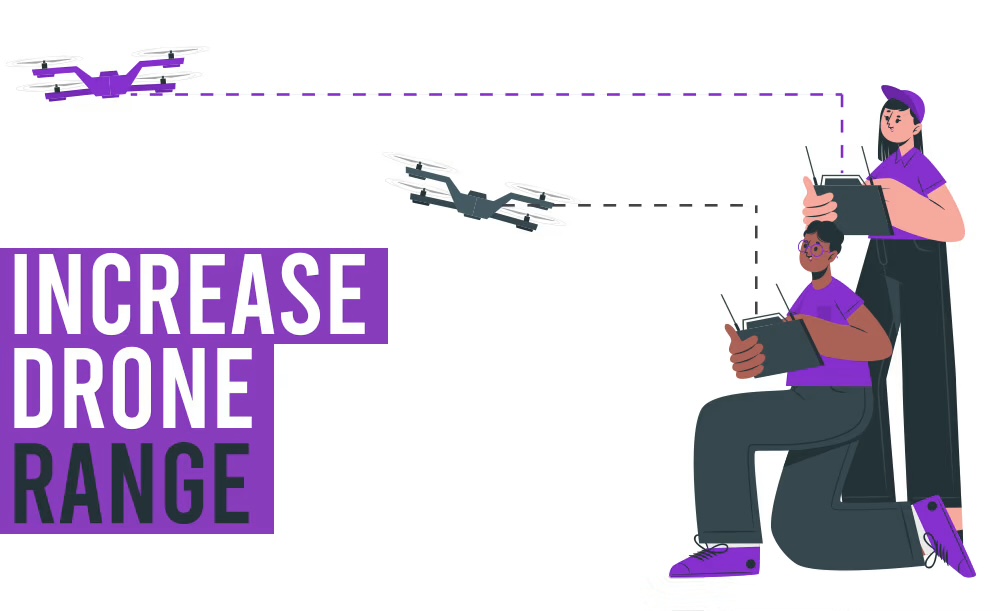
Part 107 commercial pilots can also use visual observers to extend effective range. With a spotter, one pilot can keep eyes on the drone while the other manages the camera. This is common for professional cinematography over large areas. Both pilots must still maintain combined VLOS of the aircraft.
Warning: Flying beyond visual line of sight without an FAA BVLOS waiver is a federal violation under Part 107 and recreational rules. The FAA has used video evidence (posted to social media by the pilot) to build enforcement cases. Real-world range of your drone does not determine legal range.
What Reduces Range in the Field
Antenna orientation, interference sources, and obstacle position are the three biggest variables in real-world range. Proper controller positioning alone can double usable range.
Several factors consistently reduce practical range below what the spec suggests.
Interference sources
The 2.4 GHz and 5.8 GHz bands used by most consumer drones overlap with Wi-Fi routers, Bluetooth devices, and other RC equipment. In a dense urban area, the drone's radio competes with dozens of overlapping signals. Flying in parks away from buildings helps significantly. Airports and areas with radar can also cause interference with 2.4 GHz systems.
Controller antenna orientation
Most RC controllers use flat panel antennas that transmit strongest in a specific direction. For DJI controllers with the RC 2 or RC-N1, the flat face of the antenna should face the drone, not point at it edge-on. Many pilots unknowingly hold their controllers so the antennas point toward the drone rather than face it, reducing signal strength at range.
Obstacles
Buildings, trees, and hills reduce signal even without blocking line of sight completely. A tree between the controller and drone absorbs some of the radio signal. For best range, maintain true unobstructed line of sight to the drone from the controller position. Moving laterally to find a clear corridor matters at the edge of range.
Altitude
Flying higher (within legal limits) often improves range because the drone clears more obstacles and interference sources. A drone at 100 meters altitude has fewer obstructions between it and the controller than one flying at 20 meters through a neighborhood. This is one reason range tests are typically conducted at altitude.
Tip: If you experience video dropout regularly, check your drone's signal bar in the app during flight. Signal typically degrades gradually. If it drops sharply the moment you pass behind a specific object (a building, a stand of trees), that object is your practical range limiter, not the spec sheet. Repositioning to avoid that obstacle restores full signal.
Range by Drone Category: What to Expect
Here is a realistic range guide by drone category for typical suburban flying conditions, not marketing specs:
Category
Spec Range
Typical Real-World
Example
Toy / budget (Wi-Fi)
0.1-0.5 km
100-300 m
Holy Stone HS110D
Sub-250g GPS (DJI O4)
10-20 km
1-3 km
DJI Mini 4 Pro
Mid-range camera (DJI O4+)
20-30 km
2-4 km
DJI Mavic 4 Pro
HoverAir (Bluetooth/Wi-Fi)
30-100 m
20-80 m
HoverAir X1
Long-range FPV (ExpressLRS)
10+ km
5-15 km
Custom FPV builds
The HoverAir exception
The HoverAir X1 and similar self-flying drones use Bluetooth or close-range Wi-Fi as their control link because they are designed to stay within arm's reach or a few dozen meters. They are not long-range drones. The range spec is intentionally short because the product is designed for close-in automated shots, not distance flying.
Tip: For most photographers and videographers, range is not the limiting factor. Battery life, VLOS requirements, and composition needs will determine how far you fly long before the transmission system reaches its limit. If you are regularly hitting signal issues at 500 meters, the problem is usually local interference, not your drone's spec ceiling.
FAQ
The DJI Mini 4 Pro is rated at 20 km under FCC conditions in open air with no interference. Real-world range in suburban conditions with Wi-Fi interference is typically 1-3 km before signal degradation begins. The legal limit in most cases is your visual line of sight, which for most people is 400-600 meters of reliable tracking.
Visual line of sight (VLOS) is the FAA requirement that you maintain unaided visual contact with your drone at all times. It exists so you can detect conflicts with manned aircraft and respond. Most people lose reliable visual tracking at 400-600 meters. Flying beyond that without a visual observer or FAA BVLOS waiver is a federal violation, regardless of how far your drone can technically fly.
The main factors are Wi-Fi and Bluetooth interference in the 2.4/5.8 GHz bands, obstacles between the controller and drone (buildings, trees, hills), incorrect controller antenna orientation, and FCC vs CE regulatory mode. Urban environments with dense Wi-Fi can reduce a 20 km spec drone to 500-800 meters of reliable operation.
Yes. FCC mode (used in the US) allows higher radio transmit power than CE mode (required in Europe and some other regions). The same drone hardware will achieve longer range in FCC mode. DJI drones purchased in the US are configured for FCC mode. European models use CE mode with lower power limits set by regulation.
Not without an FAA waiver for recreational flying or a Part 107 BVLOS authorization for commercial operations. Beyond VLOS flight requires demonstrating a safety case and operational procedures to the FAA. Consumer drones occasionally fly BVLOS in authorized test corridors, but this is not available to general recreational pilots.
The spec is measured in ideal conditions: open area, FCC mode, no interference. Wi-Fi from nearby routers, other RC equipment on the same frequencies, buildings blocking line of sight, or holding the controller with antennas pointing at the drone (instead of facing it) all reduce signal at shorter distances. Check your local interference environment and antenna orientation first.
Fly in open areas away from buildings and Wi-Fi sources. Keep the controller antennas facing the drone (flat face toward it, not edge-on). Fly at higher altitude to clear obstacles. Use FCC mode if you purchased in the US. Avoid flying directly after sunrise when ionospheric conditions can occasionally affect 2.4 GHz signals. Adding range extenders (signal boosters) shows mixed results with DJI systems and can interfere with automatic frequency switching.
Paul Posea founded Dronesgator in 2015 and has been reviewing consumer drones for over a decade. With 195 YouTube drone reviews drawing 3.55 million views and published work on Digital Photography School, he combines hands-on flight testing with data-driven analysis to help pilots find the right drone.
Marcus Taylor is a UK CAA certified drone pilot and owner of Deployed Consultancy Ltd. With 6 years of commercial experience spanning UN site surveys in West Africa, aerial photography across Europe, Africa, and Japan, and defence consulting, he verifies the technical accuracy of Dronesgator's drone reviews and guides.