Consumer camera drones max out at around 35-49 mph in Sport mode. Racing FPV drones built specifically for speed can exceed 100 mph in competition, and modified record-attempt drones have broken 160 mph. These two categories share the word drone and almost nothing else.
For anyone flying a DJI Mini, Air series, Mavic, or HoverAir, the spec sheet top speed is a Sport mode number. Normal mode is significantly slower. Cine mode is slower still. Most flying happens at well under half the advertised maximum, which is why the number on the box rarely reflects what the drone actually does in practice.
This guide covers what the speed ratings mean across flight modes, what physically determines how fast a drone can fly, how consumer and racing drone speeds compare, and whether speed actually matters for the type of flying most people do.
Consumer Drone Speeds: Normal, Cine, and Sport Mode
The advertised top speed applies only in Sport mode. Normal and Cine modes are significantly slower by design, trading speed for smoother footage.
Every consumer drone has at least two flight modes, and the spec sheet maximum refers to the fastest one. Most pilots spend most of their time in the slowest.
Drone
Normal Mode
Cine Mode
Sport Mode
Weight
DJI Mini 3
10 m/s (22 mph)
2 m/s (4 mph)
16 m/s (36 mph)
248g
DJI Mini 4 Pro
10 m/s (22 mph)
2 m/s (4 mph)
16 m/s (36 mph)
249g
DJI Mini 5 Pro
10 m/s (22 mph)
2 m/s (4 mph)
18 m/s (40 mph)
299g
DJI Air 3S
10 m/s (22 mph)
3 m/s (7 mph)
21 m/s (47 mph)
723g
DJI Mavic 4 Pro
10 m/s (22 mph)
3 m/s (7 mph)
22 m/s (49 mph)
1063g
DJI Neo
8 m/s (18 mph)
,
15 m/s (34 mph)
135g
What Cine mode actually does
Cine mode caps speed at around 2-3 m/s (4-7 mph) and softens control sensitivity. Every input is slowed down: takeoff, turns, forward flight, and braking all happen more gently than in Normal mode. The purpose isn't to limit what pilots can do but to make smooth, gradual movements easier to execute without precise stick control.
For cinematic video work, footage shot in Cine mode is visibly more polished than Normal mode footage at equivalent camera settings. The low speed and soft inputs remove the jerky start-stop motion that even experienced pilots struggle to eliminate in faster modes.
Sport mode trade-offs
Sport mode unlocks the hardware speed ceiling, but removes two things in exchange:
Obstacle avoidance is disabled on all DJI consumer drones in Sport mode. The flight controller ignores sensor data in this mode.
Return to Home behavior changes: with obstacle avoidance off, RTH in Sport mode will fly a direct line without avoiding obstacles on the path.
Sport mode is genuinely useful for tracking fast-moving subjects (cars, boats, athletes) and for fighting strong headwinds. It's not for casual flying near trees, structures, or other obstacles.
Note: DJI drones registered under EU/CE regulation have lower Sport mode limits than FCC-region (US) drones. A Mini 4 Pro purchased in Europe may top out at a lower speed than the same model purchased in the US. The limit is set by firmware at initialization and is not user-adjustable.
What Physically Determines Drone Speed
Motor power, propeller design, total weight, and aerodynamic frame shape all contribute to top speed. Most consumer drones are electronically limited well below their hardware maximum.
Four variables determine how fast a multirotor can physically fly: motor power, propeller design, total weight, and aerodynamics. Consumer camera drones are optimized for stable footage, not speed, so they're typically governed below their hardware ceiling.
Motor KV rating
Brushless motors are rated by their KV value, the number of RPM per volt applied. Higher KV motors spin faster and suit lighter, speed-focused builds. Lower KV motors spin large propellers slowly with more torque, favoring lift efficiency and stability. Consumer camera drones use lower-KV motors optimized for smooth hover and gradual acceleration, not maximum velocity.
Propeller design
Propeller pitch determines how much air is moved per rotation. Higher-pitch propellers accelerate the drone faster and achieve higher top speeds but are less efficient at hover. Lower-pitch propellers are efficient for hovering and slow flight but limit top speed. Consumer drones use propellers balanced for hover endurance. Racing drones use aggressive high-pitch propellers that sacrifice hover efficiency for speed.
Weight
A lighter drone needs less thrust to accelerate and can reach higher speed with smaller motors. The DJI Mini 4 Pro (249g) reaches 36 mph partly because it's light. The Mavic 4 Pro reaches 49 mph because its much more powerful motors can overcome a frame that's four times heavier. Racing drones strip out cameras, gimbals, GPS modules, and obstacle avoidance hardware specifically to reduce weight.
FPV Racing Drones: A Different Category Entirely
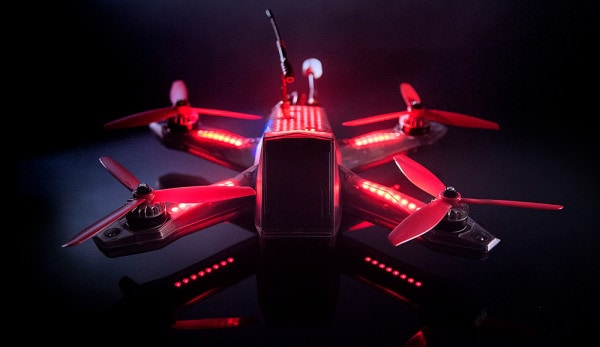
Drone Racing League aircraft reach 80-100 mph in competition. They have no camera gimbal, no GPS, no obstacle avoidance, and no automated flight modes.
FPV racing drones and consumer camera drones share the basic multirotor concept. Everything else is different.
What racing drones remove
Racing drones are stripped of every system that consumer drones depend on:
No GPS stabilization (flown in ATTI/manual mode only)
No obstacle avoidance
No camera gimbal or stabilization
No automated flight modes (no RTH, no position hold)
No built-in speed governors
The pilot flies entirely manually through FPV goggles, reacting to video feed in real time. This demands significant skill but removes the computational overhead and weight that limit consumer drone speed.
Speed figures for context
Competitive FPV racing drones used in organized leagues reach 80-100 mph in race conditions on closed courses. Purpose-built speed record machines, stripped to minimum weight with maximum motor power, have officially exceeded 160 mph. The record holder at the time of writing was a custom build created specifically for the record attempt, not a commercially available product.
The DJI Avata 2 sits between these categories: it's a consumer FPV drone with some stabilization and safety features, reaching about 60 mph in manual mode. Faster than any camera drone, but not a racing drone.
Tip: If you want to experience FPV flying without the racing drone learning curve, the DJI Avata 2 or the original DJI FPV drone offer a much more accessible entry point. They include stabilization modes that make manual flight less punishing for beginners while still delivering significantly higher speed than camera drones.
Does Drone Speed Matter for Filming?
For most aerial photography and video work, the answer is no. The modes where speed is available are the modes where footage quality drops.
When speed does matter
There are genuine use cases for higher drone speed:
Tracking fast subjects. Cars on a race track, boats, mountain bikers on downhill trails. If the subject moves at 30+ mph, you need Sport mode to keep up.
Reveal shots. A fast fly-through or dramatic push toward a subject requires more speed than Normal mode allows.
Fighting headwinds. In 20+ mph wind, Normal mode may not be fast enough to hold a straight flight line. Sport mode gives more authority over flight path.
Covering large areas efficiently. Inspection work or survey flights benefit from faster transit between points.
When speed hurts footage
Fast movement introduces several footage problems even with gimbal stabilization:
Rolling shutter distortion becomes visible at high speed, creating a jello-like warping in the video
The drone's drag-compensating lean shows in wide shots, making the horizon appear tilted
Sudden direction changes at speed cause gimbal lag and brief instability
Any vibration in the frame at high speed is magnified into visible wobble
Professional drone filmmakers typically fly slower than they could, using the speed headroom to respond to moving subjects or wind rather than to maximize how fast the drone physically travels.
FAA Speed Rules and Line-of-Sight Limits
The FAA does not set a specific numerical speed limit for drones in most airspace. Part 107 requires operations without creating a hazard to other aircraft or people on the ground, but there's no posted speed limit the way there is for altitude.
The practical speed ceiling: visual line of sight
The real speed limit is how fast you can fly while still tracking the drone with your unaided eyes. At 40+ mph over any distance, most consumer drones become difficult to track visually. At 200 meters and 45 mph, the drone is a moving speck. Maintaining VLOS, a legal requirement for both recreational and Part 107 pilots, becomes genuinely difficult and eventually impossible as speed increases.
This is the ceiling most pilots hit before the hardware ceiling. The drone can go faster. The pilot cannot see it clearly enough to maintain legal visual contact.
Sport mode and controlled airspace
Using Sport mode doesn't create any separate legal issue in terms of speed. The relevant rules remain the same: stay within VLOS, respect altitude limits, and hold any required airspace authorization. The fact that obstacle avoidance is disabled in Sport mode is a safety consideration, not a regulatory one. Pilots are responsible for collision avoidance with or without sensor assistance.
Tip: If you're flying Sport mode for tracking shots, pre-survey the entire flight path at slow speed first. Mark any obstacles mentally or on a planning app. Running Sport mode through an area you haven't scouted, with obstacle avoidance disabled, is one of the most common scenarios for drone collisions.
FAQ
The DJI Mini 4 Pro reaches 16 m/s (about 36 mph) in Sport mode under FCC (US) regulation. In Normal mode it's limited to 10 m/s (22 mph). Cine mode reduces that further to around 2 m/s (4 mph) for smooth footage. Note that Sport mode disables obstacle avoidance, so it's used selectively in surveyed areas without obstacles.
Among mainstream consumer camera drones, the DJI Mavic 4 Pro leads at 22 m/s (about 49 mph) in Sport mode, followed by the Air 3S at 21 m/s (47 mph). For FPV-style consumer drones, the DJI Avata 2 reaches around 60 mph in manual mode. Purpose-built racing drones far exceed these figures but are not mass-market consumer products.
Competitive FPV racing drones in organized events like the Drone Racing League reach 80-100 mph during races. Purpose-built speed record machines have exceeded 160 mph in controlled attempts. These are custom-built frames with no camera systems, no GPS, and no safety features, not commercially available products. The DJI Avata 2, as a consumer FPV drone, reaches about 60 mph.
Yes, on all DJI consumer drones. Sport mode disables obstacle avoidance because reacting to obstacles at Sport mode speed would cause abrupt maneuvers more dangerous than the obstacle itself. The sensors may remain active but the flight controller ignores them. Always pre-survey any Sport mode flight path for obstacles and never fly Sport mode near people, structures, or power lines without a clear, surveyed corridor.
No specific numerical speed limit exists in FAA Part 107 or recreational rules for most operations. The practical limit is set by the VLOS requirement: you must maintain unaided visual contact with the drone at all times. At 40+ mph over any meaningful distance, visual tracking becomes difficult. This is the ceiling most pilots hit before the hardware ceiling.
The spec sheet speed applies to Sport mode in calm conditions flying in a straight line. Normal mode is limited to around 22 mph on most DJI drones. Cine mode is even slower. Headwind reduces achievable speed further. If you want to approach spec speed, you need Sport mode, no headwind, and a clear straight-line path.
Not without voiding the warranty and likely violating safety rules. Consumer drone speed limits are set in firmware by territory. Third-party firmware modifications that remove speed governors also remove safety features: GPS stabilization, obstacle avoidance, and automated modes often break. If you want a faster flying experience, the right path is moving to FPV platforms designed for it, like the DJI Avata 2 or a purpose-built FPV quad.
Paul Posea founded Dronesgator in 2015 and has been reviewing consumer drones for over a decade. With 195 YouTube drone reviews drawing 3.55 million views and published work on Digital Photography School, he combines hands-on flight testing with data-driven analysis to help pilots find the right drone.
Marcus Taylor is a UK CAA certified drone pilot and owner of Deployed Consultancy Ltd. With 6 years of commercial experience spanning UN site surveys in West Africa, aerial photography across Europe, Africa, and Japan, and defence consulting, he verifies the technical accuracy of Dronesgator's drone reviews and guides.