• Find My Drone

How to Choose a Drone Propeller: Size, Pitch, Material, and Brand

Updated

By Paul Posea

How to Choose a Drone Propeller: Size, Pitch, Material, and Brand - drone reviews and comparison

Drone Propeller Size: How to Match Diameter to Your Frame

Drone propeller notation and size system explained
Prop diameter is always the first number in the notation. Frame class determines maximum diameter.

Frame Class Determines Maximum Prop Size

Prop diameter is not a free variable for FPV builds. The frame sets the maximum diameter the props can spin without hitting each other or the frame arms. Exceeding this limit causes prop strike damage on the first aggressive maneuver.

Frame ClassMax Prop DiameterCommon Use Cases
Tiny whoop (ducted)1.6" - 2.5"Indoor, close-range, micro FPV
3" micro3"Outdoor micro, travel FPV
5" freestyle / racing5"Most popular FPV class; general use
7" long range7"Efficiency builds, extended range
10"+ consumer camera8" - 10"DJI Mavic, Air, large camera platforms

How Diameter Affects Performance

Larger diameter props move more air per revolution. This means more thrust at lower RPM, which translates to better efficiency and longer flight times. A 7-inch prop on a 1700 KV motor will fly longer than a 5-inch prop on the same motor at the same battery voltage, because the larger disc sweeps more air with each rotation and does not need to spin as fast to generate the same lift.

The tradeoff is that larger props are heavier and have more rotational inertia. The drone feels heavier on the sticks and cannot change direction as quickly. For long-range efficiency builds, this is acceptable. For freestyle, where fast direction changes define the flying style, smaller faster-spinning props are preferred.

Consumer Camera Drones: Diameter Is Fixed

For DJI Mini 4 Pro, DJI Air 3S, DJI Mavic 4 Pro, and similar ready-to-fly camera drones, the prop diameter is set by the manufacturer. You cannot install a different size. Your only choice is OEM replacement props or compatible aftermarket props that fit the same quick-release hub. The full selection framework below applies only to FPV and DIY builds.

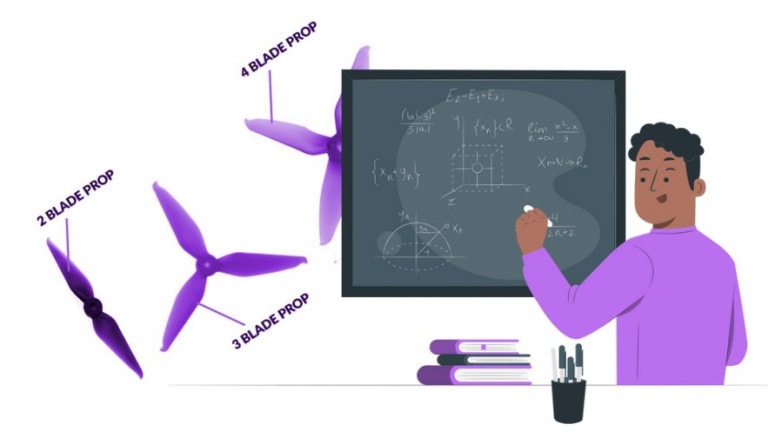
Drone Propeller Blade Count: 2, 3, and 4 Blades Compared

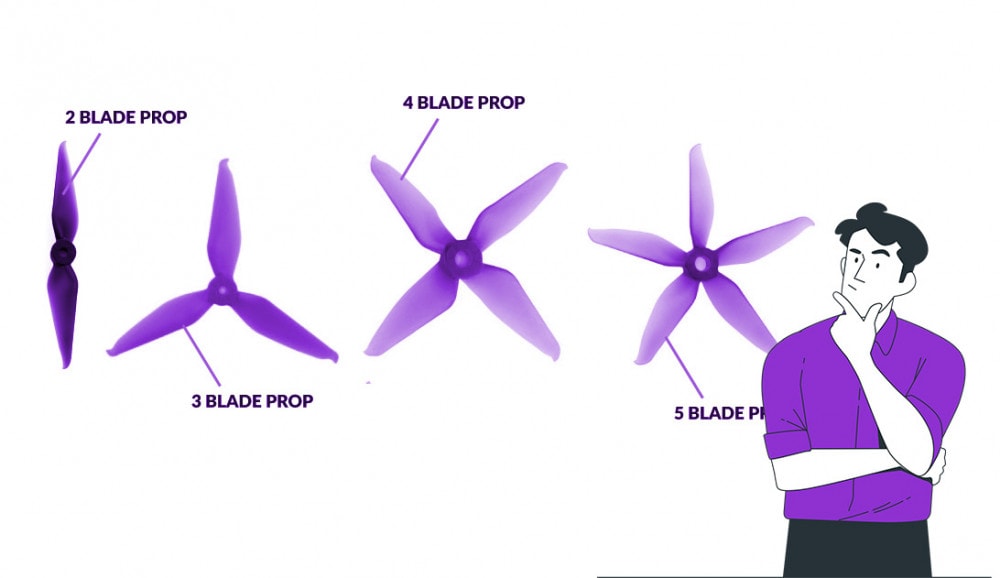
Drone propeller blade count comparison 2 3 and 4 blades
Blade count is a tradeoff between efficiency (2-blade) and thrust density (4-blade)

The Core Trade-Off

Adding blades is a way to increase thrust without increasing diameter. A 4-blade prop moves more air per revolution than a 2-blade prop of the same diameter, but it also draws more power to do it. The efficiency drops with each added blade because the blades increasingly operate in each other's airflow disruption.

Blade CountRelative ThrustEfficiencyNoiseBest Use
2-blade (bi-blade)LowestHighestLowestLong-range, aerial photography, efficiency builds
3-blade (tri-blade)Medium (+10-15% vs 2-blade)GoodModerateFreestyle FPV, racing, general use
4-blade (quad-blade)HighestLowestHighestCinewhoops, micro builds where large diameter is not possible

Why 3-Blade Is the Default for Most Pilots

3-blade props are the most popular choice for 5-inch FPV builds because they balance thrust and efficiency without the noise and power draw of 4-blade alternatives. For the same diameter, a 3-blade prop provides about 10-15% more thrust than a 2-blade prop while drawing roughly 10% more power. Most pilots accept that tradeoff.

For cinewhoops, the calculation changes. The ducted frame limits diameter, so more blades are needed to move adequate air through the constrained prop disc. A 2.5-inch, 4-blade cinewhoop prop generates more thrust in that limited space than a 2-blade could at the same diameter.

CW and CCW: The Critical Rotation Direction

Every prop set includes CW (clockwise) and CCW (counter-clockwise) variants. On a quadcopter, two motors spin CW and two spin CCW to cancel yaw torque. You must install the correct rotation direction on each motor position or the drone flips immediately at throttle-up.

Warning: Installing a CW prop on a CCW motor does not cause a slow drift. It causes an instant uncontrolled flip at takeoff. Always verify rotation direction before your first flight with any new prop set. DJI consumer drones mark props A and B, with matching marks on the motors. FPV props are usually marked with an arrow or a "R" for reversed (CCW).

Drone Propeller Materials: Nylon, Carbon Fiber, and What to Pick

Material Trade-Off Summary

MaterialDurabilityCrash BehaviorPerformancePriceBest For
ABS / Nylon (polypropylene)Low-mediumFlexes, may surviveBaselineCheapestBeginners, indoor, budget builds
Polycarbonate (PC)Medium-highFlexes then breaks cleanlyGoodMidFreestyle, general FPV; recommended default
Glass fiber reinforcedHighLess flex, cracks on hard impactBetterMid-highAll-climate, cold weather flying
Carbon fiber (CF)Very high (but brittle)Shatters, sharp fragmentsBestExpensiveRacing; not recommended for beginners

Why Polycarbonate Is the Default Recommendation

Polycarbonate props absorb impact energy through controlled flex before fracturing. When they do break, they break cleanly without producing sharp shards. For a beginner who crashes often, polycarbonate means fewer injuries during prop changes and better crash recovery odds. ABS is cheaper but gets brittle in cold temperatures, which matters if you fly in winter.

The Carbon Fiber Warning

Carbon fiber props are stiffer and lighter than any plastic alternative, which reduces vibration and improves responsiveness. But they shatter on impact, producing sharp razor-edged fragments that can damage motor windings, cut other components, and cause injury. At 15,000-25,000 RPM, a shattering CF prop is not a trivial event. Reserve carbon fiber for racing builds where controlled conditions and safety equipment are standard. For freestyle or outdoor recreational flying, polycarbonate is the better choice even if you lose a small amount of performance.

Tip: For cold weather flying (below 40°F / 4°C), ABS and standard nylon props become brittle and more prone to cracking on impact. Switch to polycarbonate or glass-fiber reinforced props for winter sessions.

Choosing a Drone Propeller: FPV Brand Recommendations

Top FPV Prop Brands for 2026

These brands dominate the FPV aftermarket and have reliable quality control. The FPV prop market is large enough that a few bad-batch issues get surfaced quickly in community forums, so established brands are safer than unknown sellers.

  • HQProp (HQ): Widest selection, consistent quality, reasonable price. The HQ5x4.3x3 is the benchmark freestyle prop in 2025 and a solid starting point for any 5-inch build.
  • Gemfan: Performance-oriented, popular for racing and freestyle. The Gemfan 51477 is widely used and recommended. Slightly stiffer than HQ at equivalent price.
  • DAL (Drone Air Lab): Markets a "Hurricane" line designed to survive more crashes. Good choice for beginners in freestyle who want to reduce replacement frequency.
  • T-Motor: Premium pricing, preferred by competitive racers. Not necessary for recreational flying.
  • Ethix: Mid-range performance, popular in the freestyle community. Good balance of responsiveness and durability.

Motor KV and Prop Matching

This is the most technically important factor beginners skip. Motor KV (revolutions per minute per volt) determines what prop size and pitch the motor can efficiently spin. Using the wrong combination leads to motor overheating, inefficiency, and shortened motor life.

Motor KVRecommended PropTypical Build
1300-1700 KV7" - 10" props, low-to-high pitchLong-range, 7" efficiency builds
1900-2200 KV5" props, 4.0-4.5" pitchStandard 5" freestyle / racing
2300-2600 KV5" props, 3.5-4.0" pitchHigh-RPM racing, 5" speed builds
2600+ KV3" props, 1.5-2.5" pitchMicro FPV, cinewhoops

Always check the motor manufacturer's recommended prop range. It is usually listed on the motor product page and takes the guesswork out of matching. If you cannot find it, check community builds on GetFPV or Oscar Liang's build guides for your specific motor.

Thrust-to-weight ratio (TWR) and prop selection: Before choosing pitch and diameter, know your total flying weight (drone + battery in grams) and your target TWR: 2.0 for casual flying, 3.0 for freestyle, 4.0-5.0+ for racing. Each motor must produce enough thrust to hit that ratio. Check the motor manufacturer's thrust table at your battery voltage to verify your prop choice reaches your target before buying a full prop set.

How to Choose Propellers for Consumer Camera Drones

OEM vs. Aftermarket for DJI Drones

DJI prop naming decoded: DJI consumer props encode diameter and pitch in the first four digits. "9450S" = 9.4-inch diameter, 5.0-inch pitch, self-tightening. "8330F" = 8.3-inch diameter, 3.0-inch pitch, foldable. The trailing letter indicates mounting type (S = self-tighten, F = foldable quick-release). Find your drone's specific prop model in the DJI spec sheet to identify the correct replacement.

If you fly a DJI Mini 4 Pro, DJI Air 3S, DJI Mavic 4 Pro, or any other consumer ready-to-fly drone, your prop selection is limited to the OEM quick-release format the drone shipped with. The full FPV selection framework does not apply. What you are choosing between is OEM DJI props and compatible aftermarket replacements.

OptionCost (per set)Vibration RiskNoiseBest For
DJI OEM Props$15-40None (matched to specs)LowestCommercial operators, warranty concerns
Freewell / Startrc aftermarket$10-15Low-moderate (some variance)Slightly higherRecreational pilots who crash frequently

When Aftermarket Props Cause Problems

Some aftermarket props for DJI drones trigger the motor vibration sensor and generate in-app warnings. DJI's Fly app monitors motor RPM consistency. If an aftermarket prop is slightly unbalanced compared to OEM tolerances, the app may display an error. This does not always happen, and some aftermarket props are fine, but it is a known risk. For commercial Part 107 work where flight logs matter, OEM is safer.

The Matched-Set Rule for Consumer Drones

DJI consumer drones use marked props: A and B (or colored indicators) that match to marked motor positions. If you replace only one damaged prop, you risk putting an A prop on a B motor if you are not careful. Always replace as a complete set of four and verify A props go on A motors (clockwise rotation on DJI quads).

For DJI drones: the right answer for most situations is OEM props. The $10-15 savings from aftermarket props is not worth the risk of motor warnings during a commercial shoot or the vibration it adds to footage.

Common Prop Selection Mistakes

  • Installing CW on CCW motor (instant flip on throttle-up)
  • Buying carbon fiber props as a first set (expensive and dangerous on crashes)
  • Over-propping a motor (too large diameter or too high pitch for the KV rating)
  • Using only one new prop among old ones (creates asymmetric thrust and vibration)
  • Ignoring prop balance (even a minor imbalance causes video vibration)
  • For consumer drones: buying aftermarket props without checking community reports for your specific model

FAQ

For FPV and DIY builds: start with the diameter your frame allows, match pitch to your flying style (low pitch for cinematic and freestyle, medium-high for racing), choose 3-blade as the default unless you have a reason for 2 or 4, and pick polycarbonate material unless you are racing. For consumer drones (DJI, Autel): buy OEM replacement props that match your model. There is no other meaningful choice for ready-to-fly camera drones.

Yes, significantly. The wrong prop size for your motor KV can cause overheating and motor failure. Installing a CW prop on a CCW motor causes an instant crash. Choosing the wrong pitch for your flying style makes the drone feel sluggish or uncontrollable. For consumer drones, using incompatible aftermarket props can trigger motor vibration warnings.

The HQ5x4.3x3 (HQProp 5-inch, 4.3-inch pitch, 3 blades) is the most widely recommended freestyle prop for standard 5-inch builds as of 2025. The Gemfan 51477 is also popular. Both hit the sweet spot of responsiveness and thrust for motors in the 1900-2300 KV range. Start with either and adjust pitch up or down based on how the drone feels.

For most FPV flying: 3-blade. They provide about 10-15% more thrust than 2-blade at the same diameter for about 10% more power draw. For long-range efficiency builds where maximizing flight time matters more than thrust: 2-blade. For cinewhoops where frame space limits diameter: 4-blade.

No. DJI consumer drones use proprietary quick-release push-fit hubs. Carbon fiber aftermarket props in this format are available from some third-party brands, but DJI does not recommend them. Carbon fiber props shatter on impact rather than flexing, which can damage motor windings and cause injury. OEM DJI props or quality polycarbonate aftermarket props are safer.

The consequences range from performance loss to immediate crash depending on the error. Installing CW on CCW motor causes an instant flip on takeoff. Using too-large props for the motor KV causes overheating and potential motor burnout over time. Using unbalanced aftermarket props causes video vibration. Using the right size but wrong pitch wastes motor efficiency for your flying style.

For FPV builds: yes, it is worth checking. Manufacturing variation means some props from the same batch are slightly unbalanced. A $10-20 prop balancer can identify and correct this with a strip of tape. For DJI consumer drones: no. OEM props are already balanced to tolerances appropriate for gimbal-stabilized camera drones, and the gimbal handles residual vibration.

Avoid unknown no-name brands from generic Amazon or AliExpress listings with no community verification. The FPV community surfaces quality issues quickly on forums and YouTube. Stick to HQProp, Gemfan, DAL, T-Motor, or Ethix for FPV. These are all available through GetFPV, RaceDayQuads, or Pyrodrone. For consumer drones: buy through DJI's official store or an authorized reseller to avoid counterfeits.

Paul Posea

Paul Posea

Author · Dronesgator

Paul Posea is the founder of Dronesgator and has been reviewing and comparing drones since 2015. With a Part 107 certification, 195 YouTube drone reviews, and published work on Digital Photography School, he combines hands-on flight testing with data-driven analysis to help pilots find the right drone.