• Find My Drone

How to Make Your Drone Quieter: 7 Noise Reduction Techniques

Updated

By Paul Posea

How to Make Your Drone Quieter: 7 Noise Reduction Techniques - drone reviews and comparison

Why Drones Are Loud and How Quiet You Can Get

70-90 dBConsumer drone at hover
6 dBMavic Platinum prop reduction
55 dBLarge quad at 100 ft altitude

The Four Sources of Drone Noise

Drone noise comes from four sources, each requiring a different fix:

  • Blade tip vortices: Air curls from the high-pressure underside to the low-pressure topside at the prop tip, creating turbulence. This is the dominant noise source and what low-noise propeller designs address.
  • Blade passage frequency: Each blade passing creates a pressure pulse. Four props, each with two blades, at 8,000 RPM creates a high-pitched tone at roughly 533 Hz, the characteristic drone whine.
  • ESC motor buzz: Standard square-wave ESC signals create an electrical switching noise that transmits through the motor and frame. Sinusoidal (FOC) ESCs eliminate most of this.
  • Frame resonance: An unbalanced propeller vibrates the entire frame, amplifying all other noise sources. Balancing props reduces this substantially.

Realistic Noise Reduction Targets

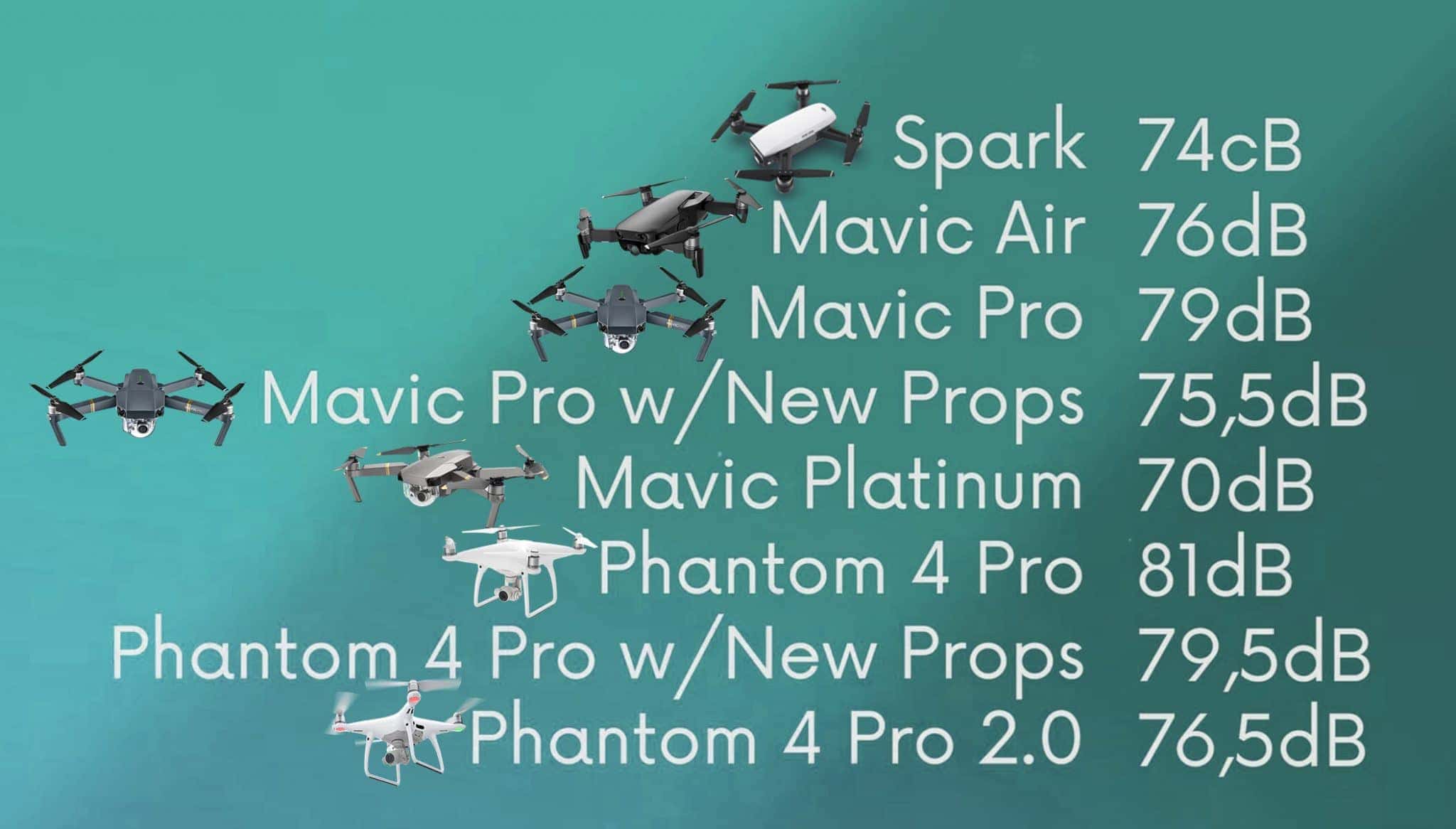
DJI drone noise levels comparison chart in decibels
Measured noise levels across DJI drone models at hover distance

Real-world noise reduction through DIY techniques is meaningful but bounded. Independent testing of consumer drone propeller swaps shows:

TechniquedB ReductionPerceived Effect
Low-noise prop upgrade3-6 dBNoticeably quieter
FOC/sinusoidal ESCUp to 11 dB (with prop swap)Significantly quieter
Propeller balancing1-3 dBSlight improvement + less vibration
Flying 30m higher~6 dB at ground levelDrone nearly inaudible from below
Propeller shroud/duct1-4 dB (varies)Small improvement
Note: Every 6 dB reduction halves the sound intensity. A 12 dB reduction feels roughly four times quieter to the human ear. The combination of a prop upgrade plus ESC sinusoidal mode on compatible drones can approach this range.

Brushed vs Brushless Motors: The Budget Drone Exception

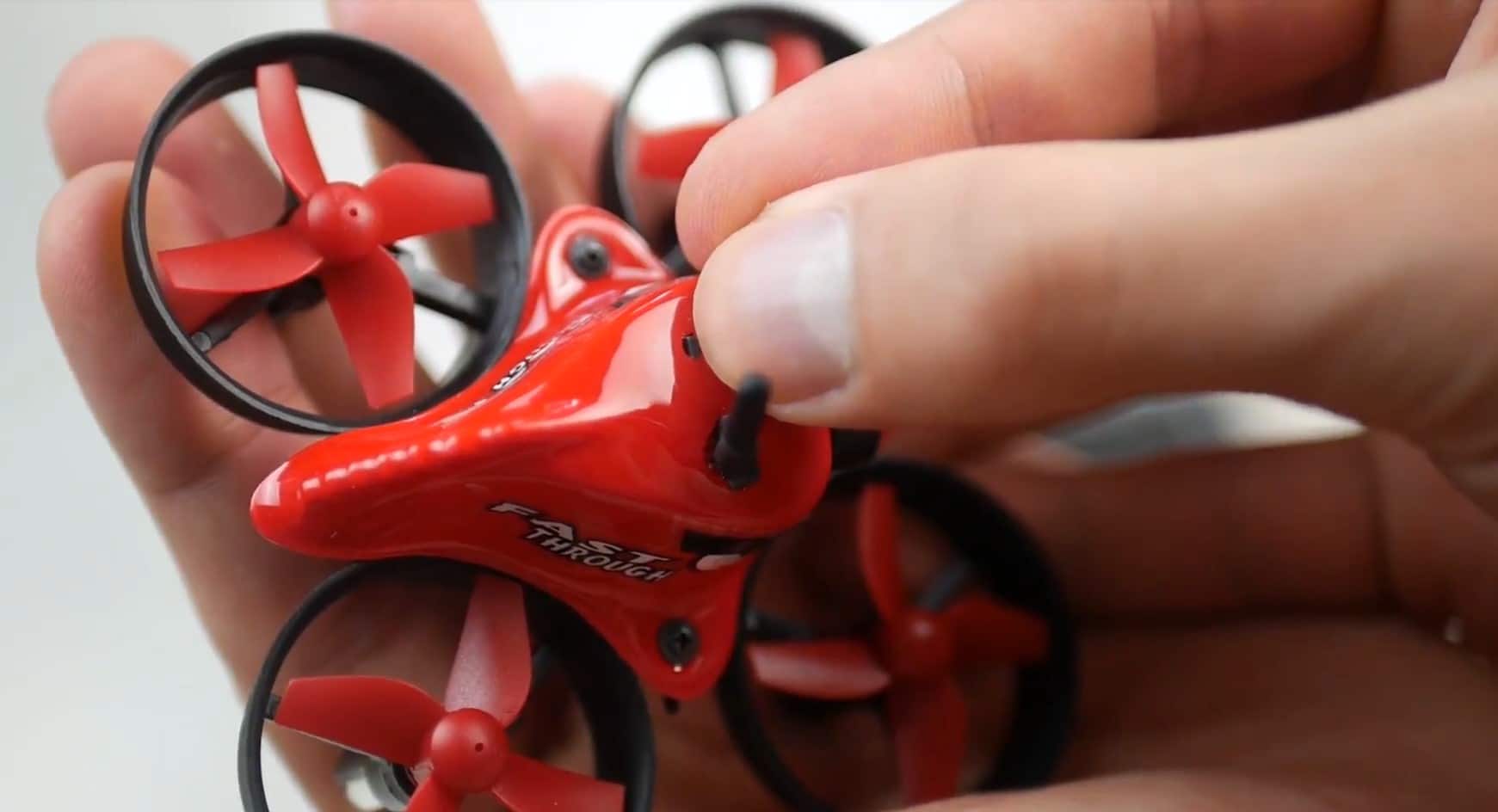
GPS camera drones use brushless motors, which are mechanically quiet by design. Toy drones under $100 often use brushed motors, which generate additional electrical noise through physical contact between brushes and the commutator ring. A brushed-motor toy drone can be louder than a heavier GPS drone despite having much smaller propellers because the motor itself is a significant noise source.

This distinction matters if you are comparing noise levels across drone categories. Upgrading props on a brushed-motor drone will reduce aerodynamic noise but won't touch the motor noise, which is the dominant source. Switching to a brushless motor platform is the only fix for this category.

Quieter Drone Propellers: The Biggest Single Improvement

What Makes a Propeller Quiet

Low-noise propellers reduce tip vortex turbulence through three design changes compared to standard props:

  • Swept or tapered tips: Narrowing the blade tip reduces the pressure differential that generates vortex noise. DJI's 8331 low-noise props for the Mavic Pro use a swept-back tip profile.
  • Lower pitch: A lower pitch prop moves less air per revolution, requiring higher RPM to generate the same lift. This sounds counterproductive, but the noise character of lower-pitch props is less annoying in practice because the tonal frequency shifts down.
  • More blades at lower RPM: Three-blade props at lower RPM can be quieter than two-blade props spinning faster, because lower tip speed reduces vortex noise even with more blade passages per second.

DJI's Low-Noise Propeller Line

DJI sells low-noise propeller sets for most of its models under the designation "Low-Noise Propellers (Part 01)" or similar. The Mavic Pro Platinum was the first consumer drone DJI designed specifically around quiet operation, pairing 8331 props with a sinusoidal FOC ESC to achieve 70 dB measured noise vs the original Mavic Pro's 76 dB.

For current models, DJI's low-noise prop variants are often included in the box at higher performance tiers or sold separately. The improvement is audible and measurable: testing by HalfChrome showed consistent 3.5 dB reductions on the Mavic series with prop swaps alone.

Aftermarket Low-Noise Props

Companies like Master Airscrew and Gemfan produce aftermarket low-noise propellers for popular DJI models. Results are variable and model-dependent. The safe approach is to stick with OEM DJI low-noise variants when available and use aftermarket options only if OEM options do not exist for your specific model.

Tip: Never mix prop types within a diagonal pair. If you upgrade two props to low-noise versions, upgrade the full set of four. Mixed props create asymmetric thrust and increased vibration that undoes the noise benefit.

Propeller Balancing and Maintenance to Reduce Drone Noise

Why Imbalance Amplifies Noise

An unbalanced propeller vibrates at its rotation frequency. On a drone spinning at 8,000 RPM (133 Hz), even a 0.1g imbalance between blades creates a 133 Hz vibration transmitted directly through the motor mount into the frame. The frame acts as a resonance chamber, amplifying the noise. This is why two drones with the same props can sound noticeably different if one has worn or asymmetric blades.

How to Balance a Propeller

Magnetic prop balancers ($10-25) hold the prop hub on a shaft suspended by bearings. An imbalanced prop will rotate to put the heavier blade at the bottom. To balance:

  1. Mount the prop on the balancer shaft.
  2. Let it come to rest. If it consistently settles to one side, that blade is heavier.
  3. Apply small strips of clear tape to the lighter blade, toward the tip, until the prop rests level in any position.
  4. Alternatively, lightly sand the heavier blade's leading edge to remove mass.
Note: DJI factory props are balanced adequately for most purposes. Balancing is most useful for older props that have worn unevenly, aftermarket props, or any prop that has been repaired after minor damage.

Propeller Maintenance for Noise Reduction

Three maintenance habits reduce noise from existing propellers:

  • Clean dirt and mud buildup: Debris on the blade surface disrupts airflow and adds noise. Wipe props with a damp cloth after flying in dusty or wet conditions.
  • Inspect for leading-edge damage: Nicks and chips on the leading edge create turbulence. Even 1mm nicks are worth replacing the prop over, the noise increase is audible.
  • Sand raised manufacturer markings: Some props have raised letters or logos stamped onto the blade surface. These create turbulent separation points. Very light sanding with 600-grit paper to smooth these flush can reduce noise slightly.

Flying Technique and ESC Settings to Quiet Your Drone

The Physics of Altitude and Distance

Drone noise decreases with distance according to the inverse square law: every doubling of distance reduces sound intensity by approximately 6 dB. A drone producing 80 dB at 10 meters produces roughly 74 dB at 20 meters and 68 dB at 40 meters. At 100 meters altitude, the same drone is under 60 dB at ground level, quieter than a normal conversation.

Flying higher is the fastest, cheapest way to make your drone quieter to people on the ground. A 30-meter altitude increase reduces perceived ground-level noise by 6-9 dB with no hardware changes.

Smooth Throttle Inputs

Abrupt throttle changes spike the RPM and the noise profile simultaneously. Aggressive acceleration and rapid descent corrections are the main cause of the loud noise bursts that attract attention. Flying in Cine mode (or Normal mode at moderate speeds) keeps throttle changes gradual. The motors maintain a steadier RPM, which reduces both peak noise and the number of noticeable noise spikes per flight.

FOC Sinusoidal ESC Mode

Standard ESCs use square-wave current switching, which creates a distinctive electrical buzz transmitted through the motor. FOC (Field-Oriented Control) ESCs use sinusoidal current waveforms that more closely match the ideal motor drive signal, reducing the switching noise substantially. DJI incorporated sinusoidal FOC into the Mavic Pro Platinum and subsequent models, this ESC change alone accounted for several dB of the Platinum's noise reduction beyond the prop upgrade.

On DJI drones, there is no user-facing ESC setting to enable or disable sinusoidal mode. It is a hardware feature built into the ESC. For FPV and DIY builds, FOC-capable ESCs are available from BLHeli_32 and AM32 firmware-equipped controllers and can be configured in BLHeli Suite or their equivalents.

The Quietest Drone Choice: Under 250g and Ducted Designs

Lighter Drones Are Inherently Quieter

A lighter drone requires less thrust to maintain hover, which means lower motor RPM and less blade tip velocity. The sub-250g class (DJI Mini 4 Pro at 249g, Mini 5 Pro at 299g) is meaningfully quieter than heavier prosumer drones, all else being equal. The DJI Mini 4 Pro measures around 74 dB at hover vs the DJI Air 3S at approximately 79 dB and the Mavic 4 Pro at 83 dB.

That 9 dB gap between the Mini 4 Pro and Mavic 4 Pro represents a difference in perceived loudness of roughly 3x. If noise is a concern for your use case (real estate, event photography, wildlife), the weight class of the drone matters as much as the propeller choice.

Ducted Propeller Designs

Ducted drone propellers design for noise reduction
Ducted propellers enclose the blade tips, reducing tip vortex noise

Ducted propellers (where the blade tips are enclosed in a cylindrical shroud) reduce tip vortex noise by interrupting the air path that creates the vortex. Research by Dotterel Technologies showed their nanofiber shroud system reduced drone noise by 2-4 dB in standardized testing. The DJI Avata 2 and DJI Neo use ducted designs primarily for crash protection, but the noise reduction is a secondary benefit.

Consumer add-on prop guards (the plastic cage guards sold for DJI Minis) do not reduce noise meaningfully because they are not true ducts, the blade tip clearance is too large for the duct effect to work. Proper noise-reducing shrouds must fit closely to the blade tip diameter.

MIT Toroidal Propeller Research

MIT Lincoln Laboratory published research in 2022 on a toroidal propeller design where two blades loop together into a donut shape, fundamentally altering tip vortex formation. In testing, the toroidal prop was described as appearing only "half as annoying" as a standard prop to listeners, with an acoustic signature closer to a drone flying at twice the distance. The toroidal design has not reached commercial consumer drone applications as of 2026, but it represents the direction manufacturers are heading for next-generation quiet drone designs.

FAQ

Yes, within limits. Upgrading to low-noise propellers reduces measured noise by 3-6 dB, which is noticeable. Combined with a sinusoidal FOC ESC on compatible drones, total reductions of up to 10 dB are achievable. Flying at higher altitude is free and reduces ground-level noise by 6 dB for every doubling of distance. Truly silent drones do not exist at consumer price points.

Sub-250g drones (DJI Mini 4 Pro, Mini 5 Pro) are the quietest consumer options at around 74 dB hover noise. Heavier prosumer drones (Air 3S, Mavic 4 Pro) measure 79-83 dB. Among non-standard designs, ducted drones like the DJI Avata 2 and DJI Neo are quieter per gram of thrust than open-prop designs because the duct reduces tip vortex noise.

Yes. DJI's low-noise propeller upgrades reduce measured noise by 3-6 dB in independent testing. A 6 dB reduction halves the sound intensity and is clearly audible. The difference is most noticeable at close range, a bystander 10 meters away will hear the difference. At 50+ meters altitude, the difference is less significant because ambient noise begins to dominate.

Balancing reduces vibration-induced noise by 1-3 dB and can noticeably reduce the buzzing character of drone noise. It is most effective on older or aftermarket props that may not have been well-balanced from the factory. DJI factory props are adequately balanced, so balancing new OEM props gives minimal additional benefit.

Increased noise from an existing drone usually means propeller wear or damage. A nicked leading edge, a slightly bent blade, or a buildup of debris on the prop surface all increase turbulence and noise. Inspect props before each flight. If visible damage is present, replace the prop. Motor bearing wear can also increase noise over time.

Consumer prop guards (the plastic cage type sold for DJI Mini drones) do not meaningfully reduce noise because the blade-to-shroud gap is too large. True noise-reducing ducts must fit closely around the blade tip diameter. Aftermarket noise-dampening shrouds from companies like Dotterel Technologies show 2-4 dB reduction, but these are not the same as standard prop guards.

Altitude dramatically reduces perceived noise on the ground. Sound follows the inverse square law, every doubling of distance reduces sound intensity by 6 dB. A drone producing 80 dB at 10 meters measures approximately 68 dB at 40 meters and around 60 dB at 100 meters altitude. Flying at legal ceiling (120 meters / 400 feet) brings most drones below the ambient noise floor for most outdoor environments.

Cine mode reduces maximum motor output and enforces slower acceleration curves, which keeps throttle changes smoother and reduces the noise spikes associated with aggressive maneuvers. The hover RPM in Cine mode is similar to Normal mode, so the baseline noise level is comparable. The practical effect is fewer loud moments during flight rather than a lower constant noise level.

Paul Posea

Paul Posea

Author · Dronesgator

Paul Posea is the founder of Dronesgator and has been reviewing and comparing drones since 2015. With a Part 107 certification, 195 YouTube drone reviews, and published work on Digital Photography School, he combines hands-on flight testing with data-driven analysis to help pilots find the right drone.