DroneWatcher App
DroneWatcher is an Android and iOS app that uses the phone's RF receiver to detect the wireless signals that many consumer drones broadcast during flight. It can identify DJI and other manufacturer signals at ranges up to 0.5 miles in clear conditions. The app alerts you to nearby drones and can log flight data. It's not perfect: analog FPV drones and drones in offline mode won't be detected, and urban RF noise can generate false positives.
Binoculars and Night Vision
Regular 7x50 binoculars work well for confirming a drone's identity at 100 to 200 meters. Night vision monoculars (gen 1, $150 to $400) let you see drone body shape in complete darkness. True gen 3 night vision starts at $3,000 and is not needed for casual identification.
IR (infrared) illuminators paired with a night vision device can reveal a drone's body heat from motors at close range, but this is specialist equipment not generally needed for civilian identification.
Professional Detection Systems
Enterprise-grade drone detection systems like DJI AeroScope (used by airports and law enforcement) scan for the remote ID signals drones are now required to broadcast under FAA rules. As of 2024, all drones over 250g must broadcast Remote ID, making them trackable by anyone with the right receiver. Consumer-accessible Remote ID receivers are starting to appear, though they are not yet common.
Note: Under
FAA Remote ID rules (effective since September 2023), most drones in US airspace must broadcast their location, altitude, and registration number in real time. Standard smartphones cannot read these signals yet, but dedicated receivers and future app updates may change this.
How to Spot a Police Drone at Night
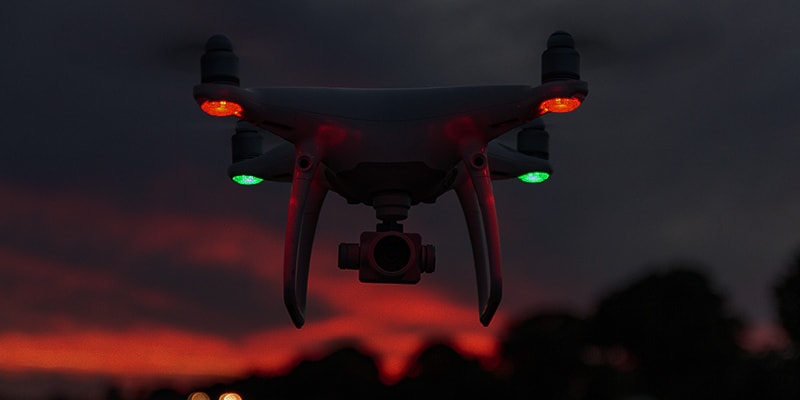
Police drones look different from consumer drones at night. Law enforcement agencies typically use larger platforms: fixed-wing VTOL drones, the DJI Matrice 300 RTK, or similar enterprise-grade hardware. These are significantly bigger than a DJI Mini 4 Pro and may carry thermal cameras, zoom lenses, or spotlight attachments that consumer drones don't.
Behaviorally, police drones often hold a fixed position at higher altitude while the thermal camera scans below. You may not hear it. If you see a single steady white light at altitude that stays stationary for several minutes with no clear navigation light cluster, that's more consistent with a law enforcement or public safety drone than a recreational pilot. Police departments operating drones at night are required to follow the same FAA lighting rules as other operators.
What Won't Work
- ADS-B receivers (used for planes): consumer drones do not broadcast ADS-B
- Radar: only military-grade systems pick up drone-sized objects reliably
- Standard radios: drones use 2.4 GHz or 5.8 GHz frequency that handheld radios can't interpret