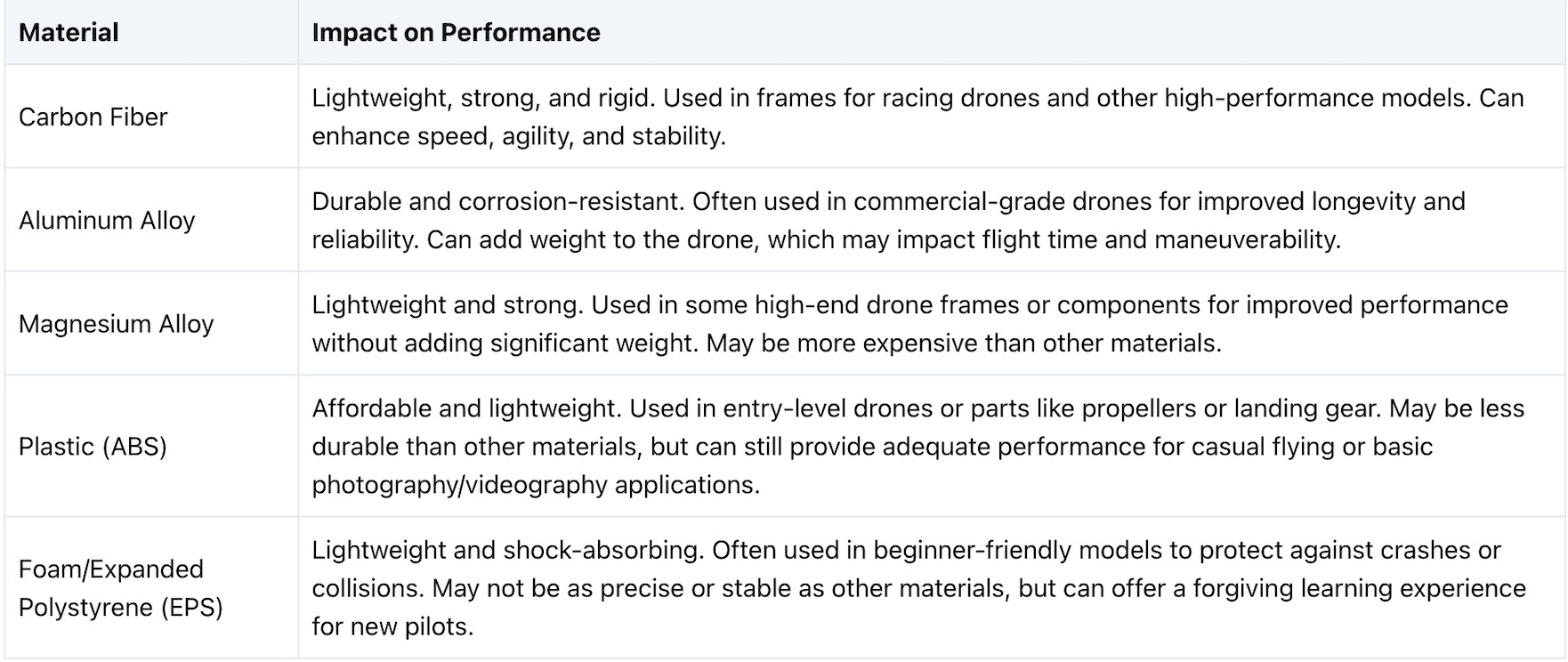
The DJI Mini 4 Pro weighs 249 grams and stays under the FAA registration threshold. That weight limit is not accidental: DJI engineers chose magnesium alloy for the internal skeleton and ABS plastic for the outer shell specifically to hit 249g, not 260g. Material choice is one of the primary design constraints for consumer drones, and understanding it explains why two drones with similar cameras and GPS can cost $300 versus $1,500.
Most consumer drones use a hybrid construction: a structural skeleton made from magnesium alloy or carbon fiber composite, covered with injection-molded ABS or polycarbonate shell panels. Budget drones use all-plastic construction with no internal metal frame, which costs less to manufacture but is heavier and less rigid. Racing FPV drones go the opposite direction: pure carbon fiber frames with no plastic shell at all, prioritizing the highest possible strength-to-weight ratio.
This guide covers the primary frame materials and their tradeoffs, the key electronic components inside every drone, how propeller material affects performance and safety, and what the LiPo battery chemistry means for handling and storage.
What Drones Are Made Of: Frame and Body Materials
Consumer drones use hybrid construction: a rigid internal frame (magnesium or carbon fiber) covered by lightweight outer panels (ABS plastic or polycarbonate). Racing and commercial drones use pure carbon fiber throughout.
ABS Plastic and Polycarbonate: Budget Consumer Drones
Acrylonitrile butadiene styrene (ABS) and polycarbonate (PC) are the dominant materials in entry-level and budget consumer drones. Both are injection-moldable thermoplastics, meaning they can be shaped into complex geometries at low per-unit cost. ABS has a density of approximately 1.06 g/cm3 and handles light impacts without cracking. Polycarbonate is slightly heavier (1.20 g/cm3) but significantly more impact-resistant and transparent, which is why it is used for camera protective covers and canopies.
Glass-fiber-reinforced nylon (PA6+GF) appears in higher-stress plastic components, including arm hinges, motor mounts, and landing gear on mid-range drones. The glass fiber increases rigidity and reduces flex compared to plain nylon.
Magnesium Alloy: The Consumer Drone Sweet Spot
Magnesium alloy is approximately 30% lighter than aluminum for the same structural volume and about 75% lighter than steel. DJI has used magnesium alloy across multiple product generations: the Inspire 2 uses an AZ91 magnesium alloy housing, the Mavic Air uses AZ91 magnesium alloy brackets for its internal structure, and the Phantom 4 Pro V2.0 used a titanium-magnesium hybrid frame. The current Mini, Air, and Mavic series continue this approach. The outer body panels remain ABS plastic (to save weight and cost), but the internal skeleton that carries structural loads is magnesium.
This hybrid construction is why DJI drones feel rigid despite thin plastic shells. The plastic absorbs cosmetic impacts and can be replaced, while the magnesium frame handles the structural loads. The approach also helps hit weight targets precisely, which matters when the 250g FAA registration threshold is a design constraint.
Carbon Fiber Composite: Professional and Racing Drones
Carbon fiber reinforced polymer (CFRP) has a density of 1.5-1.8 g/cm3 and tensile strength of 3,740-3,970 MPa. This gives it a strength-to-weight ratio approximately 4x better than aluminum and 10x better than ABS plastic. Carbon fiber frames are used on:
Racing FPV drones (entire frame is 3K or 1K woven CFRP)
Commercial mapping and inspection drones (DJI Mavic 3 Enterprise, Autel EVO II Pro RTK)
Long-range industrial platforms designed for payload capacity
Carbon fiber is electrically conductive, which means a cracked carbon fiber frame can short electronics if fragments contact circuit boards. It is also more brittle than aluminum under impact: carbon fiber shatters rather than bending, which provides no crash energy absorption. Professional pilots carry spare frame sections, not because carbon fiber breaks constantly, but because when it does break, it breaks completely.
Drone Motors and Propellers: What They Are Made Of
Brushless Motors: Copper, Magnets, and Aluminum
Consumer and professional drone motors are brushless DC (BLDC) motors. The stator (stationary part) is wound with copper wire coils that create electromagnetic fields when current flows through them. The rotor (spinning part) contains permanent magnets, typically neodymium iron boron (NdFeB) alloys, which are the strongest permanent magnets available commercially. The motor housing is always machined from aluminum alloy, even on full carbon fiber racing drones. The reason is thermal conductivity: carbon fiber dissipates heat approximately 40 times worse than aluminum, so a carbon fiber motor housing would trap heat and burn out the copper windings. Aluminum moves heat out of the motor efficiently at sustained high throttle. The main shaft is stainless steel for durability at the bearing interface.
Motor performance is defined by its KV rating (RPM per volt). Consumer camera drone motors run at 1,000-3,000 KV with large, slow-spinning propellers for efficiency. Racing FPV motors run at 2,000-6,000+ KV with smaller, faster-spinning propellers for maximum thrust response.
Electronic Speed Controllers
Each motor is paired with an electronic speed controller (ESC), which converts the flight controller's PWM or DSHOT digital signals into the three-phase AC power that brushless motors require. ESCs contain MOSFETs (metal-oxide-semiconductor field-effect transistors) that switch current at very high frequency to produce the AC waveform. The ESC housing is typically aluminum for heat dissipation, as the MOSFETs generate significant heat at high throttle.
Propeller Materials: Nylon vs. Carbon Fiber
Material
Flex
Weight
Safety
Typical Use
Nylon / polypropylene
High (absorbs impact)
Light
Safer near people (flex on contact)
Consumer GPS drones, budget toys
Carbon fiber composite
Very low (rigid)
Lightest
Can lacerate skin
Racing FPV, commercial drones
Glass-fiber nylon
Medium
Light to medium
Moderate
Mid-range consumer drones
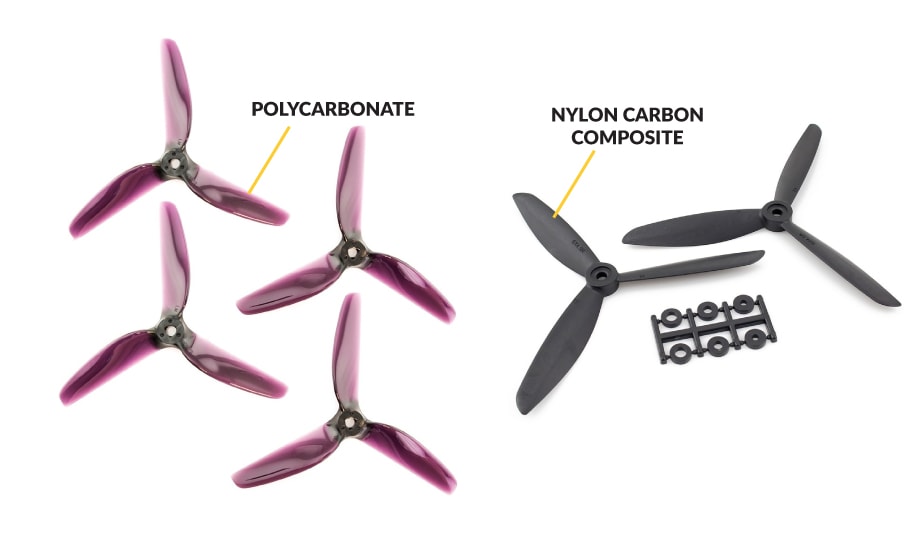
Carbon fiber propellers can cause serious cuts on contact with skin. This is specifically why the FAA's Category 1 rule (allowing flight over people) requires drones to have no exposed rotating parts that can lacerate. DJI Mini series drones use nylon props, which flex rather than cut on impact.
The Flight Controller and Sensor Stack
Consumer drone propellers (left) are nylon or glass-fiber nylon that flex on impact. Racing drone carbon fiber propellers (right) are rigid and can cause cuts on contact.
The Flight Controller: Silicon, PCB, and Firmware
The flight controller is a printed circuit board (PCB) containing a microprocessor, sensor chips, and supporting electronics. Modern DJI drones use proprietary flight controller chips. Open-source platforms use processors from STMicroelectronics (STM32 series) or NXP. The PCB substrate is FR4 (glass-reinforced epoxy laminate), the standard material for rigid circuit boards, with copper trace layers for electrical connections and a solder mask coating to protect the traces.
Sensors Inside Every GPS Drone
The sensor stack that enables stable flight and autonomous hovering:
IMU (Inertial Measurement Unit): Combines a 3-axis gyroscope and 3-axis accelerometer in one chip. Tracks rotation rates and linear acceleration continuously. Made from MEMS (Micro Electro Mechanical Systems) silicon with microscopic mechanical elements etched into the chip.
Barometer: A MEMS pressure sensor that measures air pressure to determine altitude. Accuracy approximately 0.5-1 meter in calm conditions.
Magnetometer (compass): A MEMS Hall-effect sensor that detects Earth's magnetic field to determine the drone's heading. Susceptible to interference from motors and metal structures.
GPS module: A ceramic antenna plus GPS chipset that receives satellite signals. Some modules include GLONASS, Galileo, and BeiDou support for additional satellites and improved accuracy.
Optical flow camera: A downward-facing CMOS image sensor (similar to a webcam) that tracks ground texture to detect horizontal drift.
Obstacle detection sensors: Infrared, ultrasonic, or stereo camera arrays depending on the model. Used for collision avoidance.
The Camera and Gimbal
Camera housings on consumer drones are typically machined from aluminum alloy for heat dissipation (the image sensor and processor generate heat). The lens is optical glass, the same as phone cameras, ground to precise specifications for minimum distortion. The outer protective cover around the gimbal and camera is polycarbonate, which is transparent and impact-resistant. The gimbal structure itself is typically a combination of lightweight aluminum arms with plastic pivot covers.
LiPo Batteries: Chemistry, Construction, and Safety
3.7VPer cell nominal voltage
4.2VPer cell fully charged
3.0VPer cell minimum cutoff
What LiPo Batteries Are Made Of
Lithium polymer (LiPo) batteries use lithium cobalt oxide (LiCoO2) or lithium manganese oxide as the cathode material, a graphite anode, and a polymer electrolyte separator. The polymer electrolyte is what distinguishes LiPo from older lithium-ion: it allows the battery to be formed into flat pouches rather than cylindrical cells, enabling the flat, lightweight form factor used in drones. The pouch cells are wrapped in a foil-and-polymer laminate housing, not a metal can.
The battery management system (BMS) is a small circuit board inside every drone battery that monitors individual cell voltages, controls charge and discharge current limits, tracks charge cycles, and communicates state-of-charge information to the drone and charger. DJI's Intelligent Flight Battery system adds authentication to prevent third-party batteries from operating at full capacity, though third-party batteries remain functional at reduced charge rates.
Why LiPo Batteries Need Careful Handling
The polymer electrolyte is flammable. If a LiPo cell is punctured, overcharged, or overheated, it can enter thermal runaway: the cell heats internally, which accelerates the chemical reaction, which generates more heat, until the battery vents, swells, and potentially ignites. This is why:
Crashed drones should not be immediately placed in a bag or car trunk
Swollen batteries should be disposed of immediately, not stored or charged
Batteries should be charged in a LiPo-safe bag or on a non-flammable surface
Airlines restrict drone batteries to carry-on luggage (no checked baggage) because cargo holds cannot vent a thermal runaway event effectively
Warning: Never charge a visibly swollen or deformed LiPo battery. Swelling indicates gas buildup from internal cell damage. Charging a swollen battery can cause rupture or fire. Take swollen batteries to a recycling center that accepts lithium batteries.
How Drone Materials Differ by Price and Category
Budget Toy Drones ($30-$100): All Plastic
Budget toy drones use injection-molded ABS or polypropylene for the entire frame and shell. There is no internal metal structure. Motors have aluminum bell housings but plastic-bodied mounts. Propellers are plain nylon. Flight controllers are generic chips running simplified firmware. Batteries are small single-cell or 2S LiPo packs with minimal BMS.
The all-plastic construction is not only cheaper but also crash-forgiving. ABS bends and cracks at connection points rather than shattering, and most budget drone parts (propellers, landing legs, prop guards) are replaceable. The main penalty is weight: ABS construction is heavier for the same structural rigidity compared to metal or carbon fiber, but at 200-300g total mass, these drones are light enough that it does not matter for performance.
Consumer GPS Drones ($300-$1,500): Hybrid Construction
This is the DJI Mini series, Air series, and Mavic series price range. The construction is a magnesium alloy or aluminum alloy structural frame covered with ABS or polycarbonate shell panels. The camera housing is machined aluminum. Propellers are glass-fiber nylon or carbon-fiber-reinforced nylon. The battery has a full BMS with cell-level monitoring and discharge protection.
Commercial and Professional Drones ($2,000+): Full Carbon Fiber
Enterprise drones (DJI Mavic 3 Enterprise, Autel EVO II Pro RTK, Freefly Alta X) use full carbon fiber frame construction with CNC-machined aluminum or titanium joints at high-stress connection points. Carbon fiber propellers are standard. Batteries are modular with higher capacity and faster discharge rates. Frame components are field-replaceable with tool-less connections to minimize downtime.
Note: The 250g FAA registration threshold has pushed material engineering at the consumer level. Drones like the DJI Mini 4 Pro (249g) use magnesium alloy instead of aluminum precisely because it saves 30% of the frame weight, enabling a lighter total design that stays under the registration limit.
FAQ
Consumer GPS drones use a hybrid construction: a structural frame of magnesium alloy or aluminum alloy covered with ABS plastic or polycarbonate outer shell panels. Budget toy drones are all-plastic (ABS). Racing FPV drones use full carbon fiber frames. All drones contain copper-wound brushless motors, neodymium permanent magnets, silicon sensor chips, a printed circuit board flight controller, and a LiPo battery.
Racing FPV drones and professional commercial drones use full carbon fiber frames. Consumer GPS drones from DJI and Autel use carbon fiber selectively, often in the propellers and some structural components, but the primary frame material is typically magnesium alloy or aluminum with ABS plastic shell panels. Budget toy drones use no carbon fiber and are entirely plastic construction.
Consumer drone outer shells are typically ABS (acrylonitrile butadiene styrene) or polycarbonate. ABS is the most common choice for body panels due to its impact resistance and low molding cost. Polycarbonate is used for transparent components like camera covers. Glass-fiber-reinforced nylon appears in high-stress plastic parts like motor mounts and arm hinges.
Consumer camera drones use nylon or glass-fiber nylon propellers that flex on impact, which is safer near people and absorbs crash energy without complete breakage. Racing FPV drones use carbon fiber propellers for their superior stiffness and lighter weight, but carbon fiber propellers can lacerate skin on contact. This is why the FAA's Category 1 rule (allowing flight over people) specifically requires no exposed rotating parts that can lacerate.
Drone batteries use lithium polymer (LiPo) chemistry: a lithium cobalt oxide or lithium manganese oxide cathode, a graphite anode, and a polymer electrolyte separator formed into flat pouch cells. Each cell has a nominal voltage of 3.7V and a fully charged voltage of 4.2V. The battery also contains a battery management system (BMS) that monitors individual cell voltages, controls charge rates, and communicates state-of-charge to the drone.
It depends on the drone category. Budget toy drones: injection-molded ABS plastic throughout. Consumer GPS drones (DJI, Autel): magnesium alloy or aluminum alloy internal frame with ABS plastic outer panels. Racing FPV drones: carbon fiber reinforced polymer (CFRP). Professional commercial drones: full carbon fiber with CNC-machined aluminum or titanium joints.
The 249g weight is not coincidental. Drones at or above 250g require FAA registration. DJI engineers used magnesium alloy for the internal frame (30% lighter than aluminum) and minimized plastic panel thickness to hit exactly 249g. The Mini 5 Pro crossed this threshold at 299g, which is why it requires registration while the Mini 4 Pro does not.
Most consumer GPS drones are not waterproof. The electronics, motors, and battery are exposed to water damage. Specialized waterproof drones like the SwellPro Splashdrone 4 Plus and HoverAir Aqua use sealed electronics housings with silicone gaskets and corrosion-resistant aluminum or polymer frames. Some consumer drones are splash-resistant (brief light rain) but not submersible.
Paul Posea founded Dronesgator in 2015 and has been reviewing consumer drones for over a decade. With 195 YouTube drone reviews drawing 3.55 million views and published work on Digital Photography School, he combines hands-on flight testing with data-driven analysis to help pilots find the right drone.
Marcus Taylor is a UK CAA certified drone pilot and owner of Deployed Consultancy Ltd. With 6 years of commercial experience spanning UN site surveys in West Africa, aerial photography across Europe, Africa, and Japan, and defence consulting, he verifies the technical accuracy of Dronesgator's drone reviews and guides.