• Find My Drone

What Does a Drone Look Like at Night? Lights and ID Guide

Updated

By Paul Posea

What Does a Drone Look Like at Night? Lights and ID Guide - drone reviews and comparison

What a Drone Looks Like During the Day

During daylight, consumer drones are harder to spot than most people expect. From 100 meters of altitude, a folded drone like the DJI Mini 4 Pro appears as a small dark cross or "X" shape, roughly the angular size of a small bird at that distance. The four arms and central body are visible, but detail is minimal.

How size perception deceives

Most people seeing a drone for the first time expect it to appear larger than it does. A DJI Mini 4 Pro is 178mm wide when deployed, about the size of a hardcover book. At 100 meters of altitude, it subtends roughly 0.1 degrees of visual angle, which is comparable to a thumb held at arm's length against the sky. From 200 meters, it becomes a moving speck, visible only because it contrasts against the sky and moves differently from birds.

Colors and contrast

Most consumer drones are gray or white, which blends with overcast skies. Against a clear blue sky, the gray frame is more visible. Against clouds or haze, consumer drones at altitude are difficult to track visually even when you know where to look. DJI uses status LEDs on the arms that flash red or green during operation, which adds a small amount of visibility even in daylight conditions.

Movement is the primary identifier

During the day, the clearest indicator that you are looking at a drone rather than a bird or debris is the movement pattern. Drones hover in fixed positions, move in straight lines at consistent speed, stop abruptly, and change direction without banking like a bird or plane. The flight path is controlled and deliberate in a way that natural objects are not.

What a Drone Looks Like at Night

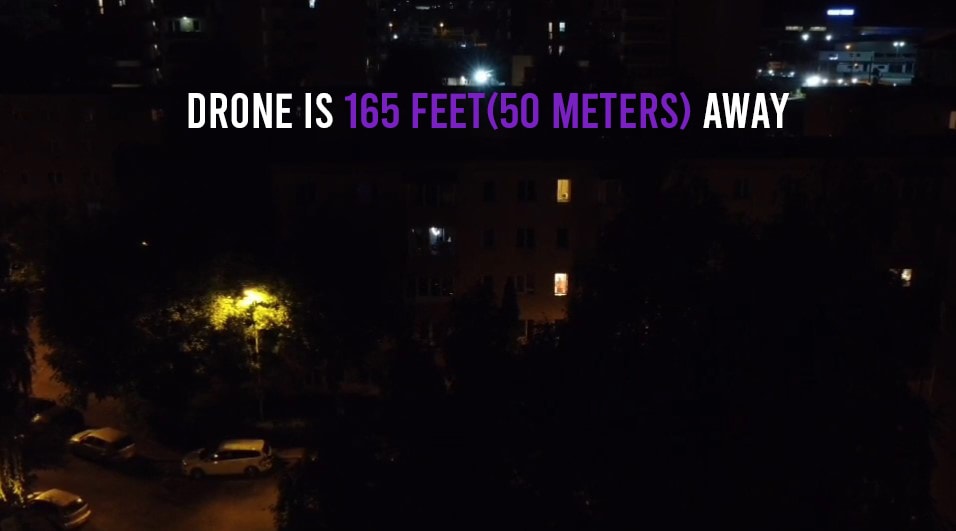
Drone lights visible at 50 meters away at night showing the characteristic light cluster pattern
At 50 meters, a consumer drone at night appears as a cluster of small lights moving together. The strobe and navigation light pattern is distinct from fixed-wing aircraft.

At night, a consumer drone's visual signature comes entirely from its lights. The aircraft itself is invisible against a dark sky; what you see is the light pattern.

FAA-required anti-collision light

The FAA requires that all drones flown at night carry an anti-collision light visible at 3 statute miles. On most DJI consumer drones, this is a white strobe at the front of the aircraft that flashes at regular intervals. The Mini 4 Pro, Air 3S, and Mavic 4 Pro all include built-in strobes that meet this requirement. The strobe is typically the brightest and most visible light on the aircraft at range.

Navigation lights

Consumer drones typically have red and green navigation lights on the left and right sides of the frame, following aviation convention (red on the left/port side, green on the right/starboard side). These are smaller and less bright than the strobe, but visible at close range. DJI drones also have status indicator LEDs at each motor arm that show flight mode and battery status through color sequences.

DJI arm LED blink patterns

On DJI consumer drones, the four arm LEDs communicate flight status through color and blink rate. Slow green blinking indicates normal GPS flight. Fast green blinking indicates the drone is searching for GPS signal. Alternating red and green blinking indicates a low battery warning. Solid red with fast blinking indicates a critical error. Understanding these patterns helps you read a DJI drone's status from the ground at close range, even at night.

What the cluster looks like in motion

The combined light cluster (strobe plus nav lights plus arm LEDs) moves together as a tight group, clearly not multiple aircraft. The strobe flashes while the nav lights remain steady. At 50-100 meters, the overall impression is a small set of lights hovering or moving at low altitude and speed. At 200+ meters, only the strobe may be visible, appearing as a single flashing white point that moves in non-aircraft patterns.

How to Tell a Drone from a Plane or Helicopter

The most common question from people who see drone lights at night is whether they are looking at a drone, a plane, a helicopter, or a satellite. Each has distinct characteristics once you know what to look for.

ObjectLightsMovementSound
Consumer droneWhite strobe, small red/green nav lights, arm LEDsHovers, changes direction abruptly, moves slowlyHigh-pitched buzz/whir, louder than aircraft at equivalent distance
Commercial airplaneBright white strobes on wingtips, red/green nav lights, steady white tail lightConsistent direction, fast, no hoveringJet roar, heard long after passing
HelicopterSimilar nav lights, sometimes search/landing lightsCan hover, but makes significant noiseLoud rotorcraft thudding, distinctly different from drone buzz
SatelliteNo lights (visible only by reflected sunlight shortly after sunset/before sunrise)Perfectly straight arc across sky, constant speedCompletely silent
Distant star / planetSteady point of light, slight twinkleStationary or very slow driftSilent

The hovering test

The single clearest identifier of a drone versus any other aircraft is hovering. Airplanes and satellites cannot hover. Helicopters can, but make dramatically more noise than any consumer drone. If a light in the sky hovers in place for more than a few seconds, it is almost certainly a drone or a manned aircraft in a holding pattern (which would be much higher and louder). At low altitude with buzzing sound and hovering behavior, it is a drone.

FAA Anti-Collision Light Rules

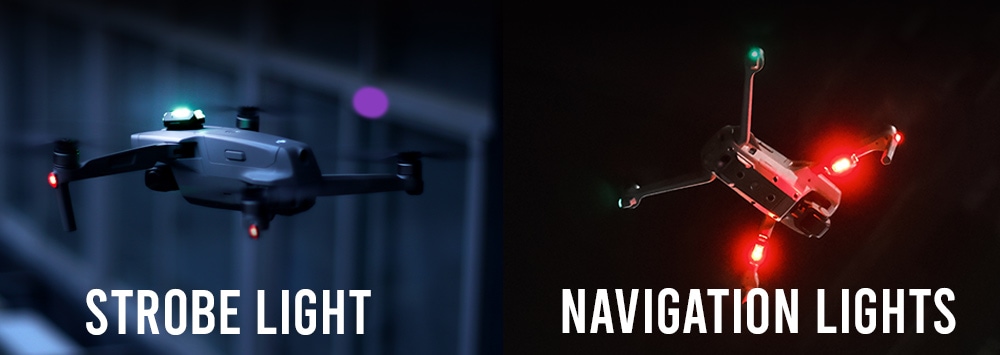
Diagram showing the difference between drone strobe lights and navigation lights for night flying
Anti-collision strobes and navigation lights serve different purposes. The strobe is for visibility at range (3 statute miles required by FAA). Nav lights help orientation from close up.

Night drone operations are legal under both recreational and Part 107 rules, but require specific lighting. The FAA updated its night flying rules effective April 2021, allowing night operations without a waiver provided the drone carries an appropriate anti-collision light.

What the FAA requires

Any drone flown at night or during civil twilight must have an anti-collision light visible for 3 statute miles. The light must flash at a rate sufficient to avoid confusion with aircraft. FAA Advisory Circular AC 107-2B specifies the requirement without mandating a specific flash pattern or color, though white is standard. The requirement applies to both recreational night fliers and Part 107 commercial operators.

Do DJI built-in lights qualify?

Yes. DJI consumer drones including the Mini 4 Pro, Air 3S, and Mavic 4 Pro include built-in strobes that DJI rates as meeting the FAA 3-statute-mile visibility requirement. You do not need to add aftermarket lights to these drones for legal night operation, provided the built-in strobe is functioning and you are not flying in unusual conditions that reduce visibility.

Aftermarket strobe lights

Some pilots add aftermarket strobes like the Firehouse Arc V or Lume Cube Strobe for additional visibility, particularly when flying in complex airspace or near other aircraft. These lights are significantly brighter than typical built-in drone LEDs and can extend visibility beyond the FAA 3-mile requirement. They add a small amount of weight (typically 10-20g) and attach via adhesive or clip mounts.

Note: Part 107 pilots flying at night should also be familiar with Remote ID requirements. Drones must broadcast their position and identification while in flight. DJI drones sold after 2023 include Remote ID broadcasting built in. This does not affect the light requirement but is a separate compliance obligation for night and day operations alike.

How to Spot a Drone Near Your Property

If you suspect a drone is flying near your property, a combination of visual and audio cues can help confirm it. Here is what to look for and what options are available.

Visual cues

At night, look for a small cluster of lights at low altitude (typically under 400 feet) that hovers or moves slowly. The lights will include at least one bright strobe and smaller colored nav lights. The cluster will move as a unit rather than drifting apart. During the day, look for a small cross-shaped object moving against the sky in a controlled, deliberate pattern, pausing in place or tracking a specific path.

Audio cues

Consumer drones produce a characteristic high-pitched buzzing or whirring sound, usually described as similar to a large swarm of bees or a high-RPM electric motor. The pitch changes with throttle and maneuvers. At 100 meters, most consumer drones are clearly audible in quiet suburban environments. The sound is unmistakable once you have heard it before.

ADS-B tracking for ruling out planes

If you see a moving light at night and are unsure whether it is a drone or a manned aircraft, Flightradar24 and similar ADS-B tracking apps show the real-time position of all transponder-equipped aircraft in your area. If the light you see does not correspond to any tracked aircraft on Flightradar24, it is almost certainly a drone (or a satellite, which moves in a straight arc without hovering).

RF detection apps

Apps like DroneWatcher use acoustic detection and RF signal scanning to identify nearby drones. These systems work by detecting the RF transmissions between a drone and its controller, which consumer drones broadcast continuously. They can identify many DJI and Autel drones by their radio signature and provide a directional bearing. Range and reliability vary by environment, but these tools provide a layer of detection beyond visual and audio observation.

What you can legally do

Interfering with a drone in flight, including attempting to disable it electronically or physically, is a federal crime under the Computer Fraud and Abuse Act and can also constitute interference with an aircraft. If you believe a drone is being operated illegally near your property, document it (photos or video of the lights, time, location, flight behavior) and report it to local law enforcement. The FAA accepts drone complaints through its UAS sightings report portal.

FAQ

A drone at night appears as a small cluster of lights: a bright white strobe at the front flashing regularly, red and green navigation lights on the sides, and smaller arm LEDs that may be red or green. The cluster moves together at low altitude and low speed. From 100-200 meters, only the strobe may be clearly visible, appearing as a single flashing white light that hovers or moves slowly.

Yes. FAA rules require drones flown at night to carry an anti-collision light visible at 3 statute miles. Consumer drones like the DJI Mini 4 Pro include built-in strobes that meet this requirement. In practice, a drone at 100-150 meters at night is clearly visible to an observer who knows what to look for, primarily as a bright white strobe against the dark sky.

Consumer drones produce a characteristic high-pitched buzzing or whirring sound, often compared to a large swarm of bees or a high-RPM electric motor. The sound is produced by the spinning propellers and changes pitch with throttle inputs. At 100 meters altitude, most consumer drones are clearly audible in quiet environments. The sound is distinctly different from airplane engines or helicopter rotors.

Look for a small cluster of lights at low altitude (under 400 feet) that hovers in place or moves slowly and returns to the same position. Listen for the characteristic high-pitched buzzing sound. A drone hovering over the same location for an extended period is a clear indicator of intentional observation. Document the time, location, and behavior, and report to local law enforcement if you believe the operation is illegal.

Yes. FAA rules require any drone flown at night or during civil twilight to carry an anti-collision light visible at 3 statute miles. This applies to both recreational pilots and commercial Part 107 operators. Most DJI consumer drones include built-in strobes that meet this requirement. Flying at night without an appropriate light is a regulatory violation.

The FAA requires drone anti-collision lights to be visible at 3 statute miles (roughly 5 km) in clear conditions. In practice, the strobe on a DJI consumer drone is visible at 1-2 km in clear dark conditions to an observer who knows what to look for. At 200+ meters altitude, the strobe appears as a single small flashing white point. Visibility is reduced significantly by light pollution, haze, or clouds.

Consumer drones typically have a white anti-collision strobe at the front, red navigation light on the left side, green navigation light on the right side, and additional status LEDs at each motor arm. The strobe is the brightest and most visible from range. DJI drones use the arm LEDs to indicate flight mode and battery status through color and flash patterns.

Yes. Apps like DroneWatcher use RF signal detection to identify drones broadcasting standard control frequencies. They can detect many DJI and Autel drones by their radio signatures and provide directional information. Drone detection reliability varies by environment and the specific drone model. Some military-grade detection systems use radar or acoustic arrays, but these are not consumer products.

Paul Posea

Paul Posea

Author · Dronesgator

Paul Posea is the founder of Dronesgator and has been reviewing and comparing drones since 2015. With a Part 107 certification, 195 YouTube drone reviews, and published work on Digital Photography School, he combines hands-on flight testing with data-driven analysis to help pilots find the right drone.