The number on a propeller that matters most is not the diameter. It is the pitch. Pitch determines how the drone actually flies: how fast it can go, how snappy the controls feel, how efficient the motors run, and how loud the drone sounds at altitude. Two props with the same diameter can fly completely differently just because the pitch number is 1 inch apart.
The problem is that prop numbers are written in three different formats depending on the manufacturer, and none of them are labeled. A prop listed as "5045" means the same thing as "5x4.5" and both mean something different from "HQ5x4.3x3." If you have ever stared at a prop description and had no idea what the numbers meant, this is why.
This guide covers how drone propeller pitch works, how to decode all three notation formats, what the trade-offs are between low and high pitch, and how to pick the right pitch for your flying style. It covers both FPV builds and consumer camera drones like the DJI Mini and Air series.
What Drone Propeller Pitch Actually Means
Pitch is the theoretical forward distance a prop would travel in one full revolution if spinning through a solid medium
The Screw Analogy
Pitch describes how far a propeller would move forward in one complete revolution if it were spinning through a solid medium with zero slippage, like a wood screw turning through solid material. A prop with 4.5-inch pitch would theoretically advance 4.5 inches per rotation. In air, actual forward movement is less due to slip, but the number is still the best single comparison point between propellers.
This is a relative measurement, not a guarantee of speed. A 5-inch pitch prop does not mean the drone moves 5 inches per motor revolution. It means that prop blade angle is set more aggressively than a 4-inch pitch prop on the same diameter disc. The higher the pitch number, the more air each blade attempts to grab per revolution.
Pitch vs. Diameter: Different Jobs
Diameter and pitch do different things, and they work together.
Diameter sets how large a disc of air the prop sweeps. Bigger diameter means more air moved per revolution, which means more thrust at lower RPM. This is why large, slow-spinning propellers (like those on agricultural drones) are efficient for heavy lifting.
Pitch sets how aggressively each blade angles through that air. Higher pitch at the same diameter means more thrust per revolution but requires more torque from the motor. The motor must work harder, drawing more current and generating more heat.
The relationship matters for motor matching. A motor rated at 2300 KV (2300 RPM per volt) is designed for relatively small, low-pitch props. Putting a large high-pitch prop on that motor overloads it. The motor cannot spin fast enough to generate efficient thrust, overheats, and may burn out.
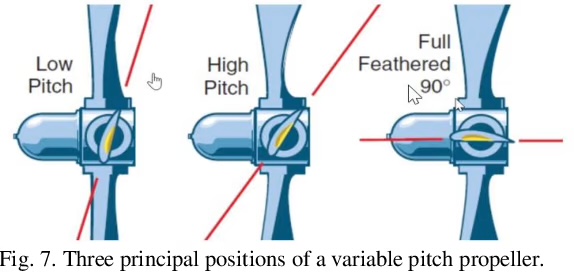
Variable Pitch vs. Fixed Pitch
Consumer and FPV drones use fixed-pitch propellers. The blade angle is molded in and cannot change. Some advanced platforms use variable-pitch propellers that can adjust blade angle in flight, similar to helicopter rotors. T-MOTOR produces variable-pitch systems for specialized commercial drones. For any consumer or hobbyist drone, fixed pitch is the only option in practice.
Geometric Pitch vs. Effective Pitch: Propeller Slip
The pitch number printed on a prop (4.5 inches, for example) is the geometric pitch: the theoretical advance distance if the prop were screwing through a solid. In air, props experience slip. A prop with 4.5-inch geometric pitch might only achieve roughly 3.6 inches of actual advance per revolution at cruise throttle, about 80% efficiency, with the 0.9-inch difference being slip loss.
Slip is not pure waste. Some slip is necessary for thrust generation. A prop with zero slip would not be pushing any net force on the aircraft. Higher slip at the same geometric pitch typically means the motor is working harder and the prop is less efficient. This is one reason high-pitch props draw more current: the steeper blade angle must overcome increasing air resistance on each revolution.
How to Read Drone Propeller Pitch Numbers
Prop packaging uses three different notation formats, all meaning the same thing
Three Notation Formats
Three prop notation systems exist in the market. None of them are labeled, and no single standard is universal. Understanding all three prevents confusion when shopping across different brands.
Format
Example
Decoded
Long format (explicit)
5 x 4.5 x 3
5" diameter, 4.5" pitch, 3 blades
4-digit compact
5045
5.0" diameter, 4.5" pitch (2 blades assumed)
4-digit with blade count
5045x3 or 50453
5.0" diameter, 4.5" pitch, 3 blades
Decoding the 4-Digit Format
The compact 4-digit format is the most common on FPV prop packaging. The first two digits are the diameter, the last two are the pitch, and the decimal point is dropped. So 5045 means 5.0-inch diameter and 4.5-inch pitch. 5040 is the same diameter but lower 4.0-inch pitch. 6045 is a larger 6.0-inch diameter with 4.5-inch pitch.
When the diameter or pitch has a decimal that is not a clean tenth (like 4.3 inches), the number becomes three digits: 5043x3 = 5.0-inch diameter, 4.3-inch pitch, 3 blades. Some manufacturers add their brand prefix: HQ5x4.3x3 is HQProp's version of that same 5-inch, 4.3-inch pitch, 3-blade prop.
A Caveat About Manufacturer Numbers
Not all manufacturers' specs match their published numbers. Some props measure slightly different than stated when you put a caliper on them. This is a known issue across the FPV prop market. The numbers are still useful for comparison, just not as precise engineering specs. If you are running a performance build with strict motor constraints, verify specs against community data, not just packaging.
Note: Consumer camera drone propellers (DJI Mini, Air, Mavic series) do not use FPV notation. DJI props are model-specific and sold as OEM replacement parts. The pitch and diameter specs are published in DJI's spec sheets but not printed on the prop itself.
Drone Propeller Pitch Trade-Offs: Speed, Efficiency, and Control
LowPitch (3"-3.5"): Responsive
MidPitch (4"-4.5"): Balanced
HighPitch (5"+): Fast
How Pitch Affects Flight Performance
Pitch has four measurable effects on how a drone flies. These trade-offs are consistent across FPV and camera drone applications, though the pitch numbers differ by drone size.
Characteristic
Low Pitch
High Pitch
Thrust per revolution
Less
More
Top speed potential
Lower
Higher
Control responsiveness
Snappier (faster RPM changes)
Slower (more inertia)
Current draw / motor heat
Lower
Higher
Battery life
Better efficiency
Shorter flight times
Noise level
Quieter
Louder
The Responsiveness Mechanism
This is the part most guides skip. Why does lower pitch feel snappier? It comes down to RPM changes. Lower pitch blades are lighter and encounter less air resistance per revolution, so the motor can accelerate and decelerate them faster. When you push a stick, the drone responds in milliseconds instead of tens of milliseconds. For freestyle FPV pilots, this snappy response is why many prefer props in the 4.0-4.3-inch pitch range over higher-pitch alternatives.
Higher-pitch props require more torque to spin up and take longer to change speed. This makes the drone feel heavier in the controls, which works well for racing where you are mostly at full throttle and do not need rapid RPM changes, but feels sluggish for freestyle maneuvers.
Pitch and Noise
Lower pitch propellers are generally quieter because each blade cuts through less air per revolution. The turbulence generated is smaller. This is why DJI's consumer props for the Mini and Air series are engineered with a moderate, quiet pitch angle alongside their low-noise serrated trailing edges. For residential or neighborhood flying where noise matters, lower-pitch props are the better choice.
Choosing Drone Propeller Pitch by Flying Style
Pitch selection depends on drone type, motor KV rating, and intended flying style
FPV Drone Pitch Recommendations
For 5-inch FPV builds (the most popular class), here is how pitch maps to flying style:
Flying Style
Pitch Range
Common Props
Racing (experienced)
4.5" - 5.6"
Gemfan 51477, HQ5x4.7x3
Freestyle
4.0" - 4.5"
HQ5x4.3x3, Gemfan 51433
Cinematic / Smoothed
3.0" - 3.8"
HQ4.3x3.6x4, Gemfan 3016
Long-range / Efficiency
Low pitch, 2-blade
HQ7x4x3, DAL 5045
The benchmark freestyle prop in 2025 is the HQ5x4.3x3. It hits the sweet spot of responsiveness and thrust for most pilots on a standard 5-inch freestyle build. If you are new to FPV and do not have a preferred style yet, start here.
Consumer Camera Drone Pitch: What You Can and Cannot Change
For DJI Mini 3, Mini 4 Pro, Mini 5 Pro, Air 3S, and Mavic 4 Pro users: prop pitch is set by DJI and is not adjustable. You are limited to OEM replacement props or compatible aftermarket props that fit the quick-release hub.
What DJI optimizes for in their consumer props is different from FPV. The goal is quiet hover and stable footage, not top speed or aggressive control response. DJI props use a lower effective pitch angle with serrated trailing edges to reduce noise, which is why these drones sound distinctly different from FPV builds at the same altitude.
For consumer camera drones, the only pitch-related decision is OEM vs. aftermarket. OEM DJI props are engineered to avoid motor vibration warnings. Third-party props are cheaper but can trigger imbalance alerts in the DJI Fly app.
Matching Pitch to Motor KV
Motor KV (RPM per volt) and prop pitch must be matched or the motor will run inefficiently or overheat. The general rule: high KV motors (2000+ KV) are paired with smaller, lower-pitch props. Low KV motors (1300-1800 KV) handle larger, higher-pitch props at lower RPM. A 2300 KV motor running a 5055 prop will draw excessive current and burn out. A 1700 KV motor on a 5043 prop is appropriate. Always check the motor manufacturer's recommended prop range before changing pitch.
Thrust-to-weight ratio (TWR) and pitch: Before selecting pitch, calculate your total flying weight (drone + battery + payload in grams). Target TWR guides which pitch range to use: 2.0 TWR for casual flying, 3.0 TWR for aggressive freestyle, 4.0-5.0+ for racing. Higher pitch generates more thrust per revolution, helping hit your target TWR on a heavier build, but at the cost of current draw and stick responsiveness.
Drone Propeller Pitch for Specific Use Cases
Cinewhoops and Indoor Drones
Cinewhoops are 2.5-3-inch drones with ducted propellers. The duct limits how large a diameter prop fits, so pitch becomes the primary way to tune performance. Low pitch (2.5-3.0 inches) in this size class produces smooth, controllable thrust that works well for indoor filming. High pitch in a cinewhoop makes the drone nervous and hard to control in confined spaces.
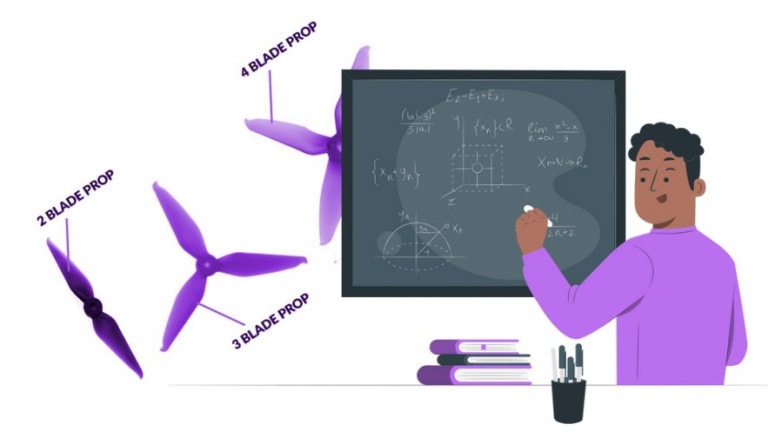
The blade count matters here too. Cinewhoops often run 4-blade props rather than 3-blade because the smaller diameter disc compensates with more blades to move adequate air. HQProp 3016x4 (3-inch diameter, 1.6-inch pitch, 4 blades) is a common cinewhoop prop.
Long-Range and Efficiency Builds
Long-range FPV builds (7-inch class and above) use a different logic. Here the goal is flight time, not speed or responsiveness. These builds use large diameter props (7-10 inches) with relatively low pitch, spinning at low RPM. Low KV motors (1000-1400 KV) with high-pitch but large-diameter props like 7x4x3 or 10x4x3 move a lot of air with minimal power. This is where flight times of 30-45 minutes are possible on a fixed-wing or long-range wing platform.
Finding Pitch Data for Props You Already Own
If you have props with no markings, check for embossed numbers molded into the hub or the underside of a blade. The prop may list diameter and pitch separately (e.g., "5" and "4.5") or in compact format. If there are no markings, check the original packaging or search the product name in the GetFPV or RaceDayQuads catalog, which lists full specs. Community databases like GetFPV and Oscar Liang's prop guide also have pitch data for most popular props.
Tip: If you are switching from 3-blade to 2-blade props on the same build, you may need to retune your PID values. Fewer blades means less rotational mass and different gyroscopic feedback, which can make the drone feel different on sticks even at the same pitch.
FAQ
Pitch is the theoretical distance a propeller would advance in one complete revolution if spinning through a solid medium with no slippage, like a screw through wood. Measured in inches, it describes how aggressively each blade is angled. Higher pitch means more thrust and top speed potential, but more current draw and less control responsiveness.
5045 is the compact 4-digit notation for a propeller that is 5.0 inches in diameter and 4.5 inches in pitch. The decimal point is dropped. If the prop has a third number (like 5045x3 or 50453), the 3 indicates it has 3 blades. A prop listed as 5045 without a third number is assumed to be 2-blade.
It depends on the flying style. Higher pitch means more top speed and thrust but slower control response and higher current draw on motors. Lower pitch is more responsive, quieter, and more efficient. Freestyle FPV pilots typically use 4.0-4.5-inch pitch for balanced feel. Racers go higher. Cinematic and long-range pilots go lower for efficiency and smooth control.
Yes. Lower pitch propellers are generally quieter because each blade displaces less air per revolution. Higher pitch creates more turbulence, which translates to more noise. DJI's consumer drone props use a moderate pitch angle combined with serrated trailing edges specifically to reduce noise for residential environments.
DJI does not publish pitch in the standard FPV notation for most consumer drones. Their props are designed as proprietary quiet-blade units optimized for hover efficiency and noise reduction rather than speed. You can find the pitch specs in their technical documentation. For most DJI consumer drones, replacement means buying OEM or compatible aftermarket props, not choosing a pitch value.
Lower pitch is generally more efficient and extends flight time. Lower pitch blades spin more easily, reducing motor current draw and generating less heat. Higher pitch props demand more from the motor on every revolution, which shortens battery life. The tradeoff is that lower pitch also means lower top speed.
These are aviation terms borrowed from fixed-wing propellers. Fine pitch means a shallow blade angle (low pitch number), which is more efficient at low speeds and generates quick acceleration. Coarse pitch means a steep blade angle (high pitch number), which is more efficient at high cruise speed. The same concepts apply to drone props but most FPV pilots just use the numerical values rather than these terms.
The most common recommendation for 5-inch freestyle builds is a pitch in the 4.0-4.5-inch range. The HQ5x4.3x3 is one of the most popular freestyle props in 2025 and a good starting point. Higher pitch makes the drone faster but harder to control for trick flying. Lower pitch gives snappier stick response, which is useful for technical maneuvers.
Paul Posea founded Dronesgator in 2015 and has been reviewing consumer drones for over a decade. With 195 YouTube drone reviews drawing 3.55 million views and published work on Digital Photography School, he combines hands-on flight testing with data-driven analysis to help pilots find the right drone.
Marcus Taylor is a UK CAA certified drone pilot and owner of Deployed Consultancy Ltd. With 6 years of commercial experience spanning UN site surveys in West Africa, aerial photography across Europe, Africa, and Japan, and defence consulting, he verifies the technical accuracy of Dronesgator's drone reviews and guides.