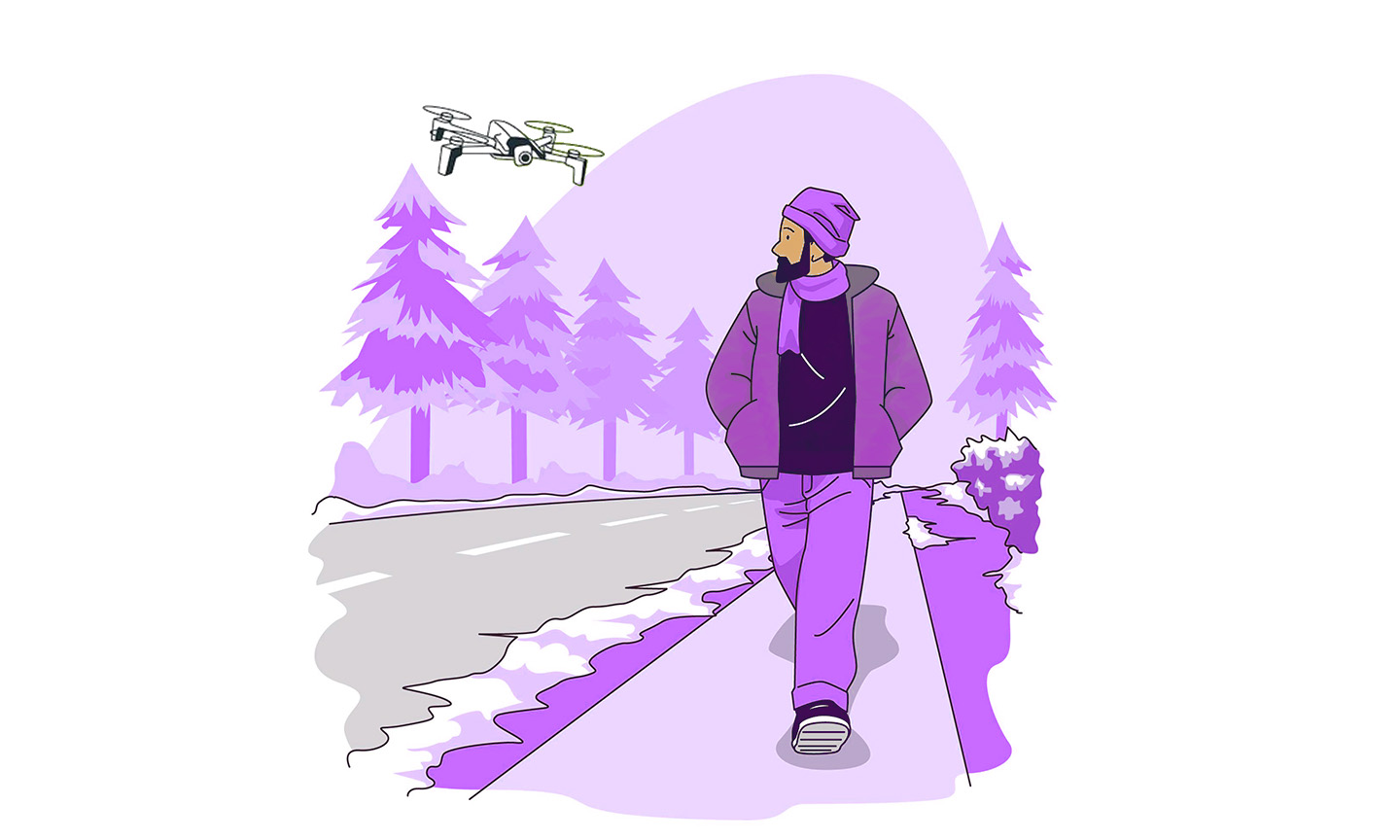
In roughly descending order of likelihood, here is why a drone near you is behaving the way it is:
1. Recreational follow-me mode filming
The most common reason by far. Follow-me and ActiveTrack modes are standard features on DJI and Autel consumer drones. A pilot filming their own outdoor activity (mountain biking, surfing, a trail run) activates this mode to track themselves. If you enter the frame or the drone briefly locks onto you instead of the intended subject, it will follow you until the pilot corrects it. This is an accident, not surveillance. The operator is typically within visual range and often doesn't realize what happened.
2. Professional or commercial operations
Survey crews, real estate photographers, utility inspectors, and infrastructure crews operate drones near private property and people as part of their work. A grid-pattern survey flight over a neighborhood, a real estate photographer circling a nearby listing, or a power company inspecting lines can all appear to track a specific person when they're actually following a programmed route. Commercial Part 107 operators are required to maintain visual line of sight and follow FAA rules, but their flight path has nothing to do with anyone on the ground.
3. Drone delivery testing and operations
Amazon Prime Air, Google Wing, and Walmart DroneUp operate delivery routes in specific suburban test areas. A drone following a delivery route that happens to parallel a road you're walking on will look like it's following you. These are automated flights on pre-programmed paths. Documented cases include Amazon and Google delivery drones appearing to follow joggers or cyclists who happened to be moving at a similar speed on the same road.
4. Technical malfunction or lost control
GPS interference, signal loss, software glitches, and battery failures can cause a drone to behave erratically: hovering in place near someone, moving unpredictably, or failing to respond to return-to-home commands. The operator may have lost control entirely and is trying to recover it. The drone isn't following anyone; it's malfunctioning near you.
5. Law enforcement or government surveillance
Police departments, federal agencies, and sheriff's offices operate drones for surveillance, warrant execution, crowd monitoring, and search operations. A law enforcement drone operating in your area legally does not require your consent and does not need to notify you in advance. If you notice a drone hovering persistently over a neighborhood, a law enforcement operation is a realistic explanation, particularly near active incidents or known investigation areas.
6. Deliberate private surveillance or stalking
An operator is intentionally using the drone to monitor, film, or intimidate a specific person. This is the least common scenario but the most serious. It is illegal in every US state under stalking and harassment statutes, and several states have enacted specific drone-stalking provisions with criminal penalties. The 2024 Virginia case (see Section 3) is the most cited recent example of successful prosecution.