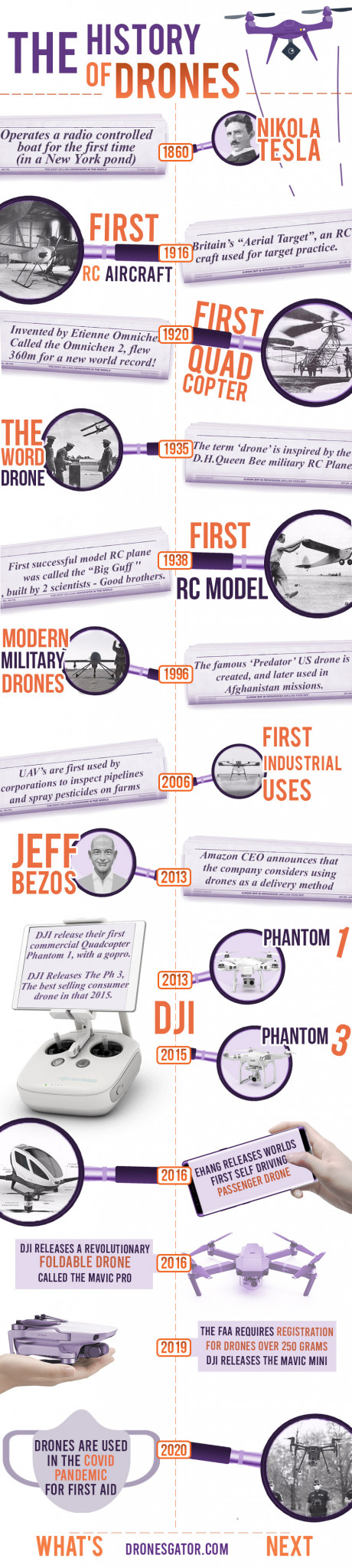
The first remotely piloted vehicle was not an airplane. It was a boat. In 1898, Nikola Tesla demonstrated a radio-controlled torpedo boat at Madison Square Garden, and no one in the audience could figure out how it moved without a person inside. Tesla patented the concept that same year (US Patent 613,809), calling it a "teleautomaton." That demonstration planted the seed for every remotely controlled aircraft, missile, and consumer drone that followed.
From Tesla's boat to the Kettering Bug in World War I, from the Cold War's spy drones to the Predator strikes of the 2000s, from the DJI Phantom that started a consumer revolution to the sub-250g drones you can buy today for under $300, the history of drones spans over 125 years of military innovation, commercial ambition, and regulatory scrambling.
This guide traces the full timeline. Each section covers a distinct era, the key aircraft and people involved, and the technological leaps that moved drones from battlefield curiosities to consumer products owned by millions.
The Origins of Drones: 1898 to World War II
From Tesla's 1898 radio boat to modern consumer drones
1898Tesla's radio-controlled boat
1918Kettering Bug aerial torpedo
1935de Havilland Queen Bee
Tesla's Teleautomaton (1898)
Nikola Tesla's radio-controlled boat, demonstrated at an electrical exhibition in New York, is widely considered the first remotely piloted vehicle. Tesla envisioned the technology as a way to build unmanned weapons that would make wars so destructive they would become obsolete. The U.S. military was not interested at the time. It took another two decades before the concept moved into the air.
The Kettering Bug and WWI Aerial Torpedoes
In 1918, Charles Kettering developed the "Bug" for the U.S. Army Signal Corps. It was an unmanned biplane designed to fly a preset course and then crash into a target. The Kettering Bug could carry 180 pounds of explosives at a speed of 120 mph, using a simple mechanical system that counted propeller rotations to determine when to cut the engine and dive. The war ended before the Bug saw combat, but it proved the concept of an autonomous aerial weapon.
The Queen Bee and the Origin of "Drone"
The de Havilland Queen Bee, introduced by the British Royal Navy in 1935, was the first reusable remote-controlled aircraft. Built as a target drone for anti-aircraft gunnery practice, the Queen Bee could be flown repeatedly, unlike expendable target aircraft before it. The name "drone" for unmanned aircraft is commonly attributed to the Queen Bee: the male honeybee (drone) does not work, just as these aircraft had no crew. Over 400 Queen Bees were built before production ended in 1943.
WWII and the Radioplane OQ-2
The Radioplane OQ-2, designed by Reginald Denny and first produced in 1939, became the first mass-produced unmanned aircraft in history. The U.S. military ordered nearly 15,000 of them during World War II as target drones for anti-aircraft training. A young Army photographer named David Conover visited the Radioplane factory in 1944 to photograph women working in the war effort and photographed Norma Jeane Dougherty on the assembly line. That photo led to a modeling career, and Norma Jeane became Marilyn Monroe.
Note: The Radioplane factory's connection to Marilyn Monroe is one of the most unexpected footnotes in aviation history. The factory was located in Van Nuys, California, and produced target drones through the Korean War era.
Military Drones Through the Cold War and Vietnam
1951Ryan Firebee first flight
3,435Firebee missions in Vietnam
90,000 ftD-21 operating altitude
The Ryan Firebee: First Modern Reconnaissance Drone
The Ryan Firebee, developed by Ryan Aeronautical in the early 1950s, started as a target drone but evolved into something far more important. After the 1960 shootdown of Francis Gary Powers' U-2 spy plane over the Soviet Union, the U.S. military urgently needed unmanned reconnaissance options. Modified Firebees (designated AQM-34 Lightning Bug) flew over 3,435 missions during the Vietnam War, photographing enemy positions, electronic warfare sites, and supply routes along the Ho Chi Minh Trail.
These drones were launched from the wing pylons of DC-130 Hercules aircraft, flew their missions autonomously using preprogrammed navigation, and were recovered mid-air by helicopters snagging their parachutes. The program was classified for over a decade.
The Lockheed D-21: Mach 3 Spy Drone
In the 1960s, Lockheed's Skunk Works (the same group that built the SR-71 Blackbird) developed the D-21, a ramjet-powered drone designed to fly at Mach 3.3 at altitudes above 90,000 feet. Originally launched from the back of an M-21 (a modified A-12, the SR-71's predecessor), the D-21 was later launched from B-52 bombers. Four operational missions were flown over China between 1969 and 1971. All four failed to return their film canisters successfully, and the program was canceled.
Israel Pioneers Modern UAV Warfare
Israel became the first country to use drones as a core military strategy, not just an experiment. During the 1973 Yom Kippur War, Israel used modified Ryan Firebees as decoys to trigger Egyptian and Syrian SAM radar systems, revealing their positions for Israeli jets to destroy. In the 1982 Lebanon War, Israeli-built Scout and Mastiff drones provided real-time video reconnaissance that gave Israeli forces a decisive advantage. This success caught the attention of the U.S. military, which began purchasing Israeli drone technology. The Pioneer UAV, a joint U.S.-Israeli design, entered U.S. Navy service in 1986.
Tip: Israel's drone industry, built from the success of the Scout and Mastiff, eventually produced companies like Israel Aerospace Industries (IAI) and Elbit Systems. Both remain major military drone manufacturers today.
The Predator Era and Armed Drones (2001-2010)
The MQ-1 Predator became the defining drone of the post-9/11 era, reshaping military strategy from 2001 to 2010
2001Predator first combat use
2007MQ-9 Reaper enters service
27 hrsReaper max endurance
The MQ-1 Predator Changes Everything
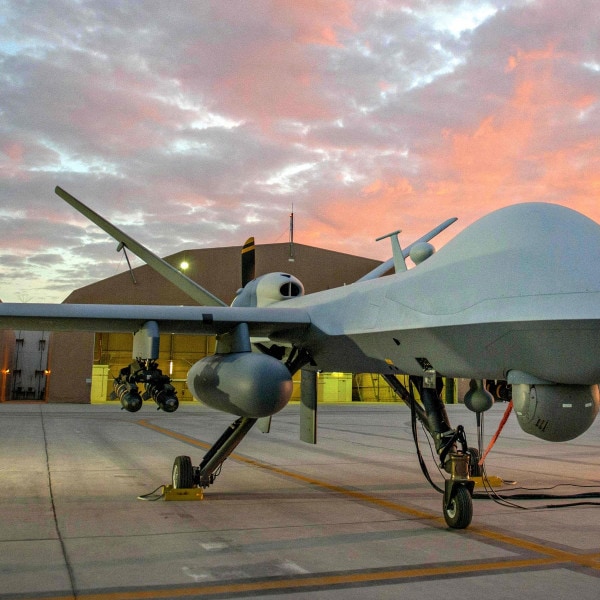
General Atomics developed the MQ-1 Predator in the mid-1990s as a surveillance platform. It first saw action over Bosnia in 1995, streaming live video back to commanders. But the Predator's defining moment came in October 2001, when it launched a Hellfire missile at a vehicle in Afghanistan. It was the first time an unmanned aircraft had fired a weapon in combat. The Predator could loiter over a target area for up to 24 hours, transmitting real-time infrared and video imagery via satellite link to operators at Creech Air Force Base in Nevada, over 7,000 miles away.
The MQ-9 Reaper: Bigger and Deadlier
The MQ-9 Reaper, introduced in 2007, was designed from the ground up as a hunter-killer rather than a surveillance platform modified to carry weapons. With a 66-foot wingspan (larger than many manned fighter aircraft), a 950-pound weapons payload, and a top speed of 300 mph, the Reaper could carry a combination of Hellfire missiles and 500-pound laser-guided bombs. It became the U.S. Air Force's primary armed drone and remains in active service as of 2026.
Controversy Over Drone Strikes
Between 2004 and 2015, the U.S. conducted hundreds of drone strikes in Pakistan, Yemen, Somalia, and other countries. The strikes killed high-value targets but also caused significant civilian casualties. Estimates of total deaths vary widely depending on the source. The Bureau of Investigative Journalism documented between 424 and 969 civilian deaths from U.S. drone strikes in Pakistan alone between 2004 and 2018. The drone strike program became one of the most debated aspects of U.S. foreign policy, raising legal and ethical questions about targeted killings that are still unresolved.
Note: The technology developed for military drones during this era, including GPS navigation, miniaturized cameras, electronic stabilization, and lithium polymer batteries, directly accelerated the development of consumer drones that arrived a few years later.
The Consumer Drone Revolution (2010-2020)
2013DJI Phantom 1 released
70%+DJI market share by 2018
2016Part 107 introduced
DJI and the Phantom That Started It All
DJI was founded in 2006 by Frank Wang in a dorm room at the Hong Kong University of Science and Technology. The company initially sold flight controller components to hobbyists. In January 2013, DJI released the Phantom 1, a ready-to-fly quadcopter with GPS stabilization that cost about $679. It was not the first consumer drone, but it was the first one that regular people could fly without crashing it on the first attempt. The integrated GPS hold, automatic return-to-home, and stable hover changed the market overnight. Suddenly, real estate agents, filmmakers, and hobbyists could get aerial footage without chartering a helicopter.
The GoPro Era and Early Competitors
The original Phantom did not have a built-in camera. Users strapped GoPro cameras to a simple mount. 3D Robotics (3DR), co-founded by former Wired editor Chris Anderson, released the Solo drone in 2015 with a GoPro-compatible gimbal and ambitious smart-shot features. Parrot, a French company, competed with the Bebop line. But DJI moved faster: the Phantom 3 (2015) introduced an integrated 4K camera and 3-axis gimbal, making GoPro mounts obsolete for most users. 3DR exited the consumer market in 2016, pivoting to enterprise software. Parrot steadily lost market share and eventually focused on enterprise drones.
The FAA Scrambles to Regulate
The sudden popularity of consumer drones caught the FAA off guard. In 2015, the agency introduced mandatory drone registration for aircraft weighing 0.55 pounds or more. In 2016, Part 107 created the first formal commercial drone pilot certification. Before Part 107, commercial operators needed a Section 333 exemption, which could take months to obtain. Part 107 standardized the process: pass a $175 knowledge test and you could fly commercially within weeks. For the full breakdown of licensing costs, see our Part 107 license cost guide.
The Mavic Pro: Drones Get Portable
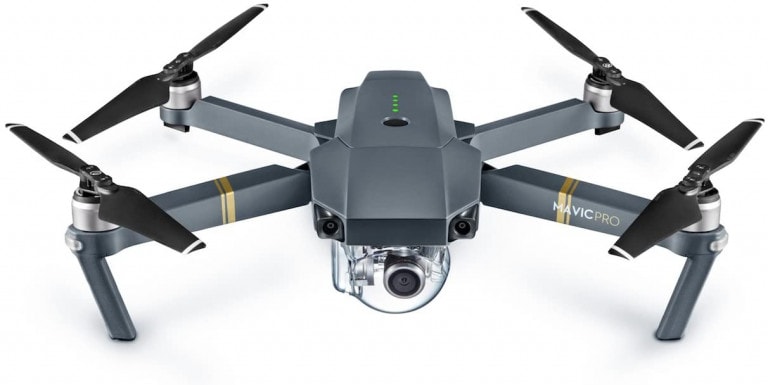
In September 2016, DJI released the Mavic Pro. It folded down to the size of a water bottle, had a 4K camera on a 3-axis gimbal, 27 minutes of flight time, and a 7 km control range. It cost $999. The Mavic Pro proved that high-quality aerial photography did not require a large, unwieldy aircraft. By 2018, DJI controlled over 70% of the global consumer drone market, and the Mavic line had become the default choice for both hobbyists and professionals.
Tip: If you want to understand how DJI dominates today, look at the 2016-2018 period. While competitors focused on one product, DJI released the Phantom 4 (obstacle avoidance), Mavic Pro (portability), and Spark (gesture control) in rapid succession, covering every segment simultaneously.
Drones Today and What Comes Next (2020-Present)
The 2016 DJI Mavic Pro made professional aerial photography accessible to consumers
249gSub-250g category threshold
2024Remote ID requirement
$300-700Modern sub-250g drone price
The Sub-250g Revolution
DJI's Mavic Mini (2019) weighed 249 grams, just under the FAA's 250g registration threshold. It was a calculated design decision. The Mini series (Mini 2, Mini 3 Pro, Mini 4 Pro, Mini 5 Pro) became the best-selling drone line in history, proving that lightweight drones could deliver professional-quality results. Competitors followed: the Autel Evo Nano+ and Potensic Atom SE both target the sub-250g segment. For current recommendations, see our best drones under 250g guide.
Remote ID and Regulatory Changes
The FAA's Remote ID rule, which took effect in March 2024, requires most drones to broadcast identification and location data during flight. This is the drone equivalent of a license plate. Remote ID compliance is built into all drones manufactured after the deadline, including the DJI Mini 4 Pro, Mini 5 Pro, and Flip. Older drones can add compliance through firmware updates or external broadcast modules. The rule sparked debate in the drone community over privacy, cost, and government tracking.
The Chinese Drone Ban Debate
Section 848 of the 2025 National Defense Authorization Act proposed restrictions on DJI and other Chinese-manufactured drones over national security concerns. While a full consumer ban has not been enacted as of March 2026, the uncertainty has driven interest in American-made alternatives. Skydio (Redwood City, California), Teal Drones (Salt Lake City, a subsidiary of Red Cat Holdings), and BRINC (Seattle) all produce drones manufactured in the United States, primarily targeting government and enterprise customers.
Drone Delivery and Autonomous Flight
Wing (Alphabet/Google) operates commercial drone delivery in parts of Virginia, Texas, and several countries. Zipline delivers medical supplies and commercial packages in Africa, the United States, and Japan. Amazon Prime Air has conducted limited deliveries in College Station, Texas and Lockeford, California. The technology works, but scaling it faces airspace management challenges, public acceptance hurdles, and regulatory complexity that will take years to fully resolve.
Drone Light Shows and Entertainment
Drone light shows have replaced fireworks at major events worldwide. Companies like Verge Aero and High Great coordinate swarms of hundreds to thousands of LED-equipped drones to create animated displays in the night sky. The 2024 Paris Olympics opening ceremony featured a drone light show component. Unlike fireworks, drone shows produce no smoke, can be programmed with custom animations, and the drones are reusable. They cost $50,000-$300,000+ per show depending on the number of drones and complexity.
Note: The drone industry is moving toward a future where autonomy, not remote control, is the default operating mode. Obstacle avoidance, automated flight paths, and AI subject tracking already exist in consumer drones under $700. Full autonomy for commercial operations (beyond visual line of sight, without a human pilot) is the next major regulatory milestone the industry is working toward.
FAQ
The first remotely piloted vehicle was Nikola Tesla's radio-controlled boat, demonstrated in 1898. The first unmanned aerial vehicle designed for military use was the Kettering Bug in 1918. The first reusable remote-controlled aircraft was the de Havilland Queen Bee in 1935. What counts as the "first drone" depends on how broadly you define the term.
No single person invented the drone. Nikola Tesla created the first remote-controlled vehicle (1898), Charles Kettering built the first aerial torpedo (1918), and Reginald Denny produced the first mass-manufactured target drone (1939). Abraham Karem, an Israeli engineer, is often called the father of the modern predator-style drone for his work on the Amber UAV in the 1980s, which evolved into the General Atomics Predator.
The name "drone" is commonly attributed to the de Havilland Queen Bee, a 1935 British target aircraft. Since the aircraft was named after a queen bee, the generic term for similar unmanned aircraft became "drone," referring to the male honeybee. The male bee has no stinger and does not work, which loosely parallels an aircraft with no crew.
Consumer drones became mainstream in 2013 with the release of the DJI Phantom 1. Earlier hobbyist drones existed, but the Phantom was the first ready-to-fly quadcopter with GPS stabilization that average consumers could operate without technical expertise. By 2016, DJI had released the Mavic Pro and the consumer drone market was growing rapidly.
DJI's first major consumer product was the Phantom 1, released in January 2013. Before that, DJI sold flight controllers and components for hobbyist multi-rotor builds. The Phantom 1 did not include a camera; users mounted GoPro cameras separately. DJI integrated cameras and gimbals starting with the Phantom 2 Vision in late 2013.
Military drones evolved from expendable target aircraft (1930s-1950s) to reconnaissance platforms (1960s-1980s, Ryan Firebee) to armed hunter-killers (2001-present, MQ-1 Predator and MQ-9 Reaper). Israel played a pivotal role in the 1970s-1980s by demonstrating that drones could provide real-time intelligence in combat, influencing U.S. military drone development programs.
The industry is moving toward autonomous beyond-visual-line-of-sight (BVLOS) operations, drone delivery networks, urban air mobility (passenger drones), and AI-powered automated inspection. Regulatory frameworks like Remote ID (2024) are building the infrastructure for more complex drone operations in shared airspace. Full commercial BVLOS approval, where drones fly without a human pilot watching them, is the next major regulatory milestone.
Paul Posea founded Dronesgator in 2015 and has been reviewing consumer drones for over a decade. With 195 YouTube drone reviews drawing 3.55 million views and published work on Digital Photography School, he combines hands-on flight testing with data-driven analysis to help pilots find the right drone.
Marcus Taylor is a UK CAA certified drone pilot and owner of Deployed Consultancy Ltd. With 6 years of commercial experience spanning UN site surveys in West Africa, aerial photography across Europe, Africa, and Japan, and defence consulting, he verifies the technical accuracy of Dronesgator's drone reviews and guides.