Best Underwater Drones (ROVs) for 2026: Exploration, Fishing, and Inspection
Updated
By Paul Posea
Written byPaul Posea
What Is an Underwater Drone and Who Uses One?
100mTypical max depth
4 hrsAvg battery per session
$300-3,000Consumer price range
ROVs vs. Aerial Drones
The fundamental difference is the physics. Aerial drones generate lift to fight gravity. Underwater drones manage buoyancy to control depth. Aerial drones use radio signals for control. Underwater drones use a physical tether cable because radio waves attenuate rapidly in water (a few meters at most for WiFi frequencies). Aerial drones are designed to be waterproof as a bonus feature. Underwater drones are designed to withstand crushing water pressure at depth, which is an entirely different engineering challenge.
The tether is both the greatest limitation and the greatest advantage. It limits range to the tether length (typically 50-300 meters). But it provides a reliable, lag-free video feed and eliminates the risk of losing the device if the signal drops. Some high-end models use fiber-optic tethers for HD video with zero latency over long distances.
Who Uses Underwater Drones
Recreational explorers: reef viewing, shipwreck exploration, underwater photography and videography
Fishers: locating fish schools, examining underwater structure, checking crab pots and fishing nets without diving
Marine inspection: boat hull surveys, dock piling condition assessment, mooring chain inspection, dam and bridge inspections
Research and education: marine biology field studies, coral reef monitoring, environmental surveys, university research projects
Search and rescue: locating submerged objects, vehicles, or persons in lakes, rivers, and harbors
Aquaculture: fish farm cage inspection, pen condition monitoring, feeding observation
Note: Underwater drones do not require FAA registration, a Part 107 certificate, or any aviation-related licensing. They are not aircraft. Some states have regulations about operating ROVs in protected marine areas or near marine life, so check local marine and wildlife rules for your intended use area. For aerial drones that can fly over water, see our best waterproof drones guide instead.
Best Budget Underwater Drones (Under $500)
Budget underwater drones can explore shallow reefs and check beneath boats at depths up to 50 meters
Chasing Diver D1 (~$300)
The Chasing Diver D1 is the most accessible entry point into underwater drones. It reaches 50 meters depth, records 1080p video, and runs for approximately 1 hour on a full charge. The 15-meter tether is short compared to pricier models, which limits it to snorkeling and shallow reef depths. Build quality is plastic, which is fine for recreational use but will not hold up to heavy commercial work. The app is functional but basic. For someone who wants to see what is under their boat or explore a shallow reef without spending a lot, the D1 does the job.
PowerVision PowerRay (~$400 Used)
The PowerRay was one of the first consumer underwater drones and is no longer in active production, but refurbished and used units are widely available at $350-450. It dives to 30 meters, shoots 4K video at 30fps, and includes a built-in fish finder sonar attachment that displays water temperature and fish location on your phone. The sonar is the main differentiator at this price point. Battery life is approximately 4 hours in standby mode, though active swimming reduces this to about 2 hours. The main drawback is limited spare parts availability since PowerVision has shifted focus to other products.
Geneinno Titan T1 Lite (~$350)
The Titan T1 Lite offers the best depth rating in the budget category at 100 meters, which is far deeper than most recreational users will ever go. It shoots 4K video, has a 150-lumen LED light system, and includes a 50-meter tether. Battery life is approximately 4 hours. The companion app supports live streaming and basic footage editing. Build quality is a step above the Chasing D1, with a more robust hull design. The main limitation is that customer support is based in China, which can make warranty claims and spare parts requests slow.
What to Expect at This Price Point
Budget underwater drones get you a camera underwater. That is essentially the value proposition. Video quality is acceptable for personal use and social media but not for professional inspection reports. Tethers are short (15-50m), lights are dim (fine for clear water, insufficient for murky conditions), and build materials are consumer-grade plastic. If you want to explore a reef on vacation or check what is under your dock, these work. If you need reliable, repeated use for commercial purposes, move up to the mid-range tier.
Warning: Tether management is the number one frustration for new underwater drone users. A tangled or snagged tether at depth can mean losing your ROV. Always deploy and retrieve the tether slowly, keep it free of knots, and avoid operating near underwater structures where the cable can catch on sharp objects.
Best Mid-Range Underwater Drones ($500-$1,500)
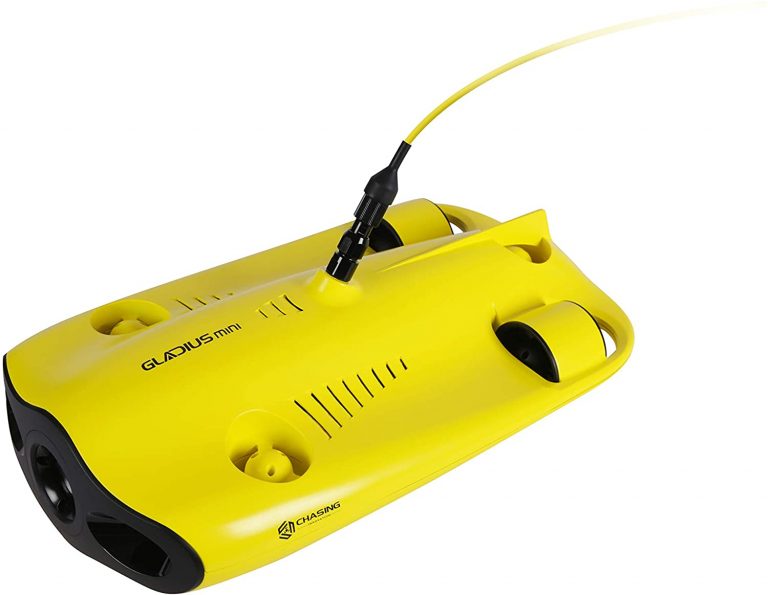
The Chasing Gladius Mini S weighs 2.5 kg and fits in a carry-on bag
150mChasing M2 Pro depth
4K/30fpsStandard camera quality
3-4 hrsTypical battery life
Chasing M2 Pro (~$900): Best Overall Value
The Chasing M2 Pro is the underwater drone most reviewers recommend as the best balance of capability and price. It dives to 150 meters (deeper than recreational scuba limits), shoots 4K/30fps video through a Sony sensor, includes a 200-meter tether, and runs for 3-4 hours per charge. Eight vectored thrusters give it stable, precise movement even in mild currents. The controller is comfortable and responsive, and the app supports live streaming, photo capture, and video recording simultaneously.
The M2 Pro also has a removable payload mount that supports accessories like a robotic claw (for grabbing objects), an external sonar module, and additional lighting. This modular approach makes it the most versatile option in the mid-range. Chasing is a Shenzhen-based company with better after-sales support than most Chinese ROV manufacturers, though response times still vary.
Gladius Mini S (~$699): Best for Portability
The Gladius Mini S weighs only 2.5 kg, making it the most portable mid-range option. It dives to 100 meters, shoots 4K video, and includes a 100-meter tether. Five thrusters provide good maneuverability, though it is less stable in currents than the eight-thruster M2 Pro. Battery life is approximately 4 hours. The compact size makes it ideal for travel: it fits in a carry-on bag. The main trade-off is the shorter tether and fewer accessory options compared to the M2 Pro.
FIFISH V-EVO (~$1,100): Best Camera System
The FIFISH V-EVO stands out for its 4K/30fps camera with a 166-degree wide-angle lens and a unique rotating body design that allows the camera to tilt 360 degrees without moving the entire ROV. It dives to 100 meters with a 100-meter tether. The AI vision lock feature can automatically track and follow fish or other moving subjects, which is useful for wildlife observation and underwater filming. Six thrusters provide omnidirectional movement. Battery life is approximately 6 hours (best in the mid-range category).
Model
Price
Depth
Camera
Tether
Battery
Thrusters
Chasing M2 Pro
$900
150m
4K/30fps (Sony)
200m
3-4 hrs
8
Gladius Mini S
$699
100m
4K
100m
4 hrs
5
FIFISH V-EVO
$1,100
100m
4K/30fps (166deg)
100m
6 hrs
6
Tip: The Chasing M2 Pro at $900 is the safest choice in this tier. It has the deepest depth rating, the longest tether, the most thrusters for stability, and the best accessory ecosystem. Unless you specifically need the V-EVO's rotating camera or the Mini S's portability, the M2 Pro covers the most use cases.
Best Professional Underwater Drones (Above $1,500)
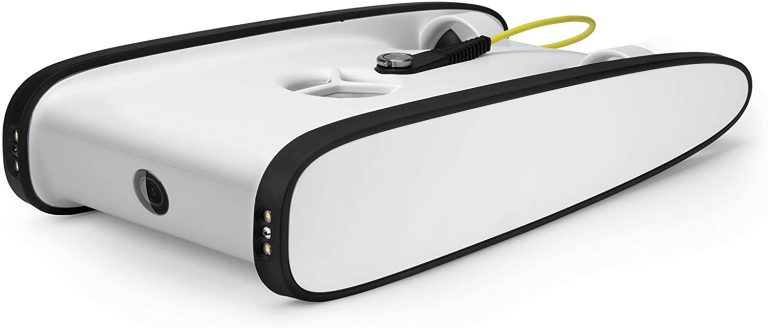
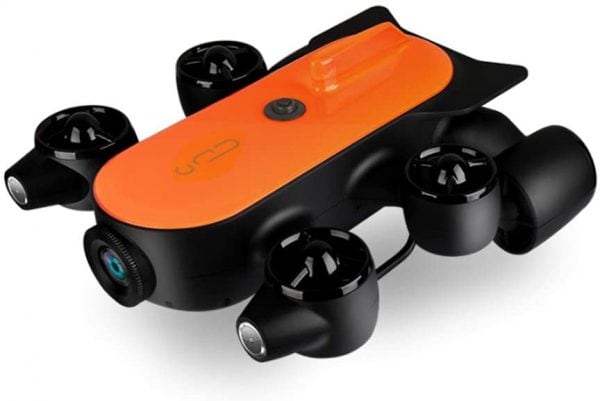
Professional-grade underwater drones like the OpenROV Trident offer tethered depth capability beyond 100 meters
Chasing M2 Pro Max (~$1,500): Extended Depth and Tether
The M2 Pro Max is an upgraded version of the M2 Pro with a 200-meter depth rating (50m deeper), upgraded motors for stronger currents, and a tether option up to 300 meters. The camera and sensor are the same as the M2 Pro. The additional depth and current resistance make it suitable for offshore inspection work (boat hulls, dock pilings, aquaculture cages) where conditions are rougher than sheltered waters. At $1,500, it sits at the boundary between prosumer and professional.
Blue Robotics BlueROV2 (~$3,500+ Assembled)
The BlueROV2 is fundamentally different from the consumer ROVs listed above. It is an open-source, modular ROV platform built for customization. The base unit includes six thrusters, a 1080p camera, and basic navigation. But the real value is the modular frame that accepts custom payloads: sonar systems, water quality sensors, manipulator arms, additional cameras, and specialized lighting. Universities, marine research institutions, and inspection companies use the BlueROV2 because they can configure it for their specific application.
Assembly is part of the experience. Blue Robotics sells both fully assembled units and kits. The company is based in Torrance, California, which means U.S.-based support, English documentation, and a large online community (forums, GitHub repositories, and YouTube tutorials) that most Chinese ROV manufacturers lack.
When to Rent Instead of Buy
Professional-grade inspection ROVs with sonar, magnetometers, and specialized sensors cost $10,000-100,000+. For occasional commercial inspection jobs (bridge inspections, pipeline surveys, underwater cable checks), renting is almost always more cost-effective than purchasing. Companies like VideoRay and Deep Trekker offer rental programs for their inspection-class ROVs, typically at $1,000-3,000 per week. If you are performing underwater inspections fewer than 10-15 times per year, renting eliminates the capital expense and maintenance burden.
Note: The BlueROV2 has become the de facto standard for university marine research and small-scale commercial inspection. Its open-source software (ArduSub, QGroundControl) means researchers can modify the control system, add custom sensors, and share code with the community. No other consumer-priced ROV offers this level of customization.
What to Look for When Buying an Underwater Drone
Depth rating, tether length, and camera quality are the three specs that matter most
Depth Rating
Match the depth rating to your actual use case. Snorkeling and shallow reef exploration: 10-30 meters is sufficient. Recreational diving depths and boat hull inspection: 30-100 meters. Offshore and professional inspection: 100-200+ meters. Buying more depth than you need wastes money. A $300 ROV rated to 50 meters does the same job as a $900 ROV rated to 150 meters if you never go below 30 meters.
Tether Length
The tether determines your operational radius. A 15-meter tether (common on budget models) is barely enough to explore under a dock. A 100-meter tether gives you reasonable range for most recreational applications. A 200-300 meter tether is needed for offshore work or deep exploration. Longer tethers add drag, which means the ROV needs more powerful thrusters to move at the same speed. Some manufacturers sell tether extensions as accessories.
Camera Quality
4K resolution is the minimum for footage that looks good on a modern screen. At depth, light drops off rapidly, so low-light sensor performance matters more than raw resolution. Check the sensor size (larger sensors capture more light) and the built-in light output (measured in lumens). Most mid-range ROVs include 2,000-4,000 lumen lights, which illuminate a few meters ahead in clear water. In murky water, even bright lights create backscatter (light reflecting off particles), and better lights alone will not solve the problem.
Battery Life
Under 2 hours of battery life is frustrating for any application. You spend time deploying the ROV, descending to depth, navigating to your area of interest, and then have limited time to actually work or explore. Budget models run 1-2 hours. Mid-range and professional models run 3-6 hours. For commercial work, 4+ hours is the practical minimum. Always factor in that thruster-intensive maneuvers (fighting currents, rapid direction changes) drain batteries faster than slow cruising.
Thruster Configuration and Current Resistance
More thrusters generally mean better stability and maneuverability. Four thrusters provide basic movement. Six thrusters add vertical precision. Eight thrusters (like the Chasing M2 Pro) provide full vectored control for stable hovering and precise positioning even in mild to moderate currents. If you plan to operate in rivers, tidal areas, or offshore environments with currents, prioritize thruster count and motor power.
Spare Parts and Support
This is the most overlooked factor. An underwater drone will eventually need a propeller replaced, a seal serviced, or an O-ring swapped after hundreds of dives. Check whether the manufacturer sells spare parts directly, whether parts are available from third-party suppliers, and what the warranty covers (water damage, depth exceedance, tether breakage). Companies with U.S. or European support offices (Blue Robotics, for example) are significantly easier to work with than brands where all support routes go through Shenzhen.
Tip: Before your first dive, practice in a swimming pool or calm, shallow water. Learn the controls, tether management, and buoyancy behavior in a controlled environment where you can recover the ROV if something goes wrong. Open water diving with an unfamiliar ROV and a tangled tether is a recipe for losing the device.
FAQ
The Chasing Diver D1 (~$300) is the most affordable entry point for beginners who want to try underwater exploration without a large investment. For slightly more capability, the Geneinno Titan T1 Lite (~$350) offers 100m depth and 4K video. If your budget allows, the Chasing M2 Pro (~$900) is the best overall value and will not need to be replaced as quickly.
Most consumer underwater drones are rated for 50-200 meters. Budget models (under $500) typically reach 30-100 meters. Mid-range models ($500-1,500) reach 100-200 meters. Professional models like the BlueROV2 can be configured for deeper depths with pressure-rated housings. The deepest consumer-accessible ROV, the Chasing M2 Pro Max, is rated to 200 meters.
No. Underwater drones (ROVs) are fundamentally different from aerial drones. They use buoyancy and thrusters instead of propellers generating lift. They require a physical tether cable because radio waves do not penetrate water effectively. They do not require FAA registration or a pilot certificate. The only similarity is remote operation with a live camera feed.
The PowerVision PowerRay (~$400 used) includes a built-in fish finder sonar, making it the most fishing-specific option. The Chasing M2 Pro (~$900) is more capable overall and supports an optional sonar accessory. For anglers who primarily want to locate fish schools and examine underwater structure, the PowerRay's integrated sonar is the most purpose-built tool at a budget price.
Budget models run 1-2 hours. Mid-range models run 3-6 hours. The FIFISH V-EVO leads the mid-range at approximately 6 hours. Active swimming against currents drains batteries faster than slow cruising. For commercial work, plan for 4+ hours of battery life as a practical minimum to allow adequate time for deployment, transit to the work area, and actual data collection.
No. Standard aerial drones are not waterproof and will be destroyed on contact with water. Even waterproof aerial drones (like the SwellPro SplashDrone 4+) are designed to land on water and take off, not to submerge. The motors, propellers, and radio systems of aerial drones are not designed for underwater operation. You need a purpose-built ROV for underwater use.
In the consumer market, "underwater drone" and "ROV" refer to the same thing: a tethered, remotely operated submersible vehicle with a camera. Technically, ROV (Remotely Operated Vehicle) is the more accurate term used in the professional and military sectors. "Underwater drone" is a marketing term that became popular because consumers are already familiar with the word "drone" from aerial products.
A basic recreational underwater drone costs $300-500. The best mid-range option (Chasing M2 Pro) costs approximately $900 and covers most recreational and light commercial needs. Professional and research-grade ROVs like the BlueROV2 start at $3,500. Commercial inspection ROVs with specialized sensors cost $10,000-100,000+, and are often rented rather than purchased.
Paul Posea
Author · Dronesgator
Paul Posea is the founder of Dronesgator and has been reviewing and comparing drones since 2015. With a Part 107 certification, 195 YouTube drone reviews, and published work on Digital Photography School, he combines hands-on flight testing with data-driven analysis to help pilots find the right drone.