SD card packaging is a wall of logos: V30, U3, Class 10, A2, UHS-I, 200MB/s. Most of it does not matter for drones, and the one number that does (sustained write speed) is usually the smallest print on the card. Here is how to read all of it, and our best SD cards for DJI drones guide for specific picks.
V30 vs V60 vs V90: SD Card Speed Classes Explained for Drones (2026)
Updated
By Paul Posea · Verified by Marcus Taylor

The Short Answer for Drone Pilots
If you fly a consumer drone (any DJI Mini, Air, Mavic, Flip, Avata, or the DJI FPV), buy a V30 (U3) card and you are done. Every one of these drones records within the speed V30 guarantees, and none can use the extra speed of a V60 or V90 card while recording. The higher ratings are real, they are just aimed at high-end mirrorless cameras and 8K rigs, not drones.

What Is a V30 Card? Video Speed Class Explained
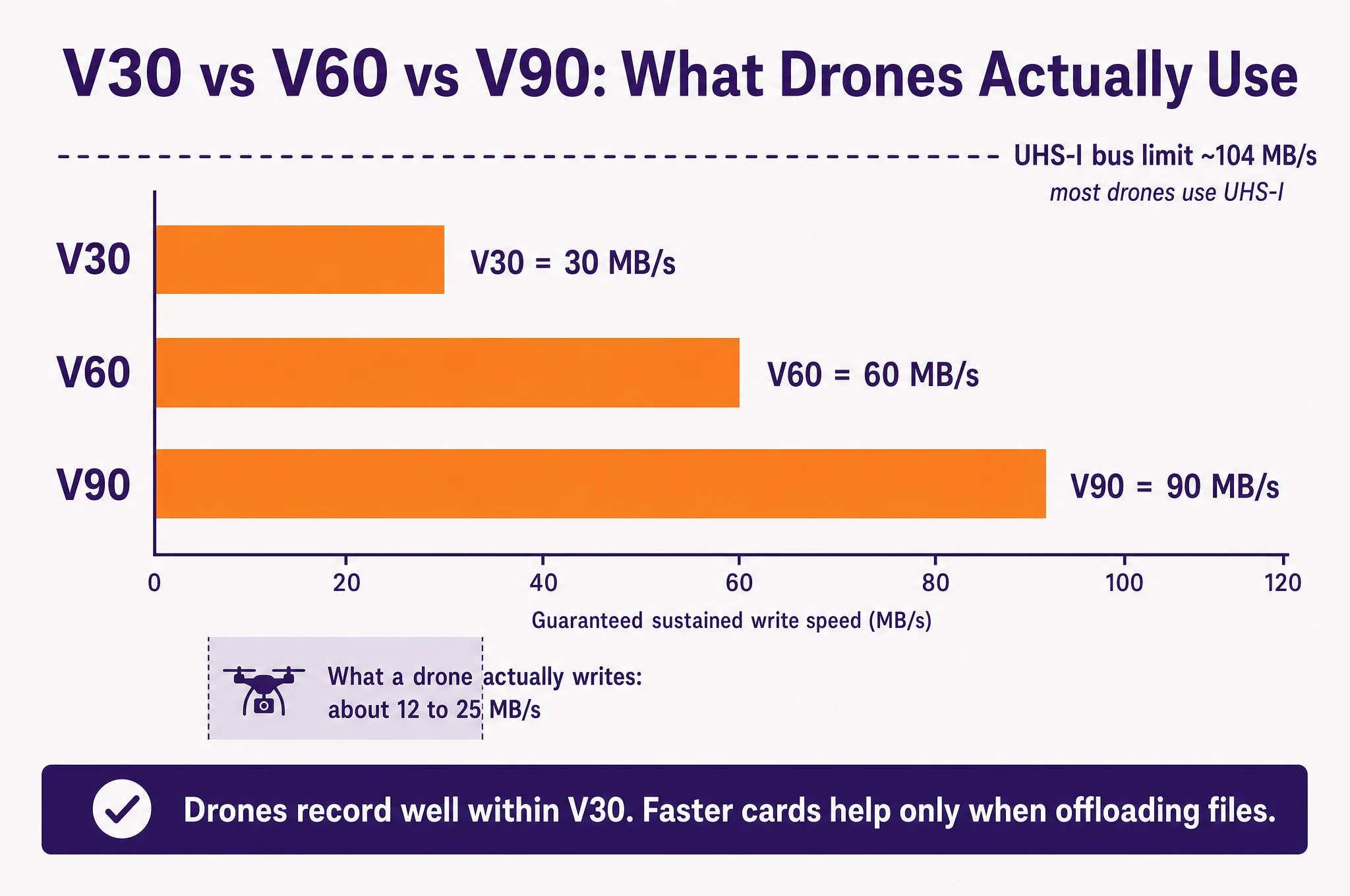
The V number is the Video Speed Class, and it is the only rating that directly describes recording. It states the minimum sustained write speed in megabytes per second that the card guarantees, even when full or under load:
- V30: at least 30 MB/s sustained write
- V60: at least 60 MB/s sustained write
- V90: at least 90 MB/s sustained write
The word sustained is the important part. A card might burst faster for a second, but video recording needs a floor it never drops below, or you get dropped frames and corrupt clips. V30 is the floor DJI requires across its drone lineup, which is why it is the answer for nearly everyone.
Class 10, U1, U3: The Confusing Overlap
SD cards have collected three overlapping rating systems over the years, which is why the packaging looks so cluttered. They mostly say the same thing in different ways:
| System | Mark | Min sustained write |
|---|---|---|
| Speed Class (oldest) | Class 10 | 10 MB/s |
| UHS Speed Class | U1 | 10 MB/s |
| UHS Speed Class | U3 | 30 MB/s |
| Video Speed Class | V30 | 30 MB/s |
For drones the practical takeaway is simple: U3 and V30 mean the same 30 MB/s minimum and are interchangeable. Many cards print both. Avoid anything that tops out at Class 10 or U1 (10 MB/s), which is too slow for stable 4K. You will also see an A1 or A2 mark; that is App Performance Class, which measures small random reads for running apps on a phone, and it is irrelevant to drone recording.
UHS-I vs UHS-II: The Bus That Caps Everything
This is the single most misunderstood spec, and it is the reason V60 and V90 cards are wasted on drones. The V rating describes the card; the bus interface describes the pipe between the card and the device. They are separate limits, and the slower one wins.
- UHS-I: bus tops out around 104 MB/s. Almost every DJI drone uses a UHS-I slot.
- UHS-II: bus tops out around 312 MB/s, using a second row of pins. Found on high-end cameras, rare in drones.
So even if you put a blazing V90 UHS-II card in a drone, it talks through the UHS-I pipe at UHS-I speed. And the drone's actual recording load (roughly 100 to 200 Mbps, which is only about 12 to 25 MB/s) never approaches even the UHS-I limit, let alone V60 or V90 territory. A UHS-II card is backward compatible and works fine in a drone, it simply records no faster than a UHS-I card would.
So What Does Your Drone Actually Need?
Rather than guess, pick your drone below and the finder shows the required speed class, the maximum supported capacity, and the card we recommend for it. The short version: it is V30 for every consumer model, with capacity (not speed) being the only real decision.
SD Card Finder for DJI Drones
Pick your drone for the required speed, max capacity, and our top card picks.
The SanDisk Extreme is the all-round pick and on DJI's list. 256GB holds roughly 190 minutes of 4K/60fps.

SanDisk Extreme 256GB
130 MB/s write speed

Samsung EVO Plus 256GB
120 MB/s write speed

Kingston Canvas Go! Plus 256GB
90 MB/s write speed
Prices approximate. We may earn a commission from these links at no cost to you.
When Faster or Bigger Genuinely Helps
There are real reasons to spend more, they just have nothing to do with recording quality.
Faster offloading
A UHS-II card with a UHS-II reader copies footage to your computer far faster. On a drone that fills cards with huge files, like the Mavic 4 Pro shooting 6K, this turns a long transfer into a short one. The card still records at UHS-I speed in the drone.
More capacity
Capacity is the decision that actually matters. Higher-resolution drones burn storage fast, so a 512GB or 1TB card means fewer swaps and offloads. The newest drones such as the Mini 5 Pro and Mavic 4 Pro now support 1TB cards for exactly this reason.
Professional codecs
A handful of pro cameras record formats like Apple ProRes that no microSD card can sustain. The DJI Mavic 3 Cine is the example, which records to a built-in SSD instead, covered in our Mavic 3 guide.
Make Sure the Card Is Genuine
The fastest way to ruin a perfect V30 recommendation is to buy a counterfeit. Fake cards report a high speed class and capacity they cannot actually deliver, then corrupt footage under load. Buy from the brand's official store or a first-party listing, and verify a new card with a free tool like H2testw before trusting it with a flight. Our main SD card guide has the full counterfeit checklist.
FAQ
A V30 card is one rated to a Video Speed Class of 30, meaning it guarantees a minimum sustained write speed of 30 MB/s. That is the floor needed for stable 4K recording and is what every consumer DJI drone requires.
Yes. Every consumer DJI drone, including 4K/120fps and 6K models, records within V30's 30 MB/s sustained write. A faster card records identical footage.
They are guaranteed minimum sustained write speeds: V30 is 30 MB/s, V60 is 60 MB/s, V90 is 90 MB/s. Drones only need V30; V60 and V90 target high-end cameras and 8K recording.
Not for recording. Drone card slots are UHS-I, which caps speed around 104 MB/s, so a UHS-II card records at the same speed in the drone. UHS-II only helps when transferring files to a computer with a UHS-II reader.
No. No consumer drone can use V90 speeds while recording, because its UHS-I slot and modest bitrate are the limiting factors. A V30 card is the correct and cheaper choice.


